Tenerife’s winter holiday season runs on a different rhythm than its summer peak, and it’s worth understanding the difference before you book. The island draws a specific kind of traveller over Christmas and New Year — people escaping colder climates for reliable sun, families combining a school holiday with warm weather, and a noticeable number of long-stay visitors settling in for several weeks rather than a single week’s trip. That mix changes what you should expect from car hire during this window, in ways that don’t map neatly onto the July–August peak-season playbook.
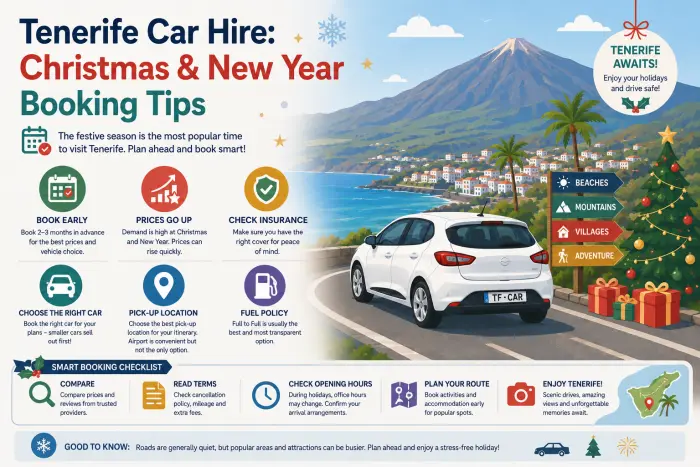
Understanding who else is on the island alongside you during this period is genuinely useful context, not just trivia. A summer crowd skews heavily toward one- and two-week package holidaymakers with fairly predictable, uniform booking patterns. The winter holiday crowd is more varied — some staying a week, others a full month or longer, some visiting family already based on the island — and that variation is exactly what makes fleet availability harder to predict from general seasonal expectations alone.
How this period compares to summer
Demand during the last two weeks of December and the first few days of January is genuinely high, though it behaves differently than the mid-summer spike. Rather than one long sustained peak, Christmas and New Year tends to concentrate around a few sharp dates — the days immediately before Christmas, and the run-up to New Year’s Eve specifically — with a bit more breathing room in between, around the days after Christmas itself when a portion of visitors have already flown home. If your dates fall in one of those narrower windows, availability tightens considerably faster than a general “it’s winter holidays” expectation would suggest.
Why it’s not just a smaller version of summer
Part of what makes this period distinct is the mix of trip lengths. Alongside the standard one- or two-week holidaymaker, a meaningful share of winter visitors are staying considerably longer — a month or more, in some cases — which changes fleet dynamics in a way summer doesn’t. Long-term rentals tie up vehicles for extended periods, which can quietly reduce the pool of cars available for shorter bookings even before overall demand numbers look dramatic on paper. If you’re booking a standard one-week rental over this period, it’s worth knowing that the headline “busy season” figure doesn’t fully capture how much fleet capacity is already committed to longer-stay guests. Our guide to long-term car hire in Tenerife covers this from the other side, if a multi-week winter stay is actually what you’re planning yourself.
Specific dates worth planning around
New Year’s Eve itself deserves particular attention. Rental desks, especially at the airport, sometimes run reduced hours or a tighter pickup window on the 31st, and some companies close entirely for part of January 1st. If your flight lands on either of these dates, it’s worth confirming your specific pickup company’s hours directly rather than assuming standard year-round service, and building in a backup plan — a taxi to your accommodation with pickup arranged for the following day — in case your arrival time doesn’t line up with a desk that’s open. This is one of the few times of year where it’s genuinely worth emailing or calling a company directly to confirm hours, rather than relying on the standard hours listed on a comparison site, since holiday-period adjustments aren’t always reflected there.
🚗 Discover Tenerife – Best Car Rental Deals
Compare top-rated suppliers, no hidden fees & free cancellation included.
Christmas Day itself tends to see similarly reduced service at some companies, though fewer flights land on the 25th to begin with, so this affects a smaller number of travellers in practice than New Year’s Eve does. Companies that do stay open on Christmas Day sometimes charge a modest surcharge for the pickup, similar in spirit to an out-of-hours fee at any other time of year — worth checking for specifically if your itinerary has you arriving that day, since it’s easy to overlook when you’re focused on flight timing rather than desk hours.
Pricing over the holiday period
| Period | Typical pricing | Booking lead time worth aiming for |
|---|---|---|
| Mid-December | Moderate, close to shoulder season | 2–4 weeks |
| Dec 20 – Jan 2 | High, comparable to or above summer peak | 6–8+ weeks |
| Early-to-mid January | Drops back toward shoulder season | 2–4 weeks |
Prices during the core holiday window can rival or exceed what you’d pay during the July–August peak, despite the island’s overall visitor numbers being somewhat lower in absolute terms — the concentration of demand into a narrower stretch of dates, combined with reduced fleet availability from long-stay bookings, pushes rates up in a way that surprises people who assume winter automatically means cheaper across the board.
What to book ahead specifically
Given how tightly this period concentrates demand, it’s worth locking in a rental car earlier than you might for a random week in spring — six to eight weeks ahead is a reasonable target if your dates fall anywhere near Christmas or New Year specifically, and longer still if you need a larger vehicle or automatic transmission, both of which sell out faster during this window than compact manuals do. Our general guide to when car hire is cheapest in Tenerife is worth reading alongside this one if your dates have any flexibility around the core holiday window, since even a few days’ shift outside the tightest dates can meaningfully improve both price and choice.
Driving conditions in December and January
Weather-wise, this is one of the more comfortable times to drive the island — daytime temperatures remain mild across most regions, and the harsher extremes of summer heat aren’t a factor. The one genuine consideration is Teide: snow at altitude becomes a real possibility during winter months, and access to the summit road can close temporarily during and after a snowfall. Our guide to snow on Teide and winter road closures is worth checking if a Teide visit is part of your plans over this period, since it’s the one place on the island where winter genuinely changes what’s drivable — the coastal and resort roads elsewhere on the island are unaffected regardless of what’s happening at altitude.
Celebrating New Year’s Eve without a car
If you’re planning to be out for New Year’s Eve celebrations, particularly in Santa Cruz or Puerto de la Cruz, both known for large public celebrations, it’s worth thinking through transport for the night itself separately from your regular rental use. Driving after any amount of drinking is obviously off the table, and taxi demand spikes sharply around midnight in the same way it does in most cities on New Year’s Eve worldwide — booking a return taxi or transfer in advance, rather than trying to hail one at 1am among thousands of other people doing the same thing, is worth the small amount of forward planning. Some larger resorts and hotels arrange group transport or shuttles specifically for New Year’s Eve, and it’s worth asking your accommodation about this well before the date itself, since options fill up as the night approaches.
A realistic booking timeline for a Christmas or New Year trip
If your flights are already set for this window, aim to have your rental car locked in within the same week as your flights if possible, particularly for a fixed arrival on the 23rd, 24th, or 30th–31st of December. Confirm your specific pickup company’s holiday-period opening hours directly rather than relying on general booking-page information, since this is one area where the standard “24-hour desk” assumption is more likely to have an exception than at any other time of year. And if your trip includes any part of the summit road on Teide, check current conditions close to your travel dates rather than assuming based on a general winter expectation, since access can change quickly after a weather event and won’t necessarily match what a search engine shows from a previous year.
Putting it together
Christmas and New Year in Tenerife offers a genuinely appealing trade — mild weather, a festive atmosphere in the main towns, and an escape from colder climates further north — but it comes with its own specific booking logic rather than simply being a quieter version of summer. Book earlier than you’d expect for winter, pay attention to the specific dates your desk might run reduced hours, and plan transport separately for New Year’s Eve itself if you’re heading out to celebrate rather than assuming your rental car covers every part of the night. It’s one of three periods on the island’s calendar with its own distinct driving logic — Carnival and Semana Santa each affect the roads in very different ways, so it’s worth knowing which one, if any, overlaps with your travel dates.