It’s one of the most searched questions before a Tenerife holiday — and the honest answer is: it depends entirely on what you’re planning to do.
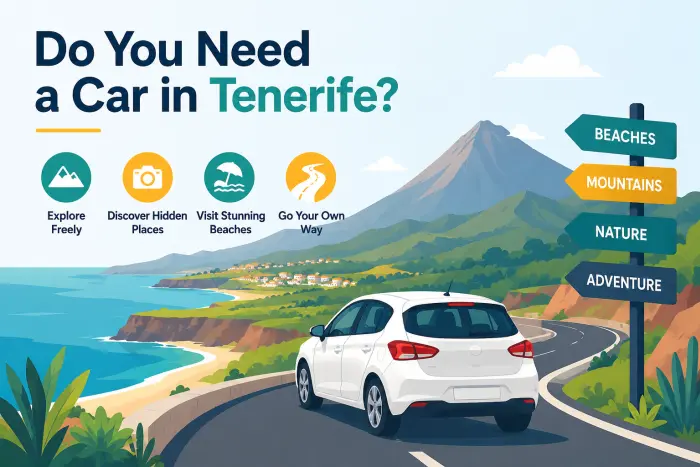
Not on the island. Not on the month. On you — your trip, your pace, your curiosity, and whether “relaxing by the pool” and “driving up a volcano” are both on your list.
This guide doesn’t push you toward a rental car or away from one. What it does is give you the real picture: what public transport can and genuinely cannot do on this island, what a car unlocks that nothing else will, what it costs to use both options, and exactly what kind of traveller truly needs one.
By the end, you’ll know which side of the line you fall on.
🗺️ First, Understand What Tenerife Actually Is
Before you can answer the car question, you need to understand the island’s geography — because it shapes everything about getting around.
Tenerife is not a flat beach island. It’s a 2,034 km² volcano rising 3,715 metres from the Atlantic Ocean. It has two entirely different coastlines — a dry, sun-drenched south built for resort tourism, and a lush, cloud-cooled north with ancient forests, heritage cities, and fishing villages that have been around for centuries. Between them sits Teide National Park: a lunar landscape of hardened lava fields that feels like another planet.
The island has two motorways: the TF-1 running along the southern coast, and the TF-5 connecting the north. These handle the main flows between towns well. But they don’t loop the whole island, and as soon as you leave the coast and climb inland — toward Teide, toward Anaga, toward the ravines of the west — the roads become narrow, winding mountain routes that require time, a decent engine, and your full attention.
That geography is the key to the car question. The well-connected bits are well-connected. The extraordinary bits are not.
🚌 What Tenerife’s Public Transport Can Actually Do
Let’s be clear: Tenerife has a genuinely good public transport network for an island its size. The bus system, run by TITSA, covers virtually the entire island, from the southern beach resorts to the mountain villages in the north. The buses are modern, air-conditioned, clean, and generally on time.
Tenerife buses are called guaguas by Canarian people (pronounced “wah-wahs”). The TITSA fleet is wheelchair accessible and in many respects of a higher standard than those found in the UK.
The most useful routes for tourists:
| Route | Connection | Frequency | Notes |
|---|---|---|---|
| 40 | TFS Airport → Playa de las Américas → Los Cristianos | Every 30–40 min | First bus you’ll likely use |
| 110 | Costa Adeje → Santa Cruz (express) | Frequent | Fast cross-island link |
| 111 | Santa Cruz → TFS → Las Américas | Every 30 min | Useful cross-island connector |
| 342 | Los Cristianos → Teide cable car | Once daily (morning) | Returns evening — plan carefully |
| 348 | Puerto de la Cruz → Teide | Once daily (morning) | Same — one return evening |
| 20/104 | TFN Airport → Santa Cruz / La Laguna | Frequent | Main north airport connection |
| 30/343 | TFN → Puerto de la Cruz | Frequent | Good north coast service |
For ticketing, tourist-friendly one-day and one-week bus passes are available, loaded onto a Ten+ card or the ten+ Móvil app — costing €10 and €50 respectively. You can buy your Ten+ card at bus and tram stations, vending machines, and authorised outlets.
Single fares range from about €1.25 for short journeys to €13+ for long cross-island routes (cash prices). For context, a return bus journey from your south resort to Santa Cruz is achievable for well under €10 with the Ten+ card.
There’s also a tram: the Metrotenerife tram operates only in the north, linking the capital Santa Cruz de Tenerife with the historic city of San Cristóbal de La Laguna.
What the buses handle well:
- Airport to resort (TFS or TFN)
- Resort to resort in the south (Las Américas, Los Cristianos, Costa Adeje)
- Resort to Santa Cruz
- Day trip to Teide (if you’re happy with fixed departure/return times)
- Puerto de la Cruz ↔ Santa Cruz ↔ La Laguna
❌ What Public Transport Cannot Do
Here’s where honesty matters most. If you want to explore the rural north, drive winding mountain roads, visit hidden beaches, or move freely between multiple areas in a single day, a rental car gives you much more flexibility. The bus can get you to the main towns, but the more remote and scenic spots — Masca village, the Anaga forest trails, the TF-436 mountain road — are either poorly served or not served at all by public transport.
Specific places that are effectively inaccessible by bus:
- Masca village — the most dramatic ravine village on the island. There is a bus, but it runs infrequently and the road is too narrow for coaches. Many tour operators won’t go there either.
- Anaga Rural Park interior — some villages in the Anaga massif have no bus service at all. The best viewpoints and trailheads require a car.
- Los Gigantes cliffs from above — the cliff road on the western tip of the island is not served by regular routes.
- Remote beaches — Playa de Diego Hernández, Playa del Ancón, many of the black-sand coves along the north coast. No bus. No access without wheels.
- Flexibility at Teide — buses 342 and 348 take you straight to the Teide cable car and other key park spots, but they run once daily in the morning with one return in the evening — plan your time carefully. Miss that return bus and you’re looking at a very expensive taxi from 2,000 metres.
- Late-night travel — if you want to explore more remote areas or travel late at night, bus frequencies may be limited. In these cases, it’s best to consider a taxi.
🚗 What a Rental Car Unlocks
This is the part worth lingering on — not because it’s a sales pitch, but because the gap between “Tenerife with a car” and “Tenerife without one” is genuinely large.
🚗 Discover Tenerife – Best Car Rental Deals
Compare top-rated suppliers, no hidden fees & free cancellation included.
Teide on your terms. Drive up at dawn before the tours arrive. Stop at the Roques de García viewpoint without a schedule. Park at the base of the cable car rather than queuing for the bus connection. Stay until the light changes.
Masca. A rental car is the only practical way to get there under your own steam. The road is an engineering marvel — or a mild terror, depending on your relationship with mountain switchbacks — but arriving at that village, looking down into the ravine, knowing most visitors never made it: worth it.
The Anaga forest. The laurisilva — ancient subtropical forest that survived the last ice age — covers the northeastern tip of the island. The road through it to Taganana has views over both coastlines simultaneously. There are no tours that do it justice. There is a bus to Taganana, but it runs infrequently and covers only one of many possible routes through the park.
Spontaneous stops. A mirador (viewpoint) sign you weren’t expecting. A restaurant in a village with three tables. A black-sand beach you spotted from the road. With a car, you stop. Without one, you watch it disappear behind you.
The drive itself. The TF-21 up to Teide is genuinely one of the finest roads in Europe. Pine forest, then bare volcanic rock, then the caldera. No bus window captures that properly.
🧭 The Honest Verdict by Trip Type
This is the section most people are actually looking for. Here it is, plainly:
| Your Trip | Do You Need a Car? | Why |
|---|---|---|
| 1 week in a south resort (beach, pool, restaurants) | ❌ Probably not | Buses cover Las Américas, Los Cristianos, Costa Adeje well. Everything walkable within resort. |
| Day trip to Teide from south resort | ⚠️ Optional | Bus 342 does the job — if you’re happy with fixed times. A car is more comfortable and flexible. |
| Visiting Santa Cruz + La Laguna | ❌ Not needed | Excellent bus connections. La Laguna also has the tram from Santa Cruz. |
| Exploring the north (Puerto de la Cruz, Anaga) | ✅ Recommended | Bus reaches Puerto de la Cruz, but Anaga interior is car-only for most trails and viewpoints. |
| Masca, Los Gigantes, west coast | ✅ Needed | Effectively inaccessible without your own transport. |
| Multiple resorts / moving around freely | ✅ Strongly recommended | Cross-island buses work but take time. A car saves hours. |
| Families with young children | ✅ Recommended | Timetables + luggage + tired children + bus queues = stress. Car = sanity. |
| Couples or solo travellers, resort-based | ❌ Fine without | Keep it simple, save the cost, use buses. |
| Hikers wanting remote trailheads | ✅ Needed | Most serious trails are not accessible by TITSA. |
| Road-trip holiday, island exploration | ✅ Essential | This is what the island is made for. Don’t leave TFS without one. |
💰 The Cost Comparison
Let’s look at this practically. A 7-day rental car in Tenerife (compact, low season, with basic insurance) costs roughly €70–€130 for the week — that’s €10–€19 per day. In peak season, add roughly €50–€100 to that total.
For comparison, a week’s worth of bus travel using a Ten+ 7-day pass costs €50 flat — but only covers the network’s routes, not the places a car takes you.
If you’re a couple and you split the car cost: €5–€9 per person per day for unlimited freedom across the whole island. That’s competitive with serious bus usage for two people, and it covers territory no bus will reach.
The hidden cost of not having a car is the things you miss. That’s harder to quantify — but worth thinking about.
🔗 Planning to Rent? Here’s Where to Go Next
If you’ve decided a car makes sense for your trip, here’s exactly what to read next on rentcarstenerife.com:
- ✈️ Car hire at Tenerife South Airport (TFS) — landing in the south? Full guide: which companies are in-terminal, honest insurance advice, drive times to every major resort. Most visitors start here.
- ✈️ Car hire at Tenerife North Airport (TFN) — flying into the north? Different airport, smaller fleet, greener island. Everything you need for a smooth pickup at Los Rodeos.
- 🚗 Complete Tenerife car hire guide — not sure which airport, which company, or what insurance you actually need? Start with the island-wide overview.
🙋 Frequently Asked Questions
Can you get around Tenerife without a car?
Yes — particularly if you’re staying in the main southern resorts. For those staying in the main tourist resorts like Playa de las Américas, Costa Adeje, Los Cristianos, or Puerto de la Cruz, getting around is easy even without a vehicle: there are taxis, efficient buses, organised excursions, and even ferries. However, some of the island’s most spectacular areas — Anaga, Masca, the remote north coast — are genuinely difficult to reach without your own transport.
Is it worth renting a car in Tenerife for just one week?
For most visitors who want to see more than their resort: yes. A week is enough time to drive to Teide, explore Anaga, visit Masca, see both coasts, and get a real sense of the island. The cost per day is low, and the freedom it provides is high. For a resort-only beach holiday, probably not necessary.
How good are the buses in Tenerife?
Genuinely good for an island. The TITSA bus network covers all the main resort areas, airports, and most tourist attractions. The buses are modern, air-conditioned, and run on time. The Ten+ card makes them affordable. The limitation is flexibility and frequency on mountain and rural routes — not the quality of the service itself.
What’s the best way to get from Tenerife South Airport to my hotel without a car?
Bus 40 runs from TFS to Playa de las Américas, Los Cristianos and Costa Adeje every 30–40 minutes. It’s cheap, easy, and reliable for the main southern resorts. For hotel pickup, many resorts also offer shuttle transfers you can pre-book. For anywhere off the main bus routes, a taxi or pre-arranged transfer is the practical option.
Is Uber available in Tenerife?
Yes, Uber has been present in Tenerife since late 2024. The service is being gradually extended. However, the traditional cab system is well organised and fares are regulated. Taxis in Tenerife are officially metered and display fixed fares at the airport — reliable and not particularly expensive for shorter journeys.
What places in Tenerife are impossible to reach without a car?
The main ones: Masca village and the ravine road leading to it; the interior trails of Anaga Rural Park; most of the west coast beyond Los Gigantes; remote black-sand beaches like Playa de Diego Hernández; and smaller mountain villages throughout the interior. These are precisely the places most worth visiting — which is why, for many travellers, a car pays for itself in experiences alone.
Do I need a car to visit Teide?
Not strictly. Bus 342 (from the south) and Bus 348 (from Puerto de la Cruz) go directly to the Teide cable car area. The buses run once daily in the morning with one return in the evening — plan your time carefully. A rental car gives you far more flexibility: you can drive up at sunrise, explore at your own pace, stop at viewpoints, and leave when you’re ready rather than when the last bus departs.
Once you’ve decided, our complete Tenerife by Car guide maps out everything else.