- The eclipse runs 18:58–20:45 on August 12, with maximum coverage (75%) at 19:53 — plan to be parked and settled by 18:30.
- Stopping on the TF-21 shoulder to watch is a €200 fine, rising to €500 if it’s judged to endanger traffic — pull into a marked parking area or viewpoint instead.
- Teide National Park is expecting its busiest single evening of the year: the eclipse lines up with the Perseid meteor shower peak on a new-moon night, and rangers are expected to close access once car parks fill.
- You need ISO 12312-2 certified eclipse glasses to look at it directly — sunglasses, camera screens, and phone cameras without a solar filter don’t protect your eyes.
- If the main park fills up, the coastal and mid-altitude viewpoints below the cloud line still get a good partial view without the traffic.
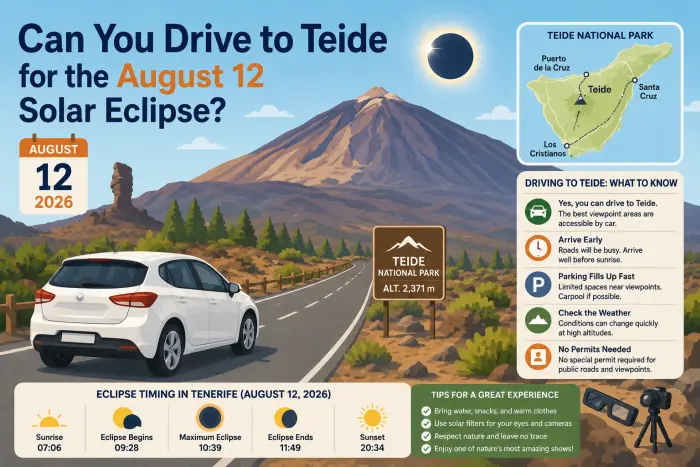
When exactly does the eclipse happen over Teide?
From Tenerife, the eclipse starts at 18:58, reaches its maximum at 19:53 with about 75% of the sun covered, and ends at 20:45. That’s not a small window — it’s over an hour and a half, timed to finish right around sunset. Totality itself only happens across the northern Spanish mainland; from the Canary Islands, including from the summit of Teide, you’ll see a deep partial eclipse rather than a full blackout. It’s still described by local astronomy guides as one of the most dramatic sky events visible from the island in years, especially from altitude where the air is clearer.
Will you actually be able to drive up that evening?
Realistically, only if you arrive early. This is a rare double event — the partial eclipse at dusk followed directly by the Perseid meteor shower peaking overnight, on a new-moon night with zero moonlight interference. Local stargazing tour operators have already announced they’re not running trips that night specifically because they expect the park to be overwhelmed. Teide National Park already restricts general roadside stopping and parking to designated areas; on a night like this, rangers are expected to close sections of road once the marked car parks reach capacity, similar to what happens during major weather alerts. If you’re driving up, treat “book early departure” as the plan, not an option — aim to be on the TF-21 by mid-afternoon, well before the crowds.
Where can you legally park to watch it?
Stick to the marked car parks and official viewpoints along the TF-21 corridor — the ones you’d normally use for sunset or stargazing stops (Mirador de Chipeque and the cable car base station car park are the two largest). Roadside verges and viewpoint shoulders that aren’t marked are off-limits year-round in the park, not just on eclipse night, and enforcement tends to increase whenever a big crowd is expected. Get there with a buffer, because on a normal clear night the main car parks already fill up for stargazing tours — on eclipse night, expect that to happen hours earlier than usual.
What happens if you stop on the road to watch?
The DGT has already issued a specific warning ahead of August 12: stopping a vehicle on a hard shoulder or motorway verge purely to watch the eclipse is a €200 fine. If the stop is judged to put other drivers at risk — blocking a lane, stopping on a blind bend, or parking somewhere with no visibility for oncoming traffic — that fine escalates to €500. This applies across Spain for the summer holiday traffic operation, and TF-21’s narrow shoulders and mountain bends make it an easy place to get caught out. The rule exists because the timing is genuinely dangerous: dusk light is already dropping fast around 19:00–20:45, and a car stopped in a driving lane on a mountain road at dusk is a real hazard, eclipse or not.
Do you need special glasses to look at it?
Yes — direct eye contact with the sun during any partial eclipse (not just totality) requires ISO 12312-2 certified eclipse glasses. Ordinary sunglasses, no matter how dark, don’t block enough infrared and UV light to be safe, and neither does viewing through a phone camera without a proper solar filter attached to the lens. Tenerife’s Museum of Science and the Cosmos has been giving away free certified glasses ahead of the date, and specialist astronomy shops on the island stock them too — but they’re the kind of item that sells out as the date gets closer, so it’s worth sorting before you drive up rather than hoping to find them at the summit.
Should you combine it with the Perseids that same night?
If you’re already making the trip, yes — this is the rare case where staying is genuinely worth it rather than just convenient. Because the eclipse coincides with a new moon, there’s no moonlight washing out the sky afterward, which is exactly the condition serious stargazers wait for. The trade-off is comfort: temperatures at altitude drop fast once the sun goes down, even in August, so pack a proper layer and closed shoes, not just a light jacket for the drive.
🚗 Discover Tenerife – Best Car Rental Deals
Compare top-rated suppliers, no hidden fees & free cancellation included.
What’s the safest way to time your drive?
Go up in daylight, not at dusk. Aim to be parked by mid-to-late afternoon, well before the 18:58 start, so you’re not navigating mountain bends and looking for parking in fading light with everyone else arriving at once. Plan your route home for after 21:00 rather than immediately when the eclipse ends at 20:45 — that’s when the exit traffic will be heaviest, funneling down through the same narrow sections of the TF-21 and TF-24. If the park does close once capacity is reached, have a lower-altitude backup viewpoint in mind rather than sitting in a queue hoping it reopens.
Eclipse day at a glance
| Time (Tenerife) | Event |
|---|---|
| ~15:00–17:00 | Recommended arrival window at Teide car parks, before crowds build |
| 18:58 | Partial eclipse begins |
| 19:53 | Maximum coverage, ~75% of the sun |
| 20:45 | Eclipse ends |
| After 21:00 | Perseid meteor shower visible overnight, peaking under new-moon dark skies |
| Overnight–dawn | Heaviest exit traffic expected shortly after the eclipse ends, easing later |
FAQ
Is the solar eclipse on August 12, 2026 total or partial in Tenerife? Partial. Totality only crosses the northern Spanish mainland; from Tenerife you’ll see around 75% of the sun covered at maximum.
Can I watch the eclipse from a rental car parked on the road? No — stopping on the TF-21 shoulder or any unmarked verge to watch is a €200 fine, rising to €500 if it’s considered a safety hazard. Use a marked car park or viewpoint instead.
Do I need to book anything to watch from Teide National Park? No permit is required just to view the eclipse from the road and viewpoints (that’s different from the separate summit hiking permit). But arriving early matters more than booking, since parking is first-come, first-served and expected to fill fast.
What if the Teide car parks are already full when I arrive? Have a backup plan below the park boundary — mid-altitude viewpoints on the way up still catch most of the eclipse without competing for the same limited spaces.
Will normal stargazing tours be running that night? Several operators have already announced they’re cancelling scheduled tours on August 12 specifically because of the expected crowding, so don’t assume a normal-night booking will go ahead as usual.
Is it worth driving up just for the eclipse, or should I skip it if I’m not into astronomy? It’s a genuinely rare double event — the eclipse plus the Perseid peak on a moonless night — but if crowds and mountain driving at dusk aren’t your thing, a coastal viewpoint will still show you a good partial eclipse with far less hassle.
Do I need special glasses even though it’s only a partial eclipse? Yes. Partial eclipses require the same ISO 12312-2 certified glasses as total ones — there’s no point during a 75%-coverage eclipse where it’s safe to look directly at the sun without them.