Booking a rental car in Tenerife means choosing between a genuinely wide field — a handful of strong local operators, a small family-run hotel-delivery specialist, the Enterprise Holdings family sharing desks and fleets under three different names, several large international brands, and a budget tier that’s cheaper but comes with real, documented risk. The headline price alone rarely tells you which category you’re actually in. Two companies charging near-identical daily rates can leave you with a €400 hold on your card or a €1,800 one, a same-day deposit release or a multi-week dispute, a calm five-minute pickup or a genuinely stressful desk confrontation. This page pulls together the specific numbers and review patterns from our full breakdown of all twelve companies, so you can see the real differences side by side before picking which deep-dive to read in full. If your priority is matching a company to your specific type of trip — family, budget, long-stay, mobility needs — rather than comparing raw numbers, our best company by trip type guide is the faster starting point.
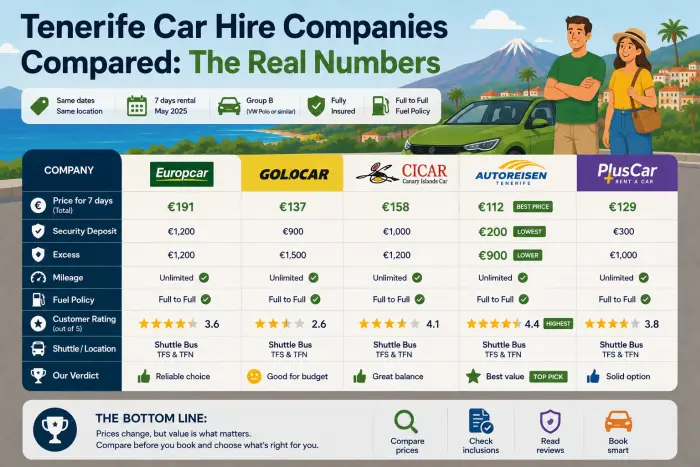
The Bottom Line, By Scenario
- Want to avoid a deposit hold entirely? Autoreisen or Sanasty both take none, and Sanasty accepts cash too.
- Staying in South Tenerife and want the car delivered straight to your hotel? Sanasty is the specialist here.
- Want the largest local fleet with a low, low-risk deposit? Cicar holds just €200–€400, with zero-excess built into the standard rate (the same terms apply if your booking shows Cabrera Medina or Payless instead).
- Booked with National and see an Alamo key tag at pickup? That’s normal — both belong to Enterprise Holdings and often share a desk on Tenerife, with deposits typically €900–€1,400.
- Want a name from that same Enterprise Holdings family with the strongest reputation? Independent review analysis on this site consistently ranks Enterprise above Avis and the budget tier for overall experience.
- Want the absolute lowest headline price and are comfortable managing some risk? PlusCar, Record Go or Budget are often cheaper, but with mixed track records worth reading first.
- Tempted by TopCar’s “no deposit” headline? Read the fine print first — most standard bookings still carry a €900–€4,000 excess.
- Seeing an unusually cheap OK Mobility quote? Read the reviews before you book — the pattern here is the most seriously documented of any company on this page.
- Booking a big international name for availability or brand familiarity? Europcar or InterRent are worth comparing — both carry a higher excess than the local operators.
- Sticking with a familiar global brand for loyalty points? Hertz is reasonable, but reviews describe a specific “pre-existing damage claimed as new” dispute pattern.
- Don’t have a credit card and need an international brand? Sixt has a documented track record of accepting debit cards.
- Want a dependable, predictable mid-tier name? Avis sits in the middle of the field.
- Seeing a very cheap Goldcar quote? Read what their reviews actually describe before booking — the most consistently documented risk pattern here.
- Booking through Discovercars, DoYouSpain or Holiday Autos rather than a fleet operator directly? Those are booking platforms, not the company that actually supplies the car — worth understanding the distinction before you compare prices.
- None of these is objectively “the best” — the right choice depends on how much you value avoiding a deposit hold versus fleet size versus absolute lowest price versus a personal, hotel-delivered experience.
How do the deposit amounts actually compare?
This is the single clearest, most checkable difference between these companies, and it varies far more than most renters expect going in. Autoreisen and Sanasty sit at one extreme with no deposit at all. Cicar holds a modest €200–€400. The Enterprise Holdings family — National and Alamo sharing a desk and fleet, plus Enterprise itself — generally runs €900–€1,400. PlusCar, TopCar and Record Go all advertise low- or no-deposit paths but carry real inconsistency in reviews. The international brands — Europcar, Hertz, Sixt, Avis, Budget and InterRent — sit similarly high, generally €800 to €2,500. Goldcar and OK Mobility sit at the very top, with contingent deposits reported as high as €3,000 and nearly €2,000 respectively.
Deposit and insurance terms aside, where you pick the car up is the other half of the decision — worth checking before you lock in a company.
| Company | Deposit / excess | Reduce to zero? | Card required |
|---|---|---|---|
| Autoreisen | None | Included as standard | Debit accepted |
| Sanasty | None (many bookings) | Included as standard | Cash accepted |
| Cicar / Cabrera Medina / Payless | €200–€400 | Included as standard | Credit card (written policy) |
| PlusCar | Often none, but inconsistent per reviews | Marketed as included | Credit card reduces risk |
| TopCar | €900–€4,000 under standard cover | Paid upgrade / condition-based | Credit or debit, inconsistently |
| National / Alamo | €900–€1,400 (shared fleet, Enterprise Holdings) | Paid upgrade required | Debit “sometimes,” bring credit as backup |
| Enterprise | Similar range to National/Alamo | Paid upgrade required | Credit card typically required |
| Record Go | €1,200–€1,400 if declining Total Comfort cover | Paid upgrade required | Credit card recommended |
| Budget | Generally €800+, budget-tier terms | Paid upgrade required | Credit card typically required |
| Europcar | €800–€2,300 | Paid upgrade required | Credit card typically required |
| InterRent | Comparable to Europcar’s range | Paid upgrade required | Credit card typically required |
| Hertz | High hundreds to low thousands (€) | Paid upgrade required | Credit card typically required |
| Sixt | ~€1,400 + mandatory Premium Location fee | Paid upgrade required | Debit accepted (documented) |
| Avis | Generally €900–€2,500, mid-tier | Paid upgrade required | Credit card typically required |
| Goldcar | €900–€3,000 if declining their insurance | Paid upgrade required | Credit card typically required |
| OK Mobility | €1,000–€1,950; higher combined figures reported | Paid upgrade required | Credit card, name-matching strict |
What’s the deal with National and Alamo sharing a desk?
They’re both owned by Enterprise Holdings, alongside Enterprise itself, and on Tenerife that ownership shows up directly at pickup — the same physical counter, the same fleet pool, and a genuine possibility of booking one brand and being handed keys with the other’s tag on them. This isn’t an error; it’s simply which brand happened to have your category of car available that day. The practical upshot is worth knowing: pricing between National and Alamo can shift day to day depending on which one is running a promotion, so comparing quotes for both before booking is genuinely worth the extra few minutes if your dates are flexible. Enterprise itself, the third name in the same family, is independently ranked ahead of Avis and the budget tier in reviews analysed across this site — worth considering if you want that same underlying reliability with the strongest individual reputation of the three.
Which companies build zero-excess into the base rate, and which sell it separately?
Autoreisen, Cicar and Sanasty all take the same fundamental approach: full, zero-excess insurance is part of the standard rate you’re quoted, not an upgrade you’re offered at the counter. This is the structural reason all three consistently outperform the rest of the field on review sentiment around the pickup experience specifically. Every other company covered here works the opposite way: the advertised rate assumes either a high excess or the purchase of the company’s own zero-excess product, a conversation that happens at the desk rather than during online booking. It’s this exact structural difference — not fleet quality or company size — that explains most of the desk-friction complaints documented across our piece on pushy add-on tactics generally.
Are Discovercars, DoYouSpain and Holiday Autos the same kind of company as Cicar or Hertz?
No, and this distinction matters. Those three are booking platforms — they take your reservation and payment, then a fleet operator (any of the companies listed elsewhere on this page) actually supplies the car and staffs the desk. Our full breakdown of how this works, including what to do if the name on your booking doesn’t match the desk you find at the airport, is worth reading if you’ve booked through a platform rather than a fleet operator’s own site. The deposit, insurance and fuel terms you actually get always follow whichever fleet operator physically hands you the car, not the platform’s own marketing copy.
What does each company’s review pattern actually look like?
Genuinely different enough to matter, once you read past star ratings into what the reviews specifically describe. Cicar, Autoreisen and Sanasty all show consistent, specific praise. PlusCar, TopCar and Record Go all split fairly evenly between very positive and genuinely concerning experiences. Among the larger international names, Enterprise and Avis both read as more consistent than Budget or InterRent, though all sit behind the local operators on transparency. Europcar, Hertz and Sixt each carry their own specific documented risk. Goldcar and OK Mobility carry the most seriously documented complaint patterns of the whole field.
🚗 Discover Tenerife – Best Car Rental Deals
Compare top-rated suppliers, no hidden fees & free cancellation included.
So which one should you actually book?
If minimising deposit risk and desk friction matters more to you than anything else, Cicar, Autoreisen or — specifically if you’re staying in the south — Sanasty are the clearest choices; our direct comparison of Cicar and Autoreisen covers that decision in more depth. If you want an Enterprise Holdings name specifically, Enterprise itself carries the strongest reputation of the three, with National and Alamo a genuinely interchangeable pair worth quote-comparing before you book. If you need a different international brand for availability or loyalty points, Europcar, Hertz and Avis are the steadier options, while Sixt suits anyone without a credit card. If the absolute lowest price is your priority and you’re willing to actively manage some risk, PlusCar, TopCar, Record Go or Budget can all work out well, but go in with eyes open. Goldcar and OK Mobility remain the two names where the documented pattern is serious enough to warrant genuinely deliberate caution rather than a default booking made on price alone.
FAQ
Which Tenerife car hire company has the lowest deposit? Autoreisen and Sanasty both take no deposit at all. Cicar is the next lowest at €200–€400.
Are National and Alamo actually different companies in Tenerife? Legally separate brand names, but both owned by Enterprise Holdings and frequently sharing the same desk and fleet on the island — expect similar terms and a possible key-tag mismatch from what you booked.
Is Cicar or Autoreisen better for a Tenerife rental? Neither is objectively better — Autoreisen suits anyone who wants to avoid any deposit hold entirely, while Cicar offers a larger fleet.
Which company has the most serious complaint pattern in Tenerife? Based on documented reviews, OK Mobility and Goldcar carry the most seriously and consistently documented complaint patterns of the companies covered here.
Is Discovercars a car rental company or a booking platform? A booking platform — it doesn’t own or operate the fleet itself; a separate company (any of those listed on this page) actually supplies your car.
Is it worth paying more to avoid the companies with worse reviews? For many renters, yes — the price difference is often smaller than the potential cost and stress of a high contingent deposit or a disputed post-return charge.
Where can I read the full breakdown of each company mentioned here? Each has its own dedicated page: Cicar, Autoreisen, Sanasty, PlusCar, TopCar, National, Enterprise, Record Go, Budget, OK Mobility, Europcar, InterRent, Hertz, Sixt, Avis, and Goldcar.