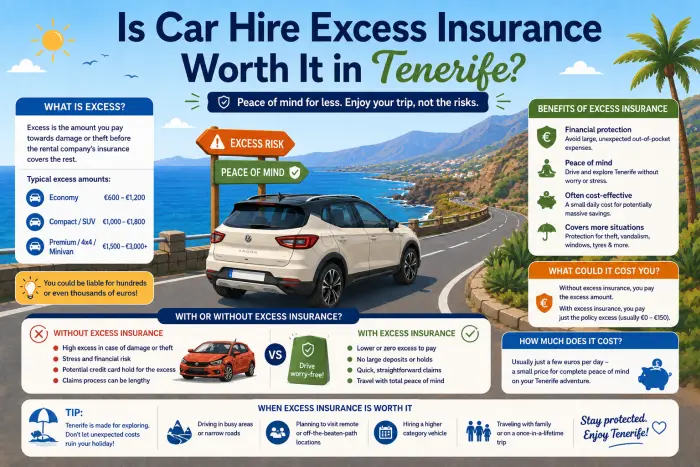
Every Tenerife rental comes with a catch buried in the small print: the excess — the amount you’re liable for if the car is damaged or stolen, often €700 to €2,000. The rental desk will offer to reduce or remove it for a daily fee, and standalone insurers will too. So the real question isn’t what the excess is — it’s whether paying to cover it is actually worth your money.
This guide tackles that decision head-on: when excess cover is worth it, when you might skip it, and — crucially — the cheapest smart way to get it. (For how the underlying insurance works, see our full car hire insurance in Tenerife guide; this one is purely about the worth-it decision.)
For most travellers, yes — covering the excess is worth it, because Tenerife’s narrow, hilly roads make minor damage (scuffed wheels, scratches, chips) genuinely common, and the excess you’d otherwise pay is large. But the smart way is not the rental desk’s pricey upsell — a cheap standalone excess policy or an all-inclusive/zero-excess rate gives the same peace of mind for far less. Skip cover only if you’re on a very short rental and comfortable risking the full excess.
🛡️ First, What Is the Excess?
In one line: the excess is the maximum you pay towards damage or theft before insurance covers the rest. Basic rates include collision and theft cover but leave you liable for this large excess. “Excess insurance” (whether the desk’s super-cover, a standalone policy, or a zero-excess rate) reduces or removes that liability. The full mechanics are in our insurance guide — here we focus on whether to buy it.
⚖️ The Four Ways to Handle the Excess
You have four real choices, and they differ hugely in cost:
| Option | Typical Cost | Verdict |
|---|---|---|
| 🏢 Desk super-cover (SCDW) | High daily fee | Convenient but the priciest route |
| 🛡️ Standalone excess policy | Cheap (per-trip or annual) | Best value for most |
| 🟢 All-inclusive / zero-excess rate | Built into price | Great for hassle-free peace of mind |
| 🎲 Self-insure (no cover) | €0 upfront | Cheapest — but you risk the full excess |
The key insight: covering the excess is usually wise, but how you cover it makes a big financial difference. The desk upsell and a standalone policy give similar protection — at very different prices.
💸 Why the Desk Upsell Is the Expensive Route
When you decline cover online, the rental desk will offer super-cover (SCDW) to reduce the excess — often at a steep daily rate, presented under time pressure as you collect the car. It works, but it’s typically the most expensive way to cover the excess.
A standalone excess policy from a third-party insurer usually costs a fraction of the desk price — bought in advance as a per-trip or annual policy — and reimburses you for excess charges after a claim. For anyone hiring more than a few days, or more than once a year, it’s almost always the better-value choice. Our hidden fees guide explains why desk upsells are priced the way they are.
💡 Note: neither the desk cover nor a standalone policy stops the deposit being held — only a true no-deposit rate does that.
✅ When Excess Cover Is Worth It
For most Tenerife visitors, covering the excess earns its cost. Consider how easily minor damage happens here:
- ⛰️ Narrow, winding mountain roads (Masca, Anaga, Teide approaches) where kerbed wheels and scrapes are common.
- 🅿️ Tight resort parking and unfamiliar streets.
- 🪟 Loose-chip and rural roads that can chip glass or paint.
- 😌 Peace of mind — driving relaxed, not terrified of every scratch, is worth a lot on holiday.
Against a potential €700–€2,000 liability, a few euros a day for cover is easy maths for most people — provided you take the cheap route, not the desk one.
🎲 When You Might Skip It
Covering the excess isn’t compulsory, and a few travellers reasonably choose not to:
- ⏱️ Very short rentals where the cumulative cover cost feels disproportionate.
- 💳 Solid credit-card cover — if your card genuinely includes rental cover and you understand its limits (see our credit card cover guide).
- 🧮 Comfortable self-insurers — confident drivers willing and financially able to absorb the full excess if the worst happens.
The trade-off is real: skip cover and you’re betting the cost of a policy against a large potential bill. Only you can judge your risk appetite — this is information to decide with, not financial advice.
🚗 Discover Tenerife – Best Car Rental Deals
Compare top-rated suppliers, no hidden fees & free cancellation included.
🎯 The Verdict: Worth It — the Smart Way
Putting it together:
| Your Situation | Recommendation |
|---|---|
| 🚗 Typical holiday hire | ✅ Cover it — via cheap standalone or zero-excess rate |
| 😬 Nervous / first time on these roads | ✅ Definitely worth it |
| ⏱️ One- or two-day rental | ⚖️ Optional — weigh cost vs risk |
| 💳 Strong credit-card cover | ⚖️ Maybe rely on it (know the limits) |
| 🏢 Tempted by the desk upsell | ⚠️ Get the same cover cheaper in advance |
For the overwhelming majority, the answer is: yes, cover the excess — but arrange it cheaply before you travel, or book an all-inclusive local rate, rather than paying the desk premium.
📊 The Maths: Desk Cover vs Standalone
A simple worked comparison shows why the route matters more than the decision. Imagine a one-week hire and the two common ways to cover the excess:
- 🏢 At the desk: super-cover charged per day, at a premium rate, adds up over a week to a sizeable chunk — often a significant share of the rental itself.
- 🛡️ Standalone policy: a per-trip excess policy bought online typically costs a fraction of that for the week, and an annual policy can cost about the same as a single week’s desk cover while protecting every rental you take that year.
The protection is broadly comparable — both reimburse you for excess charges after a claim — but the price gap is large and entirely in your control. This is why the seasoned advice is rarely “don’t cover the excess”; it’s “cover it, but never at the desk.” If you only hire once a year, a per-trip policy wins; if you travel and rent often, an annual excess policy is outstanding value. Either way, deciding and buying before you reach the counter is what saves the money — once you’re at the desk with the keys in sight, the expensive option is the only one on offer.
✅ Excess Cover Decision Checklist
- 🧮 Know your excess — often €700–€2,000.
- 🛡️ Cover it the cheap way — standalone policy or zero-excess rate.
- 🚫 Skip the desk upsell — same protection, higher price.
- ⛰️ Factor the roads — minor damage is common here.
- 💳 Check credit-card cover if relying on it.
- 🟢 Want no deposit too? Choose a no-deposit rate.
❓ Frequently Asked Questions
Is car hire excess insurance worth it in Tenerife? For most travellers, yes. The excess is large (often €700–€2,000), and minor damage is common on Tenerife’s narrow, hilly roads, so covering it brings valuable peace of mind. The key is to cover it cheaply — via a standalone policy or an all-inclusive rate — rather than through the rental desk’s pricier upsell.
What’s the cheapest way to cover the excess? Usually a standalone third-party excess insurance policy bought in advance, which costs a fraction of the rental desk’s super-cover for similar protection. Alternatively, an all-inclusive or zero-excess rate from a local company builds the cover into the price.
Should I buy excess cover at the rental desk? You can, but it’s typically the most expensive route. The same protection is usually much cheaper arranged in advance as a standalone policy, or built into a zero-excess rate. Decide before you travel so the desk upsell holds no pressure.
Can I skip excess insurance altogether? Yes, if you’re comfortable being liable for the full excess should anything happen. Some confident drivers or those with solid credit-card cover do. But given how easily minor damage occurs here, most people find covering it worthwhile.
Does excess insurance stop the deposit being held? No. Whether you use desk cover or a standalone policy, the rental company still holds the deposit. Only a genuine no-deposit rate avoids the hold. Excess cover reimburses or removes your liability for damage, separately from the deposit.
Does my credit card cover the excess instead? Some premium cards include rental cover, but it’s usually secondary, has conditions and exclusions, and doesn’t stop the deposit hold. If you plan to rely on it, check your card’s current terms carefully — see our dedicated credit card cover guide.
How much is the excess on a Tenerife hire car? It varies by car and company but is commonly in the range of €700–€2,000. The higher the excess, the more valuable it is to cover — and the bigger the gap between the cheap and expensive ways of doing so.
Is this financial advice? No. This is general information to help you weigh the decision. Insurance products, prices and card terms vary and change, so confirm current details and choose based on your own circumstances and risk comfort.
🛡️ Cover the Excess — Just Do It Cheaply
So, is car hire excess insurance worth it in Tenerife? For most people, yes — the liability is large and minor knocks are common, so the peace of mind pays for itself. The real skill is getting that protection the smart way: a cheap standalone policy or a zero-excess rate booked in advance, never the desk’s premium upsell.
👉 Compare car hire deals in Tenerife, including all-inclusive options. This guide is part of our complete Tenerife car hire guide; for the full mechanics, see our car hire insurance and no-deposit car hire guides.