The rental car desk in Tenerife is where perfectly relaxed holidaymakers suddenly feel like they’re being cross-examined by a financial advisor. CDW. SCDW. TP. Excess waiver. Super cover. Full protection. Zero liability. The agent rattles through the options with the confidence of someone who has done this ten thousand times — because they have — and you’re standing there with hand luggage, jet lag, and a vague sense that saying “no” to anything might leave you personally liable for the entire car.
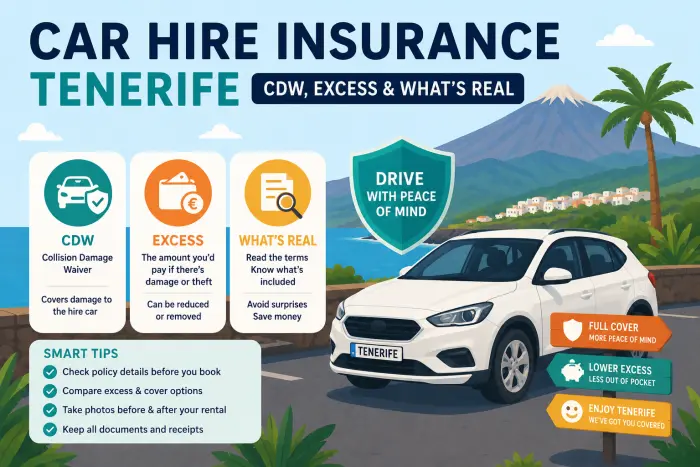
This guide is the antidote to that moment. Read it before you fly, not at the desk. By the end, you’ll know exactly what each insurance term means, what it covers, what it doesn’t, what you genuinely need, and how to avoid paying two or three times more than necessary for the same protection.
No jargon. No scare tactics. Just the honest mechanics of how car hire insurance in Tenerife actually works.
The Insurance Landscape — Start Here
Every rental car in Tenerife comes with some insurance included in the base price. The confusion starts because what’s included is not the same as being fully protected — and the gap between the two is where the upsell lives.
There are two layers of cover in any Tenerife car hire:
Layer 1 — Always included (by law): Third-Party Liability Insurance (TPL). This is mandatory under Spanish law and covers damage or injury you cause to other people and their property. Coverage limits are typically in the millions, so exceeding the cap is unlikely. This is not optional, not upgradeable, and costs you nothing extra — it’s baked into every rental.
Layer 2 — Included but with conditions: A basic Collision Damage Waiver (CDW) and Theft Protection (TP) are usually included in the quoted price. This is where most people think they’re covered — and where the detail matters enormously.
The catch: basic CDWs come with a high excess — the amount you pay before the waiver kicks in — which in Spain typically ranges from €1,200 to €2,420 or higher depending on the vehicle category. “Insurance included” doesn’t mean “zero cost if something goes wrong.” It means “you’re covered above the excess threshold.”
Every Insurance Term You’ll Encounter — Defined
| Term | What It Is | What It Covers | What It Doesn’t |
|---|---|---|---|
| TPL — Third-Party Liability | Mandatory. Always included | Damage/injury to other people & their property | Damage to your rental car |
| CDW — Collision Damage Waiver | Usually included | Damage to the rental car’s bodywork — above the excess | Tyres, glass, mirrors, undercarriage, keys |
| TP — Theft Protection | Usually included | Theft of the vehicle — above the excess | Theft due to negligence (e.g. keys left in car) |
| SCDW — Super CDW | Optional upgrade (from rental company) | Reduces or eliminates the excess; often adds glass, tyres, undercarriage | Personal belongings, keys, misfuelling (usually) |
| Excess waiver / EI | Optional (third-party or rental company) | Reimburses you for excess charges if you pay them | Usually doesn’t replace SCDW — it refunds after the fact |
| PAI — Personal Accident Insurance | Optional add-on | Medical costs for driver and passengers | Usually covered by travel insurance already |
| PEP — Personal Effects Protection | Optional add-on | Personal belongings stolen from car | Usually covered by travel insurance already |
The most important number in any rental agreement is the excess — the amount you’d pay out of pocket if something happens before the CDW or TP kicks in. This figure should appear clearly in your booking confirmation. If it doesn’t, ask before you collect the car.
What CDW Does NOT Cover — The Exclusions That Catch People Out
Basic CDWs do not cover all instances of damage. Glass, mirrors, tyres and undercarriage are usually excluded, as hire companies consider damage to these components to be the result of driver negligence.
In practice, this matters more than most guides acknowledge. Think about what actually happens to rental cars in Tenerife:
- Tyres — the mountain roads to Teide and Masca have rough surfaces and sharp volcanic rock edges. Punctures happen.
- Windscreen chips — the TF-1 motorway at 120 km/h behind a lorry is a chip waiting to happen.
- Mirrors — the narrow lanes in Anaga villages and the TF-436 to Masca routinely clip mirrors.
- Undercarriage — speed bumps (badenes) are common throughout Tenerife’s towns and resort areas, many of them unmarked. Scraping the underside on an unexpected one is a real possibility.
- Keys — losing car keys abroad is expensive. Most basic policies don’t cover it.
CDWs also do not cover misfuelling, mechanical breakdowns and towing, or lost keys. If you put petrol in a diesel car or vice versa, you’re liable for the repair — regardless of what insurance level you chose.
The Three Real Options — Costs Compared Honestly
Once you understand what basic cover leaves exposed, you have three practical paths:
Option 1: Accept the Basic Excess
You keep the base rate, decline all upgrades, and accept a deposit block of €700–€2,000 on your credit card for the duration of the rental. If there’s no damage, the hold is released at return. If there is damage — including to tyres, glass, or the undercarriage — you pay up to the excess amount, and your CDW covers the rest.
Best for: Experienced drivers, short rentals, people who are very careful and know Tenerife well. Risk: One chip, one kerbed tyre, one scrape = hundreds of euros.
Option 2: Buy Third-Party Excess Insurance
This is the most cost-effective route for most travellers. Companies like ReduceMyExcess, Bettersafe, iCarhireinsurance, RentalCover.com, CarHireExcess.co.uk and RAC all offer excess cover for £2–£6 per day. A week’s policy typically costs £15–£40.
The mechanics: you still accept the excess at the desk (the rental company puts the deposit hold on your card). If something goes wrong and you’re charged, you claim the amount back from your third-party insurer. Third-party excess insurance works by reimbursing you for costs — you’ll still need to pay the excess upfront, then claim it back from the excess insurer. Be sure to keep all documentation.
Best for: Most travellers — significantly cheaper than the rental company’s own upgrade, and covers the same core risk. Trade-off: You pay first, claim back later. Requires keeping receipts and filing a claim on return.
Option 3: Upgrade to SCDW / Zero-Excess Cover at the Desk
Super Collision Damage Waiver (SCDW) is an upgraded version of CDW that reduces or eliminates the excess. It’s more expensive and offered by the rental companies. While convenient, an SCDW can be expensive — typically £12–£30 per day from the rental company. On a 7-day rental, that’s £84–£210 extra on top of your car hire rate.
The benefit is genuine: zero excess, no deposit block, no claim to file, no admin on return. You hand back the keys and walk away regardless of what happened.
Best for: First-time visitors to Tenerife, anxious drivers, anyone who wants total peace of mind and doesn’t want to deal with a claim process. Trade-off: Highest cost. The rental company’s SCDW is almost always more expensive than equivalent third-party cover.
🚗 Discover Tenerife – Best Car Rental Deals
Compare top-rated suppliers, no hidden fees & free cancellation included.
The Counter Upsell — What Actually Happens at the Desk
Understanding what’s coming at the rental desk is as valuable as understanding the insurance itself.
When you arrive to collect your car in Tenerife — after a flight, possibly with children, usually tired — the agent will go through your booking and then, almost without exception, offer to upgrade your insurance. The pitch is designed to create urgency and mild anxiety: “Do you want to be responsible for up to €1,500 if anything happens to the vehicle?”
The answer to that question, as stated, is no — nobody wants that. But the right response isn’t to panic-buy the most expensive package. It’s to know what you’ve already arranged.
If you’ve pre-bought third-party excess insurance: Politely decline all upgrades. You’re covered. The deposit hold will appear on your card — this is normal and expected. It will be released on return if there’s no damage.
If you haven’t arranged anything: This is the wrong moment to be making decisions. The desk rate for SCDW is consistently higher than the equivalent third-party policy bought before you travel. If you’re at the desk without cover and genuinely want zero-excess protection, the rental company’s SCDW is your only option — but treat it as a lesson for next time.
One thing to watch: some agents bundle extras you didn’t ask for (roadside assistance packages, GPS, child seats at premium rates) into the insurance conversation. Check your final invoice figure against your booking confirmation before signing.
The One Habit That Protects You More Than Any Insurance
Film a 360° video of the car before you drive away. Every panel, roof, underside of doors, wheels, windscreen. Do it in front of the agent if possible, or with a clearly time-stamped phone recording if not.
This matters because: if an incident occurs, failing to notify police or provider within the required time can jeopardise coverage. Keep emergency numbers accessible and follow documented steps, not assumptions.
More practically: disputed pre-existing damage is the most common source of conflict between rental companies and customers in Tenerife. A scratch that was there before you took the car becomes your problem on return if you can’t prove it. A 2-minute video at pickup eliminates this risk entirely.
Local Companies vs International Chains — The Insurance Difference
This is a Tenerife-specific insight that most general car hire guides miss entirely.
Several Canarian-owned rental companies — most notably Cicar, Cabrera Medina, and AutoReisen — operate on a fundamentally different model. Rather than a low base rate plus upsell at the desk, they typically include genuinely comprehensive insurance (zero or very low excess, including glass and tyres) in their headline rate.
Local companies like Cicar, Cabrera Medina, Payless, AutoReisen and Plus Car offer no deposit, full insurance with no need to purchase CDW or have an excess, and have straightforward fuel policies. They will also often be cheaper overall.
This means comparing prices on a booking platform requires care. A €15/day rate from Goldcar with €1,200 excess is not the same product as a €22/day rate from Cicar with zero excess. Filter total cost, not just daily rate — and read the excess figure for every option you’re comparing.
Related Guides
- 🚗 Complete Tenerife car hire guide — island-wide overview of costs, companies, and how to find the best deal. Start here if you haven’t already.
- ✈️ Car hire at Tenerife South Airport (TFS) — picking up at TFS? Full guide on in-terminal companies, what to expect at the desk, and how to handle the insurance conversation on arrival.
- ✈️ Car hire at Tenerife North Airport (TFN) — landing in the north? Same honest advice for the smaller airport, including which companies are in-terminal vs shuttle.
- 🗺️ Tenerife North vs South Airport — which should you use? — not sure which airport to fly into? Decision matrix by resort, transfer times, and car hire fleet comparison.
- 🚗 Do you need a car in Tenerife? — still deciding whether to rent at all? Honest breakdown by trip type, budget, and what the buses can genuinely cover.
- 🛣️ Driving in Tenerife — tips for first-timers — once you’ve sorted the insurance, here’s everything you need to know about actually driving the island: speed limits, roundabouts, mountain roads, parking.
Frequently Asked Questions — Car Hire Insurance in Tenerife
Is insurance included in Tenerife car hire?
Partially — always. Third-party liability insurance (TPL) is mandatory under Spanish law and is included in every rental. A basic Collision Damage Waiver (CDW) and Theft Protection (TP) are also typically included, but both come with a significant excess — the amount you’d pay out of pocket if something goes wrong. “Insurance included” does not mean zero financial exposure. It means your liability is capped at the excess amount, which in Tenerife commonly ranges from €700 to €2,000 depending on the vehicle and company.
What is the excess on a Tenerife rental car?
The excess is the maximum amount you would pay in the event of damage to the vehicle before your CDW or TP insurance covers the remainder. In Spain — including the Canary Islands — excess figures tend to be high: typically €1,200 to €2,420 or higher depending on the vehicle category. The exact figure for your rental is always stated in the booking confirmation. If it isn’t visible, ask before collecting the car — this number is the most important detail in your agreement.
What does CDW not cover in Tenerife?
Basic CDWs do not cover glass, mirrors, tyres and undercarriage — as hire companies consider damage to these components to be the result of driver negligence. They also typically exclude misfuelling, lost keys, personal belongings, and mechanical breakdowns. In Tenerife specifically, tyre and windscreen damage are common risks given the mountain roads, speed bumps, and motorway driving — making SCDW or a good third-party policy more valuable here than in many other destinations.
Is it cheaper to buy insurance from the rental company or a third party?
Almost always cheaper from a third party — booked in advance. A week-long policy from a third-party provider might cost as little as £20–£40, while offering broader coverage than CDW. The rental company’s equivalent SCDW typically costs £12–£30 per day — potentially £84–£210 for a week. The trade-off with third-party cover is that you pay any excess upfront to the rental company and then claim the amount back, which requires keeping documentation and filing a claim after your return.
Do I need to buy additional insurance at the rental desk in Tenerife?
Not necessarily — but you do need to understand your existing exposure. If you’ve pre-purchased third-party excess insurance, you can decline upgrades at the desk. If you haven’t arranged anything, your choice is between accepting the excess risk (with a deposit block on your card) or paying for the rental company’s SCDW on the spot. The desk is not the ideal place to be making this decision for the first time — research and arrange cover before you travel.
Does travel insurance cover rental car excess in Tenerife?
Some travel insurance policies include car hire excess cover, but coverage varies significantly between policies and providers. Check your specific policy wording carefully — look for the terms “car hire excess” or “rental vehicle excess” in your policy documents. If your travel insurance does include it, verify the maximum excess amount covered and whether Tenerife / Spain is explicitly included in the geographic scope.
What happens if I damage the rental car and I have no extra insurance?
The rental company will charge your credit card up to the excess amount for the damage. This charge will be applied from the security deposit hold placed on your card at pickup. You’ll receive a damage report and invoice detailing the repair cost. If you dispute the damage — for example, if it was pre-existing — your 360° video of the car at pickup is your primary evidence. Without that evidence, disputes are difficult to win.
Can I use my credit card insurance instead of buying cover?
Some premium credit cards (typically Visa Infinite, Mastercard World Elite, and similar) include car hire insurance benefits. However, coverage varies widely: some cards exclude Tenerife or Spain, some limit the vehicle value, some require you to pay the full rental on that card, and some don’t cover commercial rental cars at all. Check the exact terms of your card’s insurance — don’t assume it applies without reading the policy document.
See the full picture in our Tenerife car hire guide.