A perfectly healthy credit card can still get declined at a Tenerife car hire desk, and it catches people out constantly because the logic isn’t obvious until you understand what’s actually being checked. A £2,000 credit limit means nothing to the terminal if £1,850 of it is already tied up in hotel holds, everyday spending, and a fuel station pre-authorisation from the day before. What matters is available credit at that exact moment, not the number printed on your statement — and Tenerife’s deposit holds, which can run into the thousands of euros for some companies, are exactly the kind of large, sudden request that exposes the gap between the two.
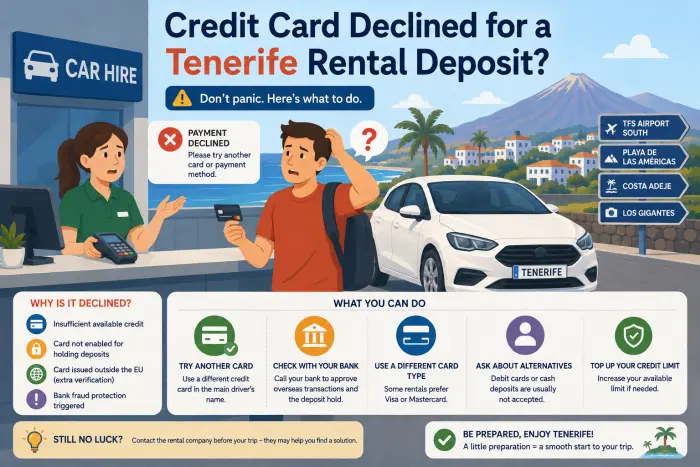
What’s Actually Blocking You
- Deposit holds check your available credit, not your total limit — existing pending transactions, hotel holds, and even previous unfreed rental holds all eat into that number before you’ve spent a cent on purpose.
- Some cards have a separate, lower cash-advance sub-limit that specific rental transactions can fall under depending on how the issuer codes them — a healthy overall limit doesn’t guarantee that narrower sub-limit is large enough.
- Deposits at Tenerife’s rental desks range widely by company — from nothing at all with Autoreisen or Sanasty up to €2,500 or more with some international brands — so the card headroom you actually need depends entirely on who you’re booking with.
- A sudden high-value, foreign-currency authorisation right after a flight is exactly the kind of transaction pattern that triggers a bank’s fraud block, sometimes declining silently until you confirm it through your banking app.
- The fastest fix at the counter is rarely arguing with the desk — it’s calling your bank directly, since they can usually see and clear the actual block in a couple of minutes.
Why does a card with a “good enough” limit still get declined at the Tenerife desk?
Because the terminal isn’t checking your credit limit — it’s checking what’s currently available against it, and those two numbers are often very different by the time you’re standing at a rental counter. If your card carries a €2,000 limit but you’ve already got €400 in hotel pre-authorisations, a couple of restaurant tabs pending settlement, and a previous car rental deposit from earlier in your trip that hasn’t cleared yet, your genuinely available credit might be closer to €1,000 — plenty for some companies, not nearly enough for others. This is the single most common reason a card that “should” work doesn’t, and it’s worth checking your actual available balance through your banking app the morning of pickup rather than assuming last week’s statement still reflects reality.
What’s actually eating into your available credit before you even land?
More than most travellers account for. Hotel check-ins commonly place their own incidental holds, which can sit on your card for days after checkout even once you’ve paid the bill in full. Fuel stations sometimes pre-authorise a higher amount than you actually pump, releasing the difference only after a delay. If you’ve already picked up one rental car earlier in a multi-stop trip, that deposit might still be sitting as a hold rather than fully released — deposit releases can take anywhere from a few days to a couple of weeks depending on your bank, which means a second rental deposit request can land while the first is still tying up your available credit. None of these individually looks like much, but stacked together they can easily eat several hundred euros of headroom you were counting on.
| What’s eating your available credit | Why it’s easy to miss |
|---|---|
| Hotel incidental holds | Can linger days after checkout, even after full payment |
| Fuel station pre-authorisations | Often higher than the amount actually pumped |
| A previous rental deposit not yet released | Bank processing takes days to weeks |
| Everyday spending on the same card | Adds up faster on holiday than at home |
| Multiple declined attempts creating pending holds | Some issuers leave a phantom hold even after a decline |
Can a low cash-advance sub-limit cause a decline even with a healthy overall limit?
Yes, and this is one of the more surprising, less-understood causes of a deposit decline. Some card issuers process rental deposit holds under a merchant category code that falls closer to a cash-advance-style transaction depending on their internal rules, and cash-advance limits are often set meaningfully lower than your standard purchase limit — sometimes a fraction of it. This means a card showing a comfortable overall limit can still hit a wall specifically on a large rental deposit, even though ordinary purchases on the same card sail through without issue. It’s not something you can easily check in advance without calling your issuer directly and asking specifically about cash-advance or rental-deposit sub-limits, but it’s worth doing before a trip if you know you’ll be facing a large hold.
What should you actually do if your card is declined at the counter?
Work through it methodically rather than panicking or assuming the card itself is faulty. First, ask the desk exactly what amount they attempted to authorise and what it covers — sometimes add-ons or a higher category than expected inflate the figure beyond what you budgeted for. Then call the number on the back of your card directly, since a genuine fraud block or a travel-related flag is often cleared in a two-minute phone call, and many banks have an in-app way to confirm a transaction that’s been silently held for review. If repeated attempts have already run, mention this to your bank specifically — multiple declined attempts can sometimes leave several small pending holds stacked up even though none of them actually succeeded, further reducing your available credit right when you need it most. If none of that resolves it quickly, a second card in the main driver’s name is the most reliable backup — worth genuinely carrying rather than assuming you won’t need it.
How much available credit should you realistically plan for in Tenerife?
It depends entirely on which company you’re renting from, and the range is genuinely wide. Autoreisen and Sanasty take no deposit at all, removing this entire concern; Cicar holds a modest €200–€400; the international brands and some budget operators can run from €800 up to €2,500 or more depending on vehicle category and cover level. The safest approach is checking your specific company’s deposit range before you fly — our full comparison across Tenerife’s major car hire companies lists this for each — and then adding a genuine buffer on top for hotel holds, fuel pre-authorisations, and everyday spending, rather than assuming your card’s headline limit alone will cover it.
Does this differ by which company you’re renting from?
Meaningfully, yes — and not just in the deposit amount itself. Some companies are stricter about card type and name matching than others, and a handful specifically flag that debit cards face tighter scrutiny or larger required holds even where they’re technically accepted. If a low or unpredictable available-credit situation is a genuine risk for your trip, choosing a company that takes little or no deposit in the first place sidesteps this entire problem rather than requiring you to manage your card headroom carefully around a large hold.
🚗 Discover Tenerife – Best Car Rental Deals
Compare top-rated suppliers, no hidden fees & free cancellation included.
Is there a way to avoid this entirely?
The most reliable fix is choosing your rental company with this specific risk in mind rather than managing around a large deposit after the fact. Booking with Autoreisen or Sanasty, both of which take no deposit at all, removes the available-credit question completely. If you’re set on a company that does require a substantial hold, the practical steps are worth treating as a checklist rather than an afterthought: check your actual available credit the morning of pickup, not from a stale statement; call your bank in advance to flag foreign travel and ask about cash-advance sub-limits specifically; and bring a second credit card in the main driver’s name as a genuine backup, not just a theoretical one.
FAQ
Why was my credit card declined for a Tenerife car rental deposit if I have a high limit? Because the hold checks your currently available credit, not your total limit — pending hotel holds, fuel pre-authorisations, and everyday spending can all reduce what’s actually available well below your headline limit.
How much available credit should I have for a car rental deposit in Tenerife? It depends on the company — from nothing needed with Autoreisen or Sanasty, to €200–€400 with Cicar, up to €800–€2,500+ with some international and budget brands. Check your specific company’s range before you fly.
Can a cash-advance limit cause my deposit to decline even with a good overall credit limit? Yes — some issuers process rental deposits under rules closer to a cash-advance transaction, which can carry a much lower sub-limit than your standard purchase limit.
What should I do first if my card is declined at the Tenerife rental desk? Call the number on the back of your card directly — a fraud block or travel flag is often cleared within a couple of minutes, faster than trying to resolve it at the counter.
Can multiple declined attempts make the problem worse? Yes — repeated attempts can sometimes leave several small pending holds on your card even though none of them succeeded, further reducing your available credit.
Is it better to book a company with no deposit if I’m worried about my card’s available credit? Yes, generally — Autoreisen and Sanasty both take no deposit at all, which removes this entire risk rather than requiring you to carefully manage available credit around a large hold.
Should I bring a second credit card to Tenerife in case my main one is declined? Yes — a second credit card in the main driver’s name, from a different bank if possible, is the most reliable backup if your primary card’s available credit falls short at the counter.