The moment you pull out of the rental car park at TFS or TFN and join your first Tenerife road, a few things will become immediately clear. The sun is brighter than you expected. The road is on the right. And the TF-1 motorway moves faster than your nervous system is ready for after a three-hour flight.
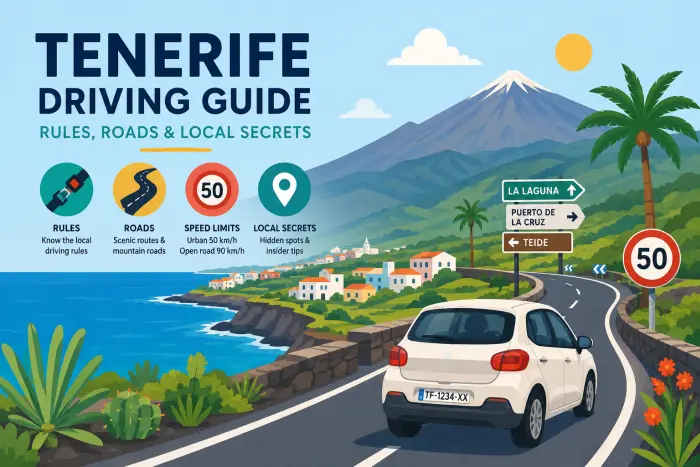
Driving in Tenerife is not difficult — but it is different. Different from UK roads, different from mainland Spain, and occasionally different from what Google Maps confidently insists you should expect. The island has its own rhythms, its own road types, a handful of rules that don’t exist elsewhere, and a few situations that catch first-timers off guard every single season.
This guide covers all of it. Not in a vague “drive carefully” way — but specifically: the speed limits per road type, what the road markings mean, how roundabouts work here, where parking goes wrong, and how to handle the mountain roads that make Tenerife genuinely extraordinary to drive.
The Road Network — What You’re Actually Driving On
Tenerife has two motorways and a surprisingly varied network of secondary roads. Understanding the categories before you drive helps enormously.
| Road Type | Examples | Condition | Speed Limit | Notes |
|---|---|---|---|---|
| Motorway (Autopista) | TF-1, TF-5 | Excellent | 120 km/h | Free, no tolls, well-lit |
| Dual carriageway (Autovía) | TF-2, TF-47 | Very good | 100–120 km/h | Merges can be short |
| A-roads | TF-21, TF-28 | Good | 90–100 km/h | Mountain roads in this class |
| B-roads / local | TF-436 (Masca), rural routes | Variable | 50–90 km/h | Can be narrow, steep |
| Urban / resort roads | Town centres, resorts | Good | 50 km/h (or lower) | One-way systems common |
| Rural tracks | Village lanes, some viewpoints | Poor | 30–40 km/h | Potholes, passing places |
TF-1 runs along the eastern and southern coast — Santa Cruz, TFS Airport, Las Américas. It’s fast, four-lane in places, well-maintained, and busy during rush hour (07:30–09:00 and 16:00–19:00 weekdays). This is the road most tourists use most often, and it’s genuinely easy once you’re on it.
TF-5 heads north and west from Santa Cruz toward Puerto de la Cruz. Equally good condition. Both motorways are completely toll-free — which surprises visitors used to mainland Spain or France.
The mountain roads — particularly TF-21 up to Teide and TF-436 toward Masca — are in a completely different category. Well-surfaced but narrow, relentlessly winding, and with gradients that will remind a 1.0L economy car of every year it has lived. More on these below.
Speed Limits — The Exact Numbers
On motorways the limit is 120 km/h, while main roads are capped at 90 km/h, and in urban areas it drops to 50 km/h or lower. Here’s the full breakdown:
| Road Type | Speed Limit | Worth Knowing |
|---|---|---|
| Motorway (Autopista) | 120 km/h | Minimum speed 60 km/h also applies |
| Dual carriageway | 100–120 km/h | Check signs — varies by section |
| Single carriageway (out of town) | 90 km/h | Most A and B roads |
| Urban / residential | 50 km/h | Can drop to 30 or 40 km/h |
| Residential zones (zona 30) | 30 km/h | Increasing in town centres |
Two things about speed enforcement that matter specifically for rental car drivers:
First, speed cameras are fixed and rental cars are fully traceable via passport details — so treat the limits as exactly that. There’s no anonymity in a hire car. Fines follow you home.
Second, there are flashing amber traffic lights in Tenerife, usually positioned at the entrance to a village after a fast road. You don’t need to stop when these are flashing, but you must slow down and stay under the speed limit. First-timers regularly miss these. They appear suddenly and the speed drop they signal is real and enforced.
Roundabouts — The Unofficial National Sport
Tenerife loves roundabouts. Most are simple and keep traffic flowing, but the larger multi-lane roundabouts can get busy at peak times. The key advice: choose your lane early, but expect drivers to cut across. Stay alert to others’ movements. Smaller roundabouts are usually one-lane and straightforward.
The rule is consistent with the rest of Spain: give way to traffic already on the roundabout. Enter from the right lane unless signs say otherwise. Indicate right when you’re exiting.
What’s less consistent is local behaviour. Local drivers tend to be assertive on roundabouts, so maintain vigilance and be prepared to yield even when you have the right of way. This isn’t aggression — it’s just the rhythm of driving here. Stay calm, signal clearly, and don’t try to enforce your theoretical right of way against a driver who isn’t looking for a debate.
One specific quirk worth knowing: if you’re driving straight on at traffic lights, get into the left-hand lane. If the lights are on red there’s often a flashing yellow light for right turns — meaning anyone wanting to turn right may proceed with caution. If you’re in that lane waiting to go straight on, you’ll block them and hear about it.
Parking — Where It Gets Complicated
Parking is the single area where most visitors make avoidable mistakes. The system is logical once you know it — but nobody explains it on arrival.
White lines = free parking. If spaces are marked with white lines and there’s no additional signage restricting time, you can park for free.
Blue lines = paid parking (Zona Azul). These zones are marked by blue lines on the road and require payment during specified hours, typically Monday to Saturday. Parking meters accept coins and, in some areas, credit cards or mobile payments. The hours are posted on the nearest meter or sign — not on the road marking itself.
Yellow lines = no parking. Don’t stop.
A solid white line in the middle of the road cannot be crossed — meaning if you try to park against the flow of traffic, you’d have to cross it. This is illegal and easily spotted by parking officers. Always park in the direction of travel.
The practical reality: finding parking in popular tourist areas is genuinely difficult, especially near beaches and at major attractions. Get to beaches, tourist hotspots and hiking trails early. Larger attractions have their own car parks. Look for clearly signed underground car parks, which are reasonably priced.
A few specific hotspots for parking problems: Playa de las Américas seafront, Los Cristianos harbour, Santa Cruz city centre, and anywhere near Teide on a clear weekend morning. For Teide specifically — arrive before 9am or accept that you’re circling.
Fuel — Good News for Once
Fuel is cheaper in Tenerife compared to the rest of Europe. Main road petrol stations are often open 24 hours and some have attendants to fill your tank. Petrol stations off the beaten track are less frequent and often closed in evenings and on Sundays.
🚗 Discover Tenerife – Best Car Rental Deals
Compare top-rated suppliers, no hidden fees & free cancellation included.
Petrol prices are low — usually between €0.91 and €1 per litre — significantly below mainland Spain and most of Europe. This is due to the Canary Islands’ special tax status (IGIC at 7% rather than mainland VAT at 21%), which also affects your car hire rate.
The green pump is petrol (gasolina / gasolina sin plomo for unleaded). The black pump is diesel (gasóleo). Check which your rental car takes before you leave the desk — it’s always on the fuel cap and in the booking confirmation.
If you’re driving an electric rental: charging infrastructure in Tenerife is expanding but still patchy away from the main towns. Most charging stations require a specific app or card for activation. Check coverage for your planned routes before you go.
Mountain Roads — What Nobody Tells You
This is the section that earns its place. The mountain roads of Tenerife are where the island becomes genuinely exceptional — and where a lack of preparation makes things genuinely stressful.
The TF-21 to Teide is the main road up to the national park and the cable car. It’s wide by mountain standards, well-maintained, and clearly signed. But it climbs consistently from sea level to over 2,000 metres. Small rental cars often have modest engines — around 1.0–1.2L. They’ll handle the roads fine but you’ll need to use lower gears and expect slower acceleration uphill. Don’t be embarrassed to pull over and let faster traffic past — there are designated passing points, and using them is courteous, not weak.
The TF-436 to Masca is the road most guides describe as “challenging” and most drivers describe as unforgettable. The road to Masca is full of hairpin turns and is very narrow, with tourist buses creating traffic jams on the tighter bends. The drive is recommended for confident drivers. If you decide to do it, go early in the morning before the crowds and buses arrive.
Practical tips for the Masca road specifically:
- Use a small or compact car — not an SUV if you can avoid it
- Go before 9am — the road genuinely transforms without tour buses
- Stop at Mirador de Cherfe on the way — one of the few safe pull-ins with a proper view
- Don’t attempt it in reverse — if two vehicles meet on the narrowest sections, the one going downhill typically reverses to the nearest passing point
Cloud and visibility. Beware of mist and fog as you climb to higher altitude. The cloud layer often sits between 800 and 1,400 metres — which means you can spend 20 minutes driving through thick grey cloud before breaking into brilliant sunshine above it. Don’t increase speed in cloud on a mountain road, regardless of how local drivers behind you might feel about the pace.
Anaga roads (eastern peninsula, toward Taganana and the north coast villages) are narrow, unlit, and occasionally single-track with passing places. Spectacular in daylight. Not recommended after dark for first-timers.
The Rules That Catch Tourists Off Guard
Beyond the standard rules of the road, a few Tenerife-specific things are worth knowing before you drive:
No flip-flops. One of Tenerife’s distinctive regulations is the prohibition of driving while wearing flip-flops or sandals — a rule that aims to prevent accidents caused by footwear getting stuck under pedals. It’s enforced more in principle than practice, but if you have an accident in sandals it directly affects your insurance claim.
No mobile phone. It is illegal to use a mobile phone while driving in Tenerife. Fines vary from €50 to €200 at the officer’s discretion, and drivers also gain points on their licence. Use a mount and hands-free only.
Children under 12 cannot sit in the front seat. Child restraint systems are required for children under 12 or shorter than 135cm.
Drink driving. The legal blood alcohol limit is 0.05% — lower than in many countries, and equivalent to very little alcohol in practice. For novice drivers (less than two years’ experience) the limit drops further to 0.03%. Police conduct regular breathalyser checkpoints, particularly at weekends. The practical advice: if you’re driving, don’t drink.
Don’t leave valuables visible. Never leave valuables visible in a parked car. Put everything with you — phones, bags, cameras. Thieves watch tourists put things in boots, and windows are frequently smashed. Leave the car empty and locked.
Traffic fines don’t disappear when you go home. If you receive a parking fine or traffic offence, instructions on how to pay are usually available online. Pay within 30 days and you receive a 50% discount. Do not ignore fines because you’ve returned to your home country. The rental company will charge your card for the fine plus an admin fee if it comes back to them.
Quick Reference — Tenerife Driving Rules at a Glance
| Rule | Detail |
|---|---|
| Side of road | Right (steering wheel on left) |
| Motorway speed limit | 120 km/h (min. 60 km/h) |
| Main road speed limit | 90 km/h out of town |
| Urban speed limit | 50 km/h (can be 30–40 km/h) |
| Alcohol limit | 0.05% BAC (0.03% for new drivers) |
| Mobile phone | Illegal to hold while driving |
| Seatbelts | Mandatory for all passengers |
| Children in front seat | Not permitted under 12 / under 135cm |
| Toll roads | None — all roads are free |
| Flip-flops / sandals | Not recommended — can affect insurance |
| Fuel cost | Lower than mainland Europe |
| Emergency number | 112 |
Related Guides on rentcarstenerife.com
- 🚗 Do you need a car in Tenerife? — Not sure whether to rent at all? This guide breaks it down honestly by trip type, budget, and what the buses can and can’t do.
- ✈️ Car hire at Tenerife South Airport (TFS) — Picking up at TFS? Full guide: in-terminal desks, insurance, drive times, and what to film before you leave the car park.
- ✈️ Car hire at Tenerife North Airport (TFN) — Landing in the north? Everything about the smaller airport — companies, shuttle stops, and why TFN is the gateway to Tenerife’s best roads.
- 🚗 Complete Tenerife car hire guide — Island-wide overview: costs, companies, insurance explained, and how to find the best deal before you fly.
Frequently Asked Questions — Driving in Tenerife
Is it easy to drive in Tenerife?
For most drivers, yes — particularly on the main motorways and resort roads. The TF-1 and TF-5 are well-maintained, well-signed, and straightforward. The mountain roads (Masca, Anaga, parts of the Teide approach) require more confidence and a smaller car, but they are manageable for any experienced driver who takes them at a sensible pace. The biggest adjustments for UK drivers are driving on the right and reading metric speed signs — both become natural within an hour.
Do I need an International Driving Permit to drive in Tenerife?
If your driving licence is written in Latin script (which includes UK, EU, and most European licences), no — your standard licence is accepted. If your licence uses a non-Latin alphabet (Arabic, Cyrillic, Chinese, Japanese, Korean, etc.) then yes, you will need an International Driving Permit alongside your original licence. Most rental companies enforce this.
Are there speed cameras in Tenerife?
Yes — fixed speed cameras operate on several main roads, particularly on the TF-1 motorway. Rental cars are traceable via passport details, so there is no anonymity. Fines issued after your return home will be charged to your card by the rental company, often with an additional admin fee. Observe the limits: they’re clearly signed throughout.
What should I do if I have an accident in Tenerife?
The emergency number is 112 — it works island-wide and connects to police, ambulance, and fire services. If you’re involved in an accident: don’t admit liability, note the other driver’s details (name, licence plate, insurance), photograph all vehicles and damage, and contact your rental company’s emergency line. If the other driver leaves the scene, call 112 immediately.
Is it safe to drive at night in Tenerife?
On the main motorways and resort roads — yes, these are well-lit and straightforward. On mountain roads, particularly in Anaga and toward Masca, driving after dark is not recommended for visitors unfamiliar with the roads. The combination of unlit roads, tight hairpin bends, and the occasional unlit farm vehicle makes them significantly more demanding after sunset.
Can I drive into Teide National Park?
Yes — the roads inside Teide National Park are open to private vehicles. The main access routes are the TF-21 (from the south/La Orotava) and the TF-24 (from La Laguna). Within the park, parking is restricted to designated zones — stopping outside these areas is not permitted and voids rental insurance. Unpaved tracks inside the park are off-limits for rental vehicles entirely.
What’s the best time of day to drive to Masca?
Early morning — before 9am — is strongly recommended. The TF-436 road to Masca is narrow, and in peak season it becomes a slow procession of rental cars, tour buses, and taxis by mid-morning. Going early means empty roads, better light for photography, and the full drama of the ravine without anyone’s bumper three metres from yours. Return before noon if possible.
What happens if I get a parking fine in my rental car?
The fine is tied to the vehicle’s registration, which leads back to the rental company. The company will pay it and then charge your credit card for the fine amount plus an administrative fee (typically €25–€50). Ignoring the fine is not an option — it will follow the vehicle record regardless of which country you’ve returned to. If you believe a fine was issued incorrectly, contact the rental company promptly — some will dispute on your behalf.
For the bigger picture, see our full guide to exploring Tenerife by car.