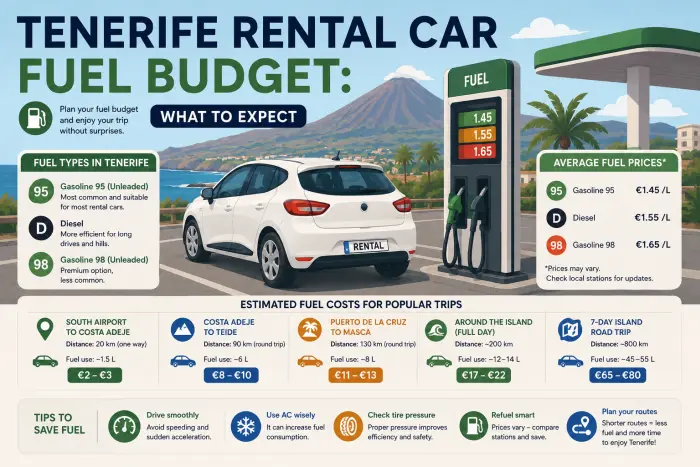
For most visitors, fuel ends up being a genuinely small part of the total cost of a Tenerife rental car trip, often less than the rental itself over a week, since the island is compact, fuel prices sit well below most of mainland Europe, and there are no toll roads anywhere to add to the bill. A typical week of moderate driving, day trips included, usually lands somewhere between €35 and €60 in fuel, depending on the car and how much ground you cover.
By the Numbers
- 💶 Fuel prices in Tenerife currently run roughly €1.10–€1.35 per liter for petrol and slightly less for diesel, among the lowest in Europe.
- 🗺️ The island is small enough that even a fairly ambitious road trip rarely burns through a full tank in a single day.
- 🛣️ There are no toll roads anywhere on Tenerife, so fuel and parking are really the only variable costs once you’ve paid for the rental itself.
- 🏙️ Stations near airports and resort strips tend to charge noticeably more than ones a short drive inland, in towns like La Laguna or Adeje’s town center.
- 🚗 A hybrid or smaller economy car will meaningfully reduce your fuel spend on a trip involving a lot of stop-start resort driving, less so on straight motorway stretches.
What Fuel Actually Costs Right Now
Prices move with the wider market, but Tenerife has consistently stayed among the cheapest places to fill a tank in Europe, generally 30–40% below prices in Germany or the UK. As a rough guide, petrol tends to run somewhere in the €1.10–€1.35 per liter range, with diesel slightly cheaper, often by 5–10 cents. These aren’t fixed numbers, treat them as a planning range rather than a guarantee, but they’re a reasonable starting point for budgeting before you land.
Realistic Budgets by Trip Length
These estimates assume a small-to-medium rental car, moderate use of air conditioning, and a mix of coastal driving with a couple of longer day trips inland, which covers how most visitors actually use a rental car here. They’re deliberately conservative on the higher end and optimistic on the lower end, since actual spend depends heavily on how much you’re driving each day rather than just how long the trip is overall. Someone based in one resort who takes two or three longer excursions will land closer to the lower figure; someone changing accommodation every few days and covering fresh ground constantly will sit nearer the top of each range.
| Trip Length | Typical Driving Pattern | Rough Fuel Budget |
|---|---|---|
| Weekend (2–3 days) | Airport transfer plus one or two local trips | €15–€25 |
| One week | Daily local driving plus 2–3 longer day trips (Teide, north coast, etc.) | €35–€60 |
| Two weeks | Similar pattern, roughly doubled, with a rest day or two included | €70–€110 |
| A single long day trip (e.g. full island loop) | Airport to Teide to the north coast and back | €12–€20 |
These ranges assume a compact or economy car. A larger SUV or automatic will typically sit toward the higher end of each range; a smaller hatchback or a hybrid will often land toward the lower end.
Where Fuel Costs More, and Where It Doesn’t
This is genuinely worth knowing before you fill up for the first time. Stations right at the airport and along the main resort strips in the south tend to charge a noticeable premium over stations just a short drive away. Pulling into a station in a town center, La Laguna, Santa Cruz, or inland Adeje rather than the beachfront strip, routinely saves a few cents per liter, which adds up over a week of refueling.
If you’re returning the car on a full-to-full fuel policy, it’s worth planning your last fill-up at one of these cheaper inland stations rather than the first convenient one near the airport on your way to drop off, since airport-adjacent stations are consistently among the most expensive on the island.
Why the Total Stays Low Even on a Full Road Trip
Two things work in your favor here that don’t apply in a lot of other rental destinations. First, there are no toll roads anywhere on the island, so a full-day loop that would rack up real toll charges elsewhere in Europe costs you nothing extra here beyond the fuel itself. Second, Tenerife is genuinely compact, a full coast-to-coast drive rarely takes more than a couple of hours, so even an ambitious north-to-south road trip burns through less fuel than the distance might suggest on a map, since you’re rarely covering more than 100–150km in a single day even on a packed itinerary.
🚗 Discover Tenerife – Best Car Rental Deals
Compare top-rated suppliers, no hidden fees & free cancellation included.
Does the Car You Choose Actually Change the Math?
More than most people expect, and it’s worth thinking about at the booking stage rather than after you’ve already picked a car. An automatic with a bigger engine will typically use noticeably more fuel over a week than a small manual economy car covering the same routes, particularly if a lot of your driving is the stop-start kind around resort towns. If you’re comparing a few options and fuel cost is a real factor, it’s worth checking which car types tend to run cheapest to hire and to run rather than assuming the lowest daily rental rate automatically means the lowest total cost once fuel is added in.
This is also where an electric rental genuinely changes the equation, since you’re paying for electricity rather than petrol entirely, though that comes with its own planning considerations around charging that are worth weighing against the simplicity of just filling up as you go.
A Few Ways to Keep the Number Down
- Choose a smaller or hybrid car if fuel cost genuinely matters to your budget. The daily rental rate difference is often smaller than the fuel savings add up to over a full week.
- Fill up inland rather than at the airport or beachfront, the price difference is real and consistent, not a one-off.
- Use air conditioning sensibly rather than constantly, it does measurably affect consumption on longer drives, particularly climbing toward Teide.
- Check whether your rental car actually needs premium fuel or takes standard, using a higher grade than required is an unnecessary cost some visitors pay out of habit rather than requirement.
Is Fuel Ever a Reason Not to Rent a Car?
Rarely, in practice. Compared against how expensive Tenerife is overall, fuel is a relatively small line item next to accommodation, food, and activities. Even a generous two-week fuel budget usually costs less than a handful of taxi transfers would, while giving you far more flexibility over where and when you go. If anything, fuel cost tends to be the part of a Tenerife trip budget that comes in under what people initially expect, precisely because the island rewards planning your route sensibly rather than punishing you for driving further than intended.
FAQ
How much fuel does a rental car in Tenerife actually use per day? For typical mixed driving, most economy and compact cars use somewhere between 5–7 liters per 100km, which on a normal day of local exploring works out to a fairly small daily fuel cost.
Is diesel or petrol cheaper to rent in Tenerife? Diesel tends to be slightly cheaper per liter, though the vast majority of rental fleets on the island are petrol, so most visitors won’t actually get a choice between the two.
Do I need to budget for tolls as well as fuel? No, there are no toll roads anywhere on Tenerife or the rest of the Canary Islands, so fuel really is the main ongoing cost once you’ve paid for the rental.
Does driving up to Teide use noticeably more fuel? A little, yes, sustained climbing does increase consumption compared to flat coastal driving, though the distance involved is short enough that the actual extra cost is modest.
Where can I check current fuel prices before my trip? Prices do shift with the wider market, so it’s worth a quick search closer to your travel dates rather than relying on older figures, since the difference between a good and a bad month can be meaningful.
Is it worth prepaying for a full tank of fuel through the rental company? Usually not, prepaid fuel options are typically priced above what you’d pay filling up yourself at a normal station, and only make sense if you’re certain you’ll return the car close to empty.
Will a bigger car or SUV cost much more in fuel than a small one? Yes, noticeably, over a week of driving a larger SUV can easily use 30–50% more fuel than a compact car covering the same routes, worth factoring in if fuel cost is a real consideration for your trip, especially if your itinerary leans heavily on the steeper inland roads rather than flat coastal driving.