Here’s a number that surprises almost every visitor: filling up in Tenerife is among the cheapest in the European Union. The Canary Islands sit under a special tax regime, so that road trip you’re planning costs far less than the same drive in the UK, Germany or France.
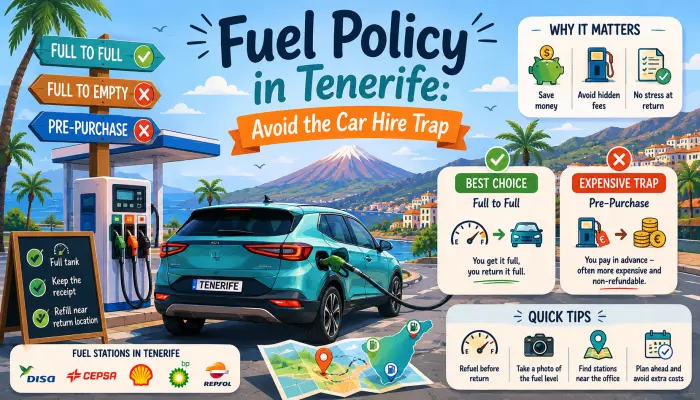
But there’s a catch, and it has nothing to do with the pump. It’s the fuel policy on your rental agreement — the single biggest source of unexpected charges and angry reviews in the car hire world. Pick the wrong one and you can hand back a tank’s worth of petrol for free. This guide covers both sides: how to choose the right fuel policy, and how to fill up cheaply and confidently once you’re on the road — including the bits nobody explains, like paying at an unattended pump at night and protecting yourself at drop-off.
⛽ Quick Answer
Always choose the “Full to Full” fuel policy when hiring a car in Tenerife: you collect the car with a full tank and return it full, paying only for what you use. Avoid “Full to Empty,” where you pre-pay for a full tank and get no refund for what’s left. Fuel itself is cheap on the island — typically around €1.00–€1.30 per litre — so refuelling a small car before drop-off costs roughly €15–€25 and takes five minutes.
📋 The Three Fuel Policies Explained
When you book, the rental company offers one of a few fuel arrangements. They sound similar but cost wildly different amounts. Here’s the plain-English breakdown:
| Fuel Policy | How It Works | Verdict |
|---|---|---|
| ✅ Full to Full | Collect full, return full. You pay only for fuel you actually burn. | Best value — always choose this |
| ❌ Full to Empty | Pre-pay for a full tank up front; no refund for unused fuel. | Worst value — avoid |
| ⚖️ Same to Same | Return the car at the same fuel level you collected it. | Fair, but read the gauge carefully |
The math is brutal. With Full to Empty, you’d need to coast back into the depot on fumes to break even — and nobody risks running dry on a motorway. In practice you almost always gift the company €20–€40 of unused fuel, plus you often pay an inflated “refuelling” rate above the pump price for that first tank.
Here’s what that looks like on a typical one-week economy rental:
| Scenario | What You Pay for Fuel | What You Waste |
|---|---|---|
| ✅ Full to Full, refuelled at drop-off | ~€30 used over the week | €0 |
| ❌ Full to Empty, returned 1/4 full | Full tank (~€55) + service markup | ~€15–€20 of paid fuel left in the tank |
💡 A “cheap” headline price paired with a Full-to-Empty policy is frequently more expensive overall than a slightly higher rate with Full-to-Full. For more on spotting deals that don’t balloon at the counter, see our guide to cheap car hire in Tenerife.
💶 How Much Does Fuel Cost in Tenerife?
This is the happy part. Because the Canary Islands run on a lower-tax system (the local IGIC sales tax is far below mainland Spain’s standard VAT, and fuel duty is lower too), petrol and diesel here are consistently cheaper than mainland Europe.
| Fuel Type | Local Name | Typical Price (per litre) |
|---|---|---|
| ⛽ Unleaded 95 | Gasolina sin plomo 95 | ~€1.00–€1.30 |
| ⛽ Unleaded 98 | Gasolina 98 | ~€1.10–€1.40 |
| 🛢️ Diesel | Gasóleo A / Diésel | ~€1.00–€1.30 |
The cheapest stations on the island can dip close to €1.00 per litre, while motorway and tourist-strip pumps sit at the higher end. To put that in perspective for visitors:
| Where You’re Filling Up | Approx. Price per Litre (95) | Tank of ~45L Costs Roughly |
|---|---|---|
| 🟢 Tenerife (Canary Islands) | ~€1.10 | ~€50 |
| 🟡 Mainland Spain | ~€1.50 | ~€68 |
| 🔴 UK / Germany / France | ~€1.65–€1.80 | ~€75–€81 |
Figures are illustrative and move with global oil, so treat them as a guide — but the bottom line holds: fuel in Tenerife is a genuine bargain, often 25–35% below what northern European visitors pay at home.
⚖️ Petrol vs Diesel for a Holiday — Which Is Cheaper?
Most short holiday hires are petrol, and for good reason: on the modest mileage of a one-week trip, the diesel saving rarely justifies anything. But if you’re planning serious distance — say a full island loop — the numbers shift slightly. Here’s a realistic estimate for a 7-day trip covering ~600 km (a generous amount for Tenerife):
| Car Type | Typical Use (L/100 km) | Fuel for ~600 km | Est. Fuel Cost |
|---|---|---|---|
| 🚗 Economy petrol (Toyota Aygo, VW Up) | ~5.5 | ~33 L | ~€40 |
| 🚙 Small/compact petrol (Polo, Ibiza) | ~6.5 | ~39 L | ~€47 |
| 🛻 SUV petrol (Qashqai, T-Cross) | ~8.5 | ~51 L | ~€61 |
| 🛢️ Compact diesel | ~5.0 | ~30 L | ~€35 |
| 🔋 Hybrid (Yaris, Corolla) | ~4.5 | ~27 L | ~€32 |
The takeaway: across a typical week, the gap between the cheapest and priciest option is roughly €25–€30 — meaningful, but small next to the rental rate itself. Choose the car that fits your trip, not the fuel type. If you’re touring the mountains or carrying a family, a slightly thirstier but more capable car is money well spent — see our SUV & 4×4 hire guide and the automatic car hire guide.
🔌 Electric & Hybrid Hire: Worth It in Tenerife?
Hybrids (especially Toyota’s) are increasingly common in island fleets and are a sweet spot for Tenerife: superb economy in town and on the coastal roads, no range anxiety, and no charging logistics.
Fully electric (EV) hire is growing but needs a little planning:
- ⚡ Charging points cluster around the resort south, Santa Cruz, the airports and major shopping centres; they thin out fast in the mountains and the rural north.
- 🔋 Steep climbs to Teide drain range quickly — though the long descent claws a surprising amount back through regenerative braking.
- 🗺️ For a coast-and-resort holiday, an EV is easy. For a 7-day island road trip deep into the highlands, a hybrid is the lower-stress choice.
💡 If you’ve never driven the island before, read driving in Tenerife first — the roads matter more than the powertrain.
⛽ Which Fuel Does My Rental Car Take?
Putting the wrong fuel in is an expensive mistake, so check before you fill:
| Engine | Fuel to Use | Nozzle Colour | Where It’s Confirmed |
|---|---|---|---|
| ⛽ Petrol | Gasolina sin plomo 95 (or 98) | Green | Sticker inside fuel flap + rental docs |
| 🛢️ Diesel | Gasóleo A / Diésel | Black | Sticker inside fuel flap + rental docs |
Filling a petrol engine with diesel (or vice versa) can wreck the engine — and it won’t be covered by basic protection. Knowing your car hire insurance in Tenerife is worth doing before you ever touch a pump. When in doubt, ask the attendant: “¿Gasolina o gasóleo?”
🏪 Petrol Stations in Tenerife: The Brands & How They Work
Petrol stations (gasolineras) are easy once you know the local rhythm. These are the names you’ll see most often:
| Brand | Type | Good to Know |
|---|---|---|
| DISA | Canarian, everywhere | The big homegrown brand — found island-wide |
| PCAN | Canarian | Local network, competitive prices |
| Cepsa / Repsol | National majors | Reliable, plentiful, often with shops & cafés |
| Shell / BP | International | Common on main routes and motorways |
| Ballenoil / Tgas | Budget / discount | Often the cheapest, frequently unattended |
A few practical points:
- Self-service vs attended: Many stations are autoservicio (self-service). At staffed stations, an attendant may fill up for you — a small tip isn’t expected but is appreciated.
- Extras: Most have an air line for tyres (free or ~€1), a car wash, and a shop for water and snacks before a long drive.
- Opening hours: Big-brand stations on main roads often run 24/7; smaller rural ones close in the evening.
🗺️ Heading into the highlands? Fill up before you go. Stations are scarce around Teide National Park, the Anaga forests and the winding road to Masca. You don’t want to discover an empty tank halfway up a volcano.
💳 How to Actually Pay at the Pump
This trips up first-timers more than anything, especially after dark. There are two systems:
🚗 Discover Tenerife – Best Car Rental Deals
Compare top-rated suppliers, no hidden fees & free cancellation included.
At a staffed, daytime station (the easy case):
- Pull up, note your pump number.
- Fill the tank (or tell the attendant how much you want).
- Walk inside and pay at the till — “Surtidor número [X]” (pump number X). Cards are accepted almost everywhere.
At an unattended or night-time pump (pre-pago):
- Insert your card at the pump first — it pre-authorises a hold (often €50–€150).
- Fill up; you’re only charged for what you actually pump, and the hold is released later.
- The receipt prints at the pump, or inside if there’s a kiosk.
💡 Keep a few euro coins and a backup card. A handful of small rural stations are cash-only, and the occasional pump rejects foreign cards. Don’t let the tank run low in the mountains assuming the next station takes plastic.
🔍 How to Find the Cheapest Fuel in Tenerife
Prices vary noticeably from station to station, so a little planning saves real money:
- Skip the tourist strips and motorway exits — those pumps charge the most.
- Head to industrial estates (polígonos) and supermarket stations — often the cheapest on the island, sometimes near €1.00/L.
- Use a fuel-price app or Spain’s official price site — both show live prices at every nearby station, so you can spot the cheapest pump before you commit.
- Fill up around Santa Cruz, La Laguna and the south — some of the lowest prices cluster there.
⛰️ Real Fuel Use on Tenerife’s Mountain Roads
Tenerife is not flat, and that changes the gauge. The climb from sea level to Teide gains over 2,000 metres, and fuel consumption on the way up can be noticeably higher than the brochure figure — small engines work hard on the gradients. The flip side is the descent: ease off, let the engine brake, and a petrol car sips while a hybrid actively recharges.
Two practical habits:
- 🔋 Start mountain days with a full tank. Even if you “only” used half on the way up, you don’t want to gamble on a sparse network up high.
- 🧯 Use engine braking downhill, not just the foot brake. It saves fuel, saves your brakes from overheating, and is far safer on the long descents from Teide and through Masca. Our best roads to drive guide covers the routes themselves.
✈️ The Golden Rule: Refuel Before You Return — and Protect Yourself
This is where Full-to-Full drivers either save money or throw it away. Always top up to full just before you drop the car back.
- ⛽ Find a station a few minutes from the airport or depot — there’s almost always one nearby.
- 🧾 Keep the receipt, and note the date, time and station — it proves the tank was full at return.
- 📸 Photograph the fuel gauge (showing full) and the dashboard at handover. If a charge appears later, this is your evidence.
- ⏰ Leave a buffer — fill up close to drop-off, not an hour away where you’ll burn through the top of the tank.
If you return short under a Full-to-Full policy, companies charge for the missing fuel plus a refuelling service fee — often well above pump price. A five-minute stop avoids that every time. Worried about deposits and end-of-rental charges generally? Our guides to no-deposit car hire and the smooth pickup at Tenerife South Airport are useful reading.
✅ Fuel Checklist for Your Tenerife Trip
Before you drive off the forecourt, run through this:
- 📋 Confirm your fuel policy is Full to Full at pickup.
- ⛽ Check which fuel your car takes (petrol 95/98 or diesel) — it’s on the fuel flap.
- 💳 Know how you’ll pay — card for most, coins as backup, pre-auth at night pumps.
- 🗺️ Fill up before mountain drives — stations are rare up high.
- 🏪 Choose cheaper stations in polígonos and away from resorts.
- 🧾 Refuel, keep the receipt, photograph the gauge before returning the car.
❓ Frequently Asked Questions About Fuel in Tenerife
Is petrol cheap in Tenerife? Yes. Thanks to the Canary Islands’ lower-tax regime, petrol and diesel are among the cheapest in the EU — typically around €1.00–€1.30 per litre, often 25–35% below the UK and northern Europe.
What is the best fuel policy for car hire in Tenerife? “Full to Full” is the best choice. You collect the car full and return it full, paying only for the fuel you actually use. Avoid “Full to Empty,” which charges you for a whole tank with no refund for what’s left.
What does “Full to Empty” fuel policy mean? You pay for a full tank when you collect the car and get no refund for any fuel remaining at return. To break even you’d have to return it almost empty, so it nearly always costs you money — typically €15–€40 of wasted fuel.
Which fuel does my rental car use in Tenerife? Petrol cars use Gasolina sin plomo 95 (or 98); diesel cars use Gasóleo A / Diésel. The correct fuel is shown on a sticker inside the fuel flap and on your rental documents — check before filling.
How do I pay at a petrol station in Tenerife? At staffed stations you fill up, then pay inside by card or cash, quoting your pump number. At unattended or night pumps you insert your card first (a temporary hold is placed) and are charged only for what you pump. Keep coins and a backup card handy.
Is diesel or petrol cheaper for a holiday in Tenerife? Diesel and hybrids use slightly less fuel, but over a typical week the saving is only €25–€30 versus an economy petrol car. Choose the car that fits your trip rather than chasing the fuel type.
Can I hire an electric car in Tenerife? Yes, EV and hybrid hire is growing. Charging is easy around the south, Santa Cruz and the airports but sparse in the mountains and rural north. For coastal holidays an EV is fine; for deep island road trips a hybrid is less stressful.
Where can I find the cheapest petrol in Tenerife? Stations in industrial estates, near supermarkets and away from tourist strips are usually cheapest — sometimes near €1.00/L. Fuel-price apps and Spain’s official price site show live prices nearby so you can compare.
Do I need to return my rental car with a full tank? Under a Full-to-Full policy, yes — top up just before drop-off, keep the receipt and photograph the full gauge. Returning it short triggers a fuel charge plus a service fee well above pump price.
Are there petrol stations near Teide and the mountain roads? They’re scarce at altitude, so always fill up in the towns before heading up to Teide, Anaga or Masca. Build the refuel into your route and start mountain days with a full tank.
🚗 Plan a Smarter, Cheaper Drive
Cheap fuel is one of Tenerife’s quiet pleasures — but only if you sidestep the Full-to-Empty trap, pay confidently at the pump, and refuel before drop-off. Get those right and the island opens up affordably in every direction.
👉 Compare car hire deals in Tenerife with a Full-to-Full policy and hit the road with confidence. Then map your adventure with our 7-day Tenerife road trip itinerary, the island’s best roads to drive, and our practical guide to parking in Tenerife. Still deciding? Start with do you need a car in Tenerife?
See all the essentials in our Tenerife by Car guide.