Search “Canary Islands tax rate” before your trip and you’ll find a consistent, cheerful headline: 7%, versus 21% VAT on the Spanish mainland. That figure is true for most goods and services — and it is not the rate applied to your car hire. Tenerife, like the rest of the Canary Islands, doesn’t charge Spanish VAT at all. It charges its own tax, IGIC, and car rental sits in a specific, higher bracket than the general rate most price comparisons quote. Knowing the actual number in advance means the final line on your rental invoice won’t be a surprise.
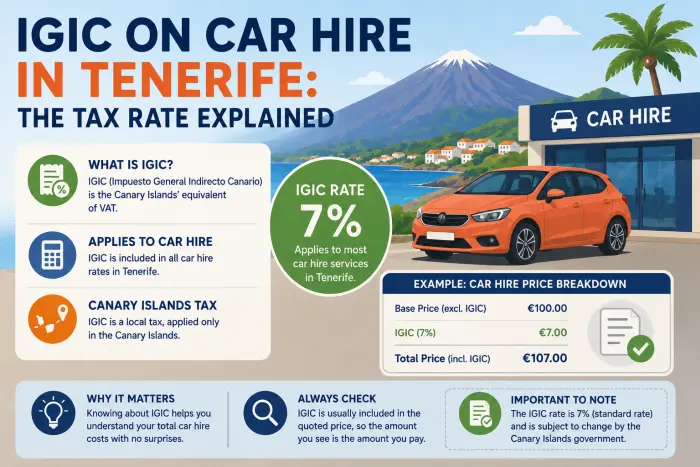
The number that actually applies: the Canary Islands run their own indirect tax system, IGIC (Impuesto General Indirecto Canario), entirely separate from mainland Spain’s VAT. The general IGIC rate is 7%, well below mainland VAT at 21% — but car rental doesn’t fall under the general rate. It’s taxed under IGIC’s special increased bracket, commonly cited at 13.5%, the same bracket that covers jewellery, perfume, and alcoholic drinks. That’s still lower than mainland Spain’s 21% VAT, but it’s roughly double the “7% Canary Islands tax” figure most general travel articles quote, and it’s why a rental price built assuming the lower rate can come in higher than expected once tax is actually applied.
🏝️ IGIC vs VAT: Two Completely Separate Tax Systems
Spain’s mainland and the Balearic Islands use VAT (IVA), the standard EU value-added tax, at a general rate of 21%. The Canary Islands, including Tenerife, don’t use VAT at all — they operate under their own regime, IGIC, established specifically to account for the extra costs of doing business on a remote archipelago. This isn’t a discount tier of the same tax; it’s a genuinely separate system, with its own rate structure, its own exemptions, and its own rules, recognised under EU treaty provisions that allow outermost regions like the Canaries to run a different tax framework from the rest of the country.
📊 IGIC’s Rate Structure
Unlike VAT’s three-tier system, IGIC uses a wider range of brackets:
| IGIC Rate | Applies To |
|---|---|
| 0% | Water, medical devices, books, newspapers, subsidised housing, basic food, air transport |
| 3% | Mining, chemical industry, textiles, timber, ground transport, vehicle repair |
| 7% (general/standard) | Most everyday goods and services not covered elsewhere |
| 13.5% (special increased) | Car rental, alcoholic beverages, tobacco above a price threshold, jewellery, perfumery, leather goods |
The general 7% rate is what almost every “Canary Islands tax” travel article quotes, since it’s genuinely the rate that applies to most day-to-day tourist spending — restaurants, hotels, shopping, most services. Car rental, however, sits specifically in the higher 13.5% bracket, alongside a small cluster of other categories the tax system treats as less essential.
💶 What This Actually Means for Your Rental Price
The practical upshot: a Tenerife rental quote that looks attractive before tax can shift once the applicable 13.5% is added, and it’s worth checking whether the headline price you’re comparing across different booking sites already includes IGIC or not. This is exactly the same category of check covered in our hidden fees guide — tax isn’t a hidden fee in the sinister sense, since it’s a legal requirement rather than a company add-on, but a quoted price that excludes it can look deceptively cheap next to one that includes it, purely because of how the comparison is presented.
| Comparison Point | Mainland Spain (VAT) | Canary Islands (IGIC) |
|---|---|---|
| General/standard rate | 21% | 7% |
| Rate applied to car rental | 21% | 13.5% (special increased bracket) |
| Still cheaper in the Canaries? | — | Yes, but by less than the “7% vs 21%” headline suggests |
Car hire in Tenerife is still genuinely taxed at a lower rate than an equivalent rental on the Spanish mainland — 13.5% is meaningfully below 21%. The point worth understanding is simply that it isn’t the ultra-low 7% figure that gets quoted for general Canary Islands shopping, so budgeting on that assumption specifically for a rental can leave you short.
🧾 Is Tax Included in the Price You See Online?
This varies by platform and by supplier, which is exactly why it’s worth checking rather than assuming either way:
- 🌐 Comparison and broker sites — see our comparison sites vs direct guide — generally display a final, tax-inclusive price at checkout, but always confirm this on the specific offer rather than assuming it’s universal practice.
- 🏢 Direct supplier quotes sometimes show a base rate with tax added at a later step, particularly for business or corporate-facing pricing pages rather than standard tourist checkout flows.
- 📄 Your final rental agreement, signed at the desk, is the document that actually itemises what you’re being charged and at what rate — if you want certainty, that’s the one to check, not the initial online quote.
If a quoted price seems unusually low compared to others for a similar vehicle and dates, it’s worth double-checking whether IGIC is already factored in before assuming you’ve found a genuine bargain.
🚗 Discover Tenerife – Best Car Rental Deals
Compare top-rated suppliers, no hidden fees & free cancellation included.
🌍 Why the Canary Islands Have Their Own Tax System at All
This isn’t an arbitrary quirk — it’s a long-standing recognition, going back centuries and reaffirmed under modern EU treaty law, that the Canary Islands’ remoteness and insularity justify a different tax and economic framework from mainland Spain. The lower general rate helps offset the genuinely higher cost of importing goods to an island archipelago, and it applies across a huge range of everyday spending — which is exactly why the 7% figure is so widely quoted as “the” Canary Islands tax rate, even though a specific category like car rental sits in a different bracket entirely.
✅ Checklist for Budgeting Around IGIC
- 🧾 Assume 13.5%, not 7%, when estimating tax on your Tenerife car rental specifically.
- 🔍 Check whether a quoted price is tax-inclusive before comparing it against other offers.
- 📄 Read your final rental agreement for the itemised breakdown if you want certainty on what’s actually been charged.
- 💶 Still expect a lower overall tax burden than mainland Spain, just not as dramatically lower as the general 7% figure implies.
- 💳 Pay attention to currency too — if you’re comparing prices across currencies, keep our DCC guide in mind so a currency conversion markup doesn’t stack on top of tax confusion.
- 🏢 Compare a few rental companies on their final, tax-inclusive price rather than a headline base rate.
❓ Frequently Asked Questions
Does Tenerife charge VAT on car hire? No. The Canary Islands, including Tenerife, don’t use Spain’s mainland VAT system at all. They apply their own tax, IGIC, which has an entirely different rate structure.
What is the IGIC rate on car rental in Tenerife? Car rental falls under IGIC’s special increased rate, commonly cited at 13.5%, rather than the general 7% rate most Canary Islands shopping is taxed at.
Is car hire still cheaper in Tenerife than mainland Spain because of lower tax? Yes, generally. 13.5% IGIC is still meaningfully lower than mainland Spain’s 21% VAT, even though it’s a higher bracket than the general 7% Canary Islands rate most travel articles quote.
Why do so many travel articles say the Canary Islands tax rate is just 7%? Because 7% is genuinely the general/standard IGIC rate that applies to most everyday tourist spending — restaurants, hotels, most retail. Car rental specifically falls into a separate, higher bracket alongside categories like alcohol and jewellery.
Is the tax already included in the price shown when I compare car hire deals online? It varies by platform and supplier. Most reputable comparison sites display a final, tax-inclusive price at checkout, but it’s worth confirming this on your specific offer rather than assuming.
Why does the Canary Islands have a different tax system from the rest of Spain? It’s a long-standing arrangement, recognised under EU treaty provisions for outermost regions, designed to offset the higher costs faced by a remote island economy. It applies to a wide range of goods and services, not just car rental.
Does IGIC apply to fuel as well as the rental itself? Fuel and car rental fall into different parts of the IGIC rate structure, so it’s worth treating them as separate line items on your final costs rather than assuming the same rate applies to both.
Should I factor IGIC into my budget before booking? Yes — assuming 13.5% for the rental itself, rather than the lower general 7% figure often quoted for the Canary Islands generally, gives a more accurate picture of your likely final cost.
🏁 Final Verdict: Lower Than the Mainland, Higher Than the Headline
Car hire tax in Tenerife is a genuine example of a good deal buried under a slightly misleading headline number. The 7% figure that gets attached to “Canary Islands tax” everywhere online is real, and it’s simply not the rate that applies to your rental — 13.5% is. Still cheaper than the mainland’s 21% VAT, just not by quite as much as the popular comparison suggests.
👉 Compare car hire deals in Tenerife with a clear, tax-inclusive final price. This guide is part of our full Tenerife car hire guide — for the rest of the pricing picture, see our cheap car hire Tenerife guide.