The payment terminal at a Tenerife rental desk shows you an amount in pounds, dollars, or Swedish kronor. It says something like “pay in your home currency for convenience” or offers you a “guaranteed exchange rate.” It feels helpful. It costs you money. This is Dynamic Currency Conversion, known as DCC, and at Spanish airport car hire desks in particular, it’s one of the most consistent, low-drama ways for a few percent of your total rental cost to disappear before you even reach the car park.
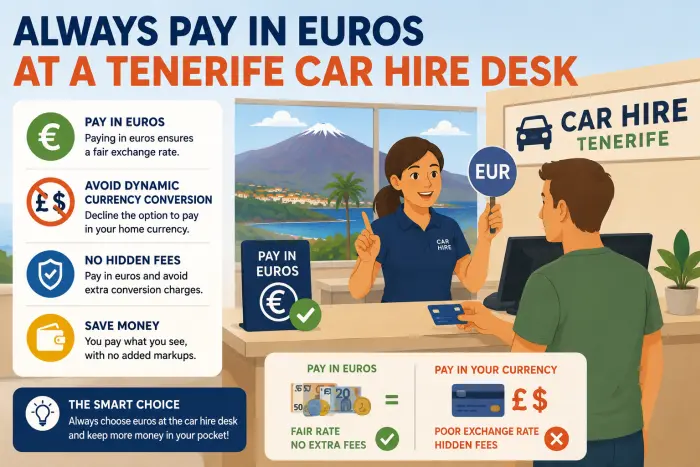
One rule, applied every single time: when a payment terminal offers you a choice of currency, always select euros. Always. Whether it’s the deposit, the rental charge, the fuel option, or the damage waiver added at the desk — every transaction at a Spanish rental counter should be settled in euros, and your own card or bank handles any conversion from there. A “guaranteed exchange rate” from a DCC processor typically builds in a 3-6% markup over the rate your card would apply, which on a deposit hold or a few hundred euros of rental charges adds up to a meaningful amount. The Spanish phrase to use if you need it: “Cobren en euros. No acepto conversion dinamica.” (Charge in euros. I don’t accept dynamic conversion.)
What DCC Actually Is
Dynamic Currency Conversion is a service offered by payment processors at the point of sale. When a card terminal detects a non-euro card, it offers to convert the transaction into your home currency right there, rather than letting your card issuer handle the conversion on its end. The terminal shows you a familiar number in your home currency, along with reassuring language like “guaranteed rate” or “no hidden fees.”
What that language doesn’t say: the exchange rate being applied is set by the DCC processor, not by your bank or Visa/Mastercard, and it typically includes a markup of somewhere between 3% and 6%, plus in some cases an additional service fee on top. Your card’s own exchange rate, usually the Visa or Mastercard interbank rate with a small network fee, is almost always better.
What the Terminal Looks Like
Knowing what to watch for makes refusing DCC a two-second habit rather than a stressful negotiation:
| What You See on Screen | What It Means | What to Do |
|---|---|---|
| “Pay in EUR” | Local currency – correct option | Select this |
| “Pay in GBP / USD / SEK / AUD” | DCC – costs more | Decline |
| “Guaranteed exchange rate” | A DCC rate, not your bank’s rate | Decline |
| “Pay in your home currency” | DCC phrased helpfully | Decline |
| “Charge in cardholder preferred currency” | DCC by a longer name | Decline |
When EUR appears as an option alongside your home currency, select EUR every time. When the screen only shows your home currency and doesn’t offer EUR, ask the desk agent to void the transaction and reprocess it selecting the local currency option. They can do this, even if they sometimes suggest they can’t.
Where DCC Appears at the Car Hire Desk
DCC doesn’t only happen once. It can reappear at multiple points during a single car hire transaction:
| Transaction Point | When DCC Can Appear |
|---|---|
| Deposit pre-authorisation | At collection, when the deposit hold is placed on your card |
| Rental charge | When you pay or confirm the rental cost itself |
| Insurance/waiver upsell | When extra cover is added at the desk |
| Fuel option | If you buy a prepaid fuel option at the counter |
| Return settlement | When any remaining balance or extra is charged at drop-off |
Each of these is a separate terminal prompt, and DCC can appear on any or all of them. The habit to build is a consistent one: read the currency on the screen before you tap, insert, or sign, every single time, regardless of how many transactions you have already done correctly at the same counter.
What to Say at the Desk
A few phrases that resolve this without any awkwardness:
- In Spanish: “Cobren en euros. No acepto conversion dinamica.” The most direct option, understood immediately by any Spanish rental desk agent.
- In English: “Please charge in euros only. I’ll let my bank handle the conversion.” Clean and unambiguous.
- If the wrong currency has already been selected: “Could you void that and reprocess it in euros?”
Most agents will comply without any issue. If you’re told the terminal “only allows” your home currency, ask them to try again. This is almost never actually true, and is either a misunderstanding of the terminal settings or a response to a genuinely misconfigured system that can be overridden at the desk.
Check the Receipt Before You Leave
Before walking away with the keys, take ten seconds to read the currency on the receipt:
- Correct: the amount is shown in EUR with no secondary currency line, no “conversion rate” section, and no “DCC” or “dynamic conversion” wording.
- DCC applied: the receipt shows an amount in your home currency, includes an exchange rate figure, or mentions “DCC”, “dynamic currency conversion”, or “cardholder currency”.
If the receipt shows DCC was applied and you’re still at the counter, ask for the transaction to be voided and reprocessed in euros while you’re still there. Once you’ve left the desk, reversing it becomes a lengthier process involving your card issuer — possible, but considerably more effort than catching it at the desk.
🚗 Discover Tenerife – Best Car Rental Deals
Compare top-rated suppliers, no hidden fees & free cancellation included.
Why “Guaranteed Exchange Rate” Is a Warning Sign, Not a Benefit
The word “guaranteed” in DCC language sounds reassuring but means something specific and unfavourable: the rate being applied is guaranteed at the DCC processor’s rate for that specific transaction, which is typically worse than the rate your card would apply. Your card issuer’s rate is, for almost all non-specialist consumer cards, a better starting point than a DCC-converted rate plus any markup the processor adds. A “guaranteed” rate simply means a guaranteed markup, not a guaranteed saving.
Photograph the Terminal Screen
One practical habit from experienced travellers dealing with Spanish rental desks specifically: photograph the terminal screen at the moment the hold or charge is processed, while it still shows the transaction currency. If a charge appears later, sending that photo and one short message in clear Spanish can resolve most disputes quickly. It is a more useful piece of evidence than a receipt alone, since it shows the specific choice made at the terminal rather than just the outcome.
Does DCC Apply to Debit Cards Too?
Yes. DCC appears for any non-euro card, debit or credit, and the same avoidance rule applies regardless. The reason a debit card adds an extra layer of consideration is that DCC on a debit deposit hold can lock real funds in your account at a worse rate than necessary, on top of the delay already covered in our deposit refund time guide. If you are choosing between a debit or credit card specifically, our best debit card for car hire guide covers the broader comparison.
DCC Avoidance Checklist
- Select “Pay in EUR” every time a terminal offers a currency choice, for every transaction at the desk.
- Read the screen before tapping, not after — DCC acceptance happens at the confirmation step.
- Check the receipt before leaving the desk: should show EUR, no conversion rate, no DCC wording.
- Use the Spanish phrase if needed: “Cobren en euros. No acepto conversion dinamica.”
- Photograph the terminal screen at each transaction as a record of the currency chosen.
- Ask for a void and reprocess if you catch DCC on the receipt while still at the counter.
- Treat this alongside the other hidden fees worth knowing before your trip — DCC is one of the more avoidable ones once you know to look for it.
Frequently Asked Questions
What is dynamic currency conversion at a car hire desk? It’s when the payment terminal offers to convert the transaction into your home currency rather than euros, at an exchange rate set by the DCC processor rather than your bank. It typically costs 3-6% more than letting your card handle the conversion.
Should I always pay in euros at a Tenerife car hire desk? Yes, regardless of your home currency or card type. Selecting euros means your own card’s exchange rate applies, which is almost always better than the DCC rate on offer.
What does “guaranteed exchange rate” mean at a rental desk? It means the DCC processor is locking in their own rate for that transaction, not your card’s rate, and not necessarily a favourable one. The word “guaranteed” refers to the processor’s rate, not a saving for you.
Can DCC appear more than once during a single car hire? Yes. It can appear separately on the deposit, the rental charge, insurance upsells, fuel options, and any return settlement. Each terminal prompt should be declined individually.
What should I say if the desk agent tells me they can only charge in my home currency? Ask them to try again or to change the terminal settings. A genuine technical limitation where the local currency option simply doesn’t exist is very rare.
What if I only notice DCC on my receipt after walking away? If you catch it immediately, ask the desk to void and reprocess in euros. Once you’ve left, the next step is contacting your card issuer to raise a dispute, providing the receipt as evidence.
Is DCC illegal? No. DCC is legal and is technically offered as a consumer choice. The issue is that the choice is often presented in a way that makes the costlier option look more appealing, and the rate applied is almost always worse than the card issuer’s rate.
Does this apply when I pay at the fuel station too? Yes. Fuel stations in Spain can present DCC at the pump or at the till. The same rule applies: select “otra divisa” (other currency) or explicitly choose euros when given the option.
Final Verdict: Two Seconds, Three to Six Percent
Dynamic currency conversion at a Tenerife rental desk is technically a choice you make, presented in a way designed to make the wrong option look helpful. Once you know what to look for, avoiding it takes about two seconds at the terminal. The phrase, the button, and the receipt check are all you need.
This guide is part of our full Tenerife car hire guide. For the rest of the at-desk small print worth knowing before you travel, see our collection checklist and no-deposit car hire guides, compare providers in our best car hire companies in Tenerife guide, and search deals at rentcarstenerife.com.