Most car hire disputes in Tenerife aren’t decided by who’s telling the truth. They’re decided by who has evidence. The inspection you do at the rental desk — before you’ve even pulled out of the parking bay — is the single biggest factor in whether a disagreement about a scratch, a dent, or a fuel level three weeks later resolves in five minutes or drags on for weeks. It takes about five minutes to do properly. Most people skip it because they’re tired from a flight, excited to start their holiday, or simply don’t realise how much it matters until they need it.
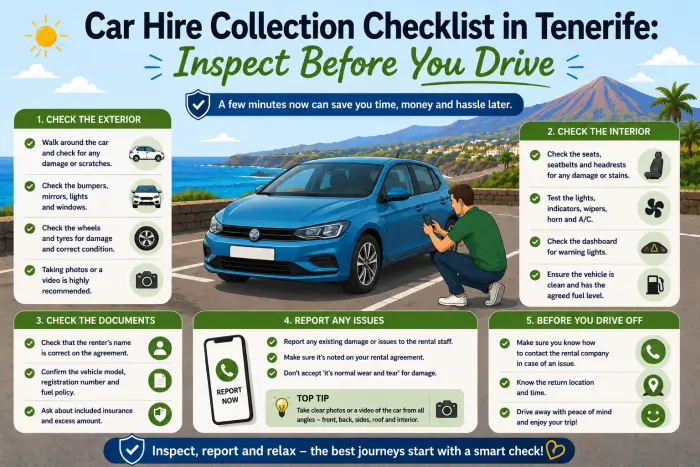
Quick verdict: before you drive away, walk the full perimeter of the car with your phone recording video, capture every panel, wheel, the windscreen, the roof, and the interior, and note the exact fuel level and odometer reading. Get any existing damage written onto the paper contract or confirmed in the company’s check-in app — a verbal “don’t worry about that one” from the desk staff means nothing once you’re comparing notes at return. This single habit is what makes an excess insurance claim, a deposit release, or a fuel dispute straightforward instead of stressful.
🔑 Why This Five-Minute Habit Matters More Than the Contract
The contract you sign tells you the rules. The inspection tells you the starting condition of the car those rules apply to. Without it, you’re relying entirely on memory and goodwill weeks later, often from a different country, trying to recall whether that scuff on the rear bumper was there at pick-up. With it, you have timestamped proof. This isn’t about assuming bad faith from any particular company — it’s simply that nobody, including the rental staff, accurately remembers a vehicle’s exact condition after it’s been driven for a week. A photo does.
This habit also pairs directly with bigger financial decisions you’ve likely already made. If you’ve weighed up excess insurance or are relying on credit card cover, the inspection is what actually lets that cover work in your favour — insurance only resolves who pays, but the inspection is what establishes what actually happened.
📋 The Collection Checklist, Step by Step
- 🚗 Walk the full exterior before signing anything, ideally with a staff member present, not just before driving off afterwards.
- 🎥 Record a continuous video, narrating the date as you go, rather than relying only on still photos.
- 🛞 Check all four wheels and tyres, including the inner sidewalls, which are commonly missed.
- 🪟 Check the windscreen and roof for chips or dents — both are easy to overlook from a standing position.
- 🪑 Photograph the interior: seats, dashboard, boot, and any existing stains or tears.
- ⛽ Note the fuel gauge reading and 🔢 the exact odometer figure before you leave.
- 🧾 Cross-check any existing damage against the paperwork — if it’s not listed and you can see it, ask for it to be added before you sign.
- 📱 Save your photos/video somewhere backed up, not only on the device you’ll be using for the rest of the trip.
- 🔑 Test the basics — indicators, lights, wipers, and aircon — for two minutes in the car park rather than discovering an issue once you’re on the road.
📸 What to Photograph and Why
| Area | What to Capture | Why It Matters |
|---|---|---|
| 🚙 All four sides + corners | Wide shots showing each full panel | Establishes overall pre-existing condition |
| 🛞 Wheels and tyres | Close-ups including sidewalls | Kerb scuffs here are commonly disputed later |
| 🪟 Windscreen and roof | Any chips, cracks, or dents | Easy to miss in a quick walkaround |
| 🪑 Interior and boot | Seats, dash, boot liner | Covers stains, tears, and missing equipment |
| 🔢 Odometer | Clear, readable shot of the exact figure | Your reference point for any mileage question |
| ⛽ Fuel gauge | Clear shot of the needle/digital reading | Matches against the fuel policy on your contract |
| 📄 The signed agreement itself | A photo of the full document, both sides | Your proof of exactly what was agreed |
⛽ Fuel and Mileage: The Two Numbers Worth Recording Immediately
These two figures cause more post-rental disputes than almost anything else, simply because they’re easy to forget to check at the start:
| Number | Why It’s Disputed | How to Avoid It |
|---|---|---|
| ⛽ Fuel level at collection | Some companies use “full-to-full,” others “same-to-same” or a pre-paid tank — mismatches cause confusion | Photograph the gauge and confirm verbally which fuel policy applies to your contract |
| 🔢 Odometer at collection | Needed if your contract has any mileage condition at all | Photograph it even if you believe your rate includes unlimited mileage — it costs nothing to be sure |
If either figure looks off from what’s printed on your paperwork, raise it at the desk immediately rather than after you’ve already driven away — it’s a much easier conversation in the first five minutes than in the last five.
🧾 Getting Existing Damage Officially Noted
Different companies handle this differently, and it’s worth knowing which kind you’re dealing with:
- 📝 Paper diagram check-in: staff mark existing damage on a printed car diagram. Make sure every mark you can see is actually marked, and take a photo of the completed diagram before you leave.
- 📱 App-based digital check-in: some companies, especially those reviewed in our best car hire companies in Tenerife guide, use an app where you photograph the car yourself at collection, timestamped automatically. If offered, use it in addition to your own photos, not instead of them.
- 🗣️ Verbal-only acknowledgement: if staff simply tell you “that one’s already noted” without writing or photographing it, politely ask for it in writing anyway. It takes thirty seconds and removes any ambiguity later.
🚦 Staying Relaxed at the Collection Desk
The desk is also where add-ons are offered, and it helps to know in advance what you actually need versus what you can confidently decline:
- 🛡️ If you’ve already arranged cover via excess insurance, a credit card, or your base rental insurance, you can decline a duplicate offer at the desk without worry.
- 💳 Know which card you’re paying with and what it means for any deposit hold — see our debit card car hire Tenerife guide if you’re unsure.
- 🧾 If a fee is mentioned that you don’t recognise, ask what it covers before agreeing — our hidden fees guide lists the most common ones so you can spot them in advance.
None of this requires confrontation. Knowing your own paperwork in advance is usually enough to keep the conversation short and friendly.
🕐 Picking Up at Night, Early Morning, or in a Rush
Late flights and tight transfer windows make a thorough inspection feel harder, but it matters just as much — arguably more, since poor lighting hides damage that’s obvious in daylight:
🚗 Discover Tenerife – Best Car Rental Deals
Compare top-rated suppliers, no hidden fees & free cancellation included.
- 💡 Use your phone’s flashlight to check panels properly if the car park lighting is dim.
- 🛫 If you’re collecting at Tenerife South Airport or Tenerife North Airport, build a few extra minutes into your plan specifically for the walkaround, rather than treating it as something to rush through.
- 🚐 If your pick-up point doesn’t use a shuttle (see our car hire without a shuttle guide), you’ll likely have a short walk before you even reach the car — use that time to mentally reset rather than arriving flustered and skipping the check.
🔄 The Same Process Applies at Return
The inspection isn’t a one-way habit. At drop-off:
- 📸 Photograph the car again, in the same order, before you hand over the keys.
- ⛽ Photograph the fuel gauge and odometer, exactly as you did at collection.
- 🧾 Ask for written confirmation that the return was accepted with no new damage noted, if that’s offered.
- 🕓 Allow a few extra minutes, especially if you’re catching a flight straight after — a rushed return is when new disputes tend to start.
If anything ever does go wrong mechanically during the rental itself rather than at drop-off, that’s a different process — covered in our hire car breakdown guide.
✅ Quick Pre-Departure Recap
- 🎥 Full video walkaround, all four sides, wheels, roof, interior.
- 🔢 Odometer photographed.
- ⛽ Fuel gauge photographed.
- 🧾 Existing damage confirmed in writing or in-app, not just verbally.
- 📄 Photo of the signed agreement itself.
- 💡 Extra care if collecting in low light.
- 🔁 Repeat the same process, briefly, at return.
❓ Frequently Asked Questions
Do I really need to inspect a hire car if the company already checks it? Yes. The company’s own check protects their records; your own photos and video protect yours. Both can be accurate and still disagree later about details like a small scuff or the exact fuel level — your own evidence is what resolves that quickly in your favour.
What’s the best way to document a hire car at collection? A single continuous video, narrated with the date, covering all four sides, the wheels, roof, interior, odometer, and fuel gauge, is more useful than a handful of still photos, since it shows the full condition in context rather than isolated angles.
What if I notice damage that isn’t marked on the contract? Point it out to staff immediately and ask for it to be added to the paper diagram or digital check-in before you sign or drive away. It’s a much simpler conversation at collection than trying to prove it wasn’t your fault at return.
Does the inspection matter if I’ve already bought excess insurance? Yes, just as much. Excess insurance determines how much you might have to pay if something is genuinely your responsibility — the inspection is what determines whether a dispute exists about responsibility in the first place.
Should I inspect the car again when I return it? Yes — photograph the car, the fuel gauge, and the odometer at return as well, ideally just before handing over the keys. This protects you in exactly the same way the collection inspection does, just at the other end of the rental.
What if the rental desk staff seem to rush me through the inspection? Politely ask for a few extra minutes — most staff are used to this request and it’s a completely normal part of collection. It’s reasonable to want to check the car properly before signing, regardless of how busy the desk is.
Is a verbal note about existing damage enough? It’s better than nothing, but not as reliable as a written note, a marked diagram, or an app-based photo. If staff verbally acknowledge a mark, ask for it to also be recorded in whichever system they use before you leave.
Does this matter for short rentals too, like a single day? Yes — the length of the rental doesn’t change how disputes get resolved. A one-day rental with no inspection photos is just as hard to argue about as a longer one; the five-minute habit is worth it regardless of how long you’re keeping the car.
🏁 Final Verdict: Five Minutes That Protect Your Whole Trip
The collection inspection is the cheapest insurance you’ll ever take out — it costs nothing but a few minutes, and it’s the difference between a damage or fuel dispute being resolved instantly and it becoming a drawn-out argument from another country. Make it a habit every single time, regardless of how tired you are or how short the rental is.
👉 Compare car hire deals in Tenerife from companies with clear, fair check-in processes. This guide is part of our full Tenerife car hire guide — for the booking side of things, see our no-deposit car hire and free cancellation guides.