Our guide to driving licence rules for digital nomad visa holders covers the six-month deadline and which nationalities get a straightforward exchange. This one picks up where that leaves off — for the nationalities that don’t get an exchange agreement at all, and instead face Spain’s full driving test from scratch. If your licence was issued in the US, Canada, Australia, New Zealand, or South Africa, this is the process that actually applies to you once your six months of residency are up, and it’s worth understanding well before that deadline arrives rather than after.
Two Exams, Not One
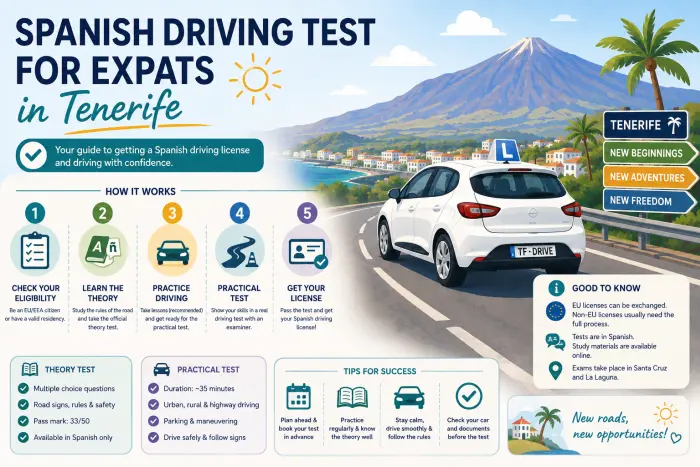
Spain’s Category B licence (standard car) requires passing both a theory exam and a practical driving test — there’s no route that skips either one, regardless of how many years you’ve been driving at home. The theory exam comes first, and you generally need to pass it before booking the practical.
| Exam | Format | Pass Mark | Language |
|---|---|---|---|
| Theory (teórico) | 30 multiple-choice questions, 30 minutes | No more than 3 errors (90%) | Available in English, French, German, and regional Spanish languages |
| Practical (práctico) | On-road driving assessment with a DGT examiner | Pass/fail on driving competence | Conducted in Spanish |
The theory test has genuinely been made accessible to English speakers — the DGT introduced an official English-language version of the exam in 2024, translated by the DGT itself rather than a third party, and it remains available. The practical exam is a different story: it’s conducted in Spanish, and while the examiner is assessing driving ability rather than your fluency, you’ll need enough Spanish to understand basic instructions during the test itself.
The Medical Certificate You’ll Need First
Before you can book the theory exam, you need a certificate of psychophysical fitness (psicotécnico) from an authorised medical centre (Centro de Reconocimiento de Conductores) — a straightforward check of eyesight, reflexes, and coordination, typically costing €25–€55. This step is easy to underestimate on a timeline, since it has to happen before the theory booking rather than in parallel with it.
Autoescuela or Independent Candidate?
Most people assume an official driving school (autoescuela) is legally required, and most people do end up using one — but it isn’t actually mandatory. The DGT itself allows candidates to present as an independent candidate (“por libre”) for both exams, without enrolling in a school. In practice, though, an autoescuela handles the DGT paperwork, appointment booking, and scheduling logistics that are genuinely fiddly to navigate solo in a second language, which is why the vast majority of expats go that route despite the extra cost.
| Route | What You Get | Rough Cost |
|---|---|---|
| Autoescuela | Paperwork handled, structured lessons, exam booking support | €700–€1,400 total |
| Independent (por libre) | Lower cost, but you manage all DGT registration and scheduling yourself | Closer to €200–€300 in fees alone, though realistically higher once lessons are added |
For most expats without strong Spanish and without prior experience navigating Spanish bureaucracy, the autoescuela route is worth the premium simply for the reduced friction — but it’s genuinely optional, not a legal requirement, if you’re comfortable handling the DGT process yourself.
What the Whole Process Actually Costs and Takes
Budgeting realistically matters here, because the “six months” you have before your foreign licence expires for driving purposes doesn’t leave much room for a slow start. Total cost through an autoescuela typically runs €700–€1,400, covering enrolment, theory materials, the medical certificate, practical lessons, and the DGT exam fees themselves (currently in the region of €94 for the theory tasa and a further fee for the practical). Timeline-wise, most people going through this process with consistent effort complete it in two to three months — but that assumes passing both exams on the first or second attempt. Failing the theory exam once means paying the retake fee and waiting for the next available slot; failing the practical means additional lessons are often required before a school will rebook you.
Getting Around While You’re Going Through the Process
There’s a practical question underneath all of this: how do you actually get around Tenerife while you’re working through exams, retakes, and DGT appointments? For the portion of your six months where your original licence and IDP are still valid, renting is exactly as straightforward as it is for any tourist — our driving licence requirements guide covers what a rental desk actually checks. The complication arrives only once that window closes without a Spanish licence in hand, at which point driving — rented car or otherwise — genuinely isn’t an option until you pass. Planning your test timeline with real margin before that cutoff isn’t just about avoiding a fine; it’s about not losing the ability to drive at all for however long it takes to reschedule and retake whatever component you failed.
The Gap Risk Worth Planning Around
This is the detail that catches people out. If your six-month IDP-and-original-licence window closes before you’ve actually passed both exams — because you started late, failed a component, or hit scheduling delays at a busy provincial office — you’re left without a valid licence for driving in Spain until you pass. That’s not a small inconvenience if you’re relying on a car, rented or owned, for daily life on the island. Our long-term car hire guide is worth reading with this specifically in mind: renting rather than owning during this window at least keeps your other logistics (insurance, registration) simpler while you sort the licence itself, even though neither renting nor owning solves the core problem of needing a valid licence to drive at all.
🚗 Discover Tenerife – Best Car Rental Deals
Compare top-rated suppliers, no hidden fees & free cancellation included.
The practical takeaway: start the medical certificate and theory booking within the first month or two of your residency clock starting, not the fourth or fifth month, and treat the six-month mark as a hard deadline rather than a rough guide.
Frequently Asked Questions
Do I have to use an autoescuela to take the Spanish driving test?
No — the DGT permits independent candidates for both the theory and practical exams. Most expats use an autoescuela anyway because it handles the paperwork and scheduling, but it isn’t a legal requirement.
Is the Spanish driving theory test available in English?
Yes. The DGT introduced an official English-language version of the theory exam in 2024, translated directly by the DGT, and it remains available at most testing centres — worth confirming availability at your specific provincial office before booking.
Is the practical driving test also available in English?
No — the practical exam is conducted in Spanish. The examiner is assessing driving competence rather than language ability, but you’ll need enough Spanish to follow basic instructions during the test.
How much does it cost to get a Spanish driving licence from scratch?
Through an autoescuela, typically €700–€1,400 total, covering enrolment, materials, the medical certificate, lessons, and DGT exam fees. Going independently reduces the direct fees but shifts the administrative burden onto you.
How long does the whole process take?
With consistent effort and no failed attempts, roughly two to three months is typical. Delays from a failed exam, provincial office scheduling, or a slow start can push this well past that, which is why starting early in your six-month residency window matters.
What happens if I don’t finish the process before my six months are up?
You’re left without a valid licence for driving in Spain until you pass both exams — your original foreign licence and any interim IDP no longer cover you at that point, regardless of how close you are to finishing.
Which nationalities actually need to take the full test rather than exchange their licence?
Licences from the US, Canada, Australia, New Zealand, and South Africa currently have no reciprocal exchange agreement with Spain, meaning residents from these countries need to complete the full theory and practical process. Always confirm your specific country’s status directly with the DGT, since this list can change.
Can I use my existing driving experience to skip any part of the process?
No. Years of driving experience at home don’t reduce or waive any part of the Spanish process — everyone taking the full-test route sits the same theory and practical exams regardless of how long they’ve held a foreign licence. The only thing prior experience genuinely helps with is passing the practical exam itself, since the underlying driving skill transfers even though the bureaucratic requirement doesn’t.
Start This Earlier Than Feels Necessary
The Spanish driving test isn’t a formality you can leave until month five of your residency — between the medical certificate, theory booking, and the real possibility of needing a retake on either exam, the timeline is tighter than it looks from the outside. Treat the process as something to begin in your first few weeks in Tenerife, and the six-month deadline stops being a source of stress and becomes just another item you’ve already handled.