Somewhere between “tourist renting a car for two weeks” and “local with a Spanish licence and their own vehicle” sits a growing group of visitors who don’t quite fit either category: people on Spain’s digital nomad visa, settling into Tenerife for six months, a year, or longer. The car hire questions this group actually faces are different from a standard holiday rental — and one specific rule catches people out more than any other, because it has nothing to do with car hire terms at all and everything to do with residency status.
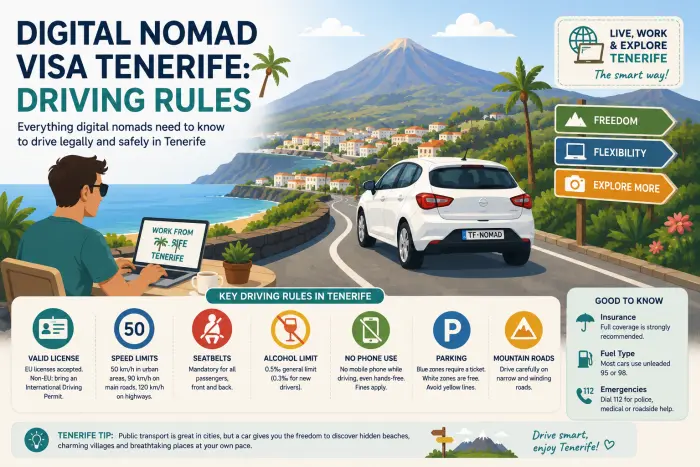
The Rule That Changes Everything: You’re Not a Tourist Anymore
A standard tourist can drive in Spain on a foreign licence for as long as their visit lasts, provided the usual IDP rules for their nationality are met. That changes the moment you register as a resident — which a digital nomad visa requires you to do, typically through empadronamiento (municipal registration) or when your TIE residency card is issued. From that date, Spanish law gives you six months to exchange your foreign driving licence for a Spanish one. After that window closes, your original licence is no longer valid for driving in Spain, full stop — not for a rental car, not for a car you own, regardless of visa type or how long you’ve held that licence at home.
This isn’t a car hire company policy that varies by brand or that you can negotiate around — it’s Spanish traffic law (the Reglamento General de Conductores), and driving on an expired-for-Spain licence past the six-month mark is a genuine offence, carrying fines and, critically, the risk that your insurance won’t cover an incident that happens while you’re driving without a valid licence.
What the Exchange Process Actually Involves, by Nationality
This is the detail that varies most, and it’s worth knowing before your six-month clock starts running rather than three months in.
| Licence Origin | What Applies |
|---|---|
| EU/EEA countries | No exchange needed — EU licences remain valid for residents under freedom-of-movement rules |
| UK | A bilateral agreement allows a direct exchange — no driving test required |
| US | No bilateral agreement with any state — requires an International Driving Permit for the first six months, then a full Spanish driving test to obtain a Spanish licence |
| Other non-EU countries | Varies significantly — some have direct-exchange agreements with Spain, others require the full test route |
If it doesn’t, you’re looking at the IDP-then-test route, which takes considerably longer and is worth starting well before your six-month window closes — our Spanish driving test guide for expats covers exactly what that process involves, including realistic costs and timelines. The DGT (Spain’s traffic authority) publishes the current list of countries with exchange agreements, and it’s worth checking directly rather than relying on secondhand advice, since this list does change.
So Should You Rent, or Should You Buy?
For a standard two-week holiday, this question doesn’t come up. For a digital nomad visa stay of six months to a year, it genuinely does, and the honest answer depends on how long you’re actually staying and where your licence situation stands — our buy vs rent guide for residents runs the full numbers, including registration costs and the Canary Islands’ own tax advantage on new cars. If Santa Cruz is your base, ownership also unlocks something renting can’t — a resident parking permit at preferential rates, tied to the same empadronamiento that starts your licence exchange clock.
Renting long-term makes more sense when:
- Your stay is closer to the 6–12 month range and you’re not certain you’ll extend
- You’re still within your licence’s valid window and haven’t exchanged yet
- You want to avoid Spanish vehicle registration, insurance setup, and eventual resale hassle
- Flexibility matters more than cost — you might relocate to another island or leave Spain entirely
Buying starts to make more financial sense when:
- You’re committing to a year or more, likely renewing your visa
- You’ve already exchanged your licence and are settled with an NIE and Spanish bank account
- You want a car you can modify, keep gear in permanently, or that suits digital nomad life beyond just driving (a proper home base rather than a rotating rental)
Our long-term car hire guide covers the practical mechanics of monthly rental rates and what changes at that length of booking, though it’s worth reading with the residency distinction in mind — those terms are generally written for extended-stay tourists rather than visa-holding residents, and the insurance and paperwork side works differently once you’re actually resident.
🚗 Discover Tenerife – Best Car Rental Deals
Compare top-rated suppliers, no hidden fees & free cancellation included.
Insurance: What Changes Once You’re a Resident
A rental car’s insurance, whether zero-excess or standard, is built around the assumption that the named driver holds a currently valid licence for driving in Spain. Our car hire insurance guide covers how that cover works generally, but the resident-specific risk is this: if your six-month exchange window has closed and you’re still driving on your original foreign licence, you’re not just risking a fine — you’re risking that any claim following an incident gets denied on the basis that you weren’t legally licensed to drive at the time. That’s a materially different risk than anything a standard tourist faces, and it’s worth building your exchange timeline around avoiding it entirely rather than treating the six-month mark as a soft deadline.
How This Differs From a Standard Long-Stay Tourist
It’s worth being precise about where the line actually sits, since “long-stay visitor” and “resident” get used loosely and mean very different things legally. A tourist who books a villa for three months and drives on a standard rental agreement never registers residency, never starts the six-month clock, and continues under the same rules as a two-week visitor for the entire stay — our who can rent a car in Tenerife guide covers that baseline eligibility. A digital nomad visa holder, by contrast, is required to register as a resident as part of the visa conditions themselves — empadronamiento isn’t optional paperwork you can skip to stay in tourist-rules territory. The visa status itself is what triggers the licence exchange requirement, not the length of the stay alone. Someone could technically stay six months as an unregistered tourist without ever facing this issue, while a digital nomad visa holder faces it by the nature of the visa, regardless of how quickly they settle in.
Practical Steps for the First Six Months
- Register your residency (empadronamiento) promptly once you arrive and have accommodation sorted — this is what starts your six-month clock, so know the date precisely.
- Check your country’s exchange status with the DGT early, not in month five, especially if you hold a US, Australian, or other non-agreement licence facing the longer test route.
- Rent rather than commit to a purchase during this window, unless you’re already certain about your longer-term plans — it keeps your options open while the licence question resolves.
- Keep your rental company informed of your residency status if it changes mid-booking — a company that quoted you as a tourist may have different terms for a resident renter.
- Book your IDP before you need it, if your nationality requires one for the interim period — our IDP guide covers where to apply and how long it typically takes.
Frequently Asked Questions
Do digital nomad visa holders need to exchange their driving licence in Spain?
Yes, within six months of registering residency (via empadronamiento or TIE issuance), regardless of visa type. This applies to digital nomad visa holders the same way it applies to any other non-EU resident.
Can I still rent a car in Tenerife after my foreign licence becomes invalid for driving?
Not legally, and most rental companies won’t knowingly rent to a resident driving on an expired-for-Spain licence. You’d need to complete the exchange process — direct exchange if your country has an agreement, or the IDP-then-test route if it doesn’t — before continuing to drive, rented or otherwise.
Is a UK driving licence enough for a digital nomad visa stay in Tenerife?
For the first six months of residency, yes, on the same terms as any UK visitor. After that, UK licence holders benefit from a direct-exchange agreement with Spain — no driving test required, though there’s a paperwork and processing timeline to account for.
What happens if I don’t exchange my licence in time?
Your original licence stops being valid for driving in Spain once the six-month window closes. Continuing to drive is an offence with real fines, and — more seriously — any insurance claim following an incident risks being denied on the grounds that you weren’t legally licensed at the time.
Should I buy a car instead of renting long-term on a digital nomad visa?
It depends mainly on how long you’re committing to Tenerife and where you stand with your licence exchange. Renting keeps things flexible while your residency paperwork settles; buying starts to make sense once you’re a year or more into a settled stay with your licence situation resolved.
Does this six-month rule apply to tourists too, not just visa holders?
No — this specifically applies once you register as a resident. A tourist staying under the standard visa-free or short-stay limit never triggers the residency clock and continues to drive under ordinary tourist rules for the length of their trip.
Before You Commit to Anything Long-Term
The digital nomad visa opens up a genuinely appealing way to base yourself in Tenerife for months at a time, but the driving licence question is the one piece of admin that trips people up specifically because it doesn’t feel like a car hire issue — it feels like immigration paperwork, and it gets deprioritised until it’s suddenly urgent. Sort your residency date, check your nationality’s exchange status with the DGT directly, and plan your car situation — rental or eventual purchase — around that timeline rather than around it.
This article covers the general framework, not individual legal advice — for anything specific to your situation, Spain’s official DGT resources or a residency-focused advisor will have the most current, binding answer.