Some tour listings and travel blogs describe the Teide cable car as accessible for visitors with mobility issues, and it genuinely isn’t — the base station entrance is stairs-only, with no ramp or lift built in, a detail confirmed repeatedly by wheelchair users who’ve made the trip and found out the hard way. It’s a real gap between marketing copy and the physical reality on the ground, and it’s worth knowing before you build a Teide day around the cable car specifically if mobility is a genuine concern for anyone in your group.
What You Actually Need to Know
- The cable car’s base station has a stairs-only entrance to the platform — there is no wheelchair-accessible route onto the cable car itself, regardless of what some third-party listings suggest.
- Officially, access is also restricted for anyone with cardiovascular or neurological conditions, respiratory problems, or who is pregnant, due to the altitude risk at 3,555 metres — the operator states it can’t guarantee a safe evacuation within the required time for passengers with reduced mobility.
- You can still reach the lower cable car station by road and enjoy genuinely spectacular views above the cloud layer without ever needing the cable car itself — the drive alone is one of the most accessible high-altitude experiences on the island.
- An adapted rental vehicle with a tail lift is a realistic option for wheelchair users wanting full flexibility — Cicar is one local operator that’s been used successfully for this by other travellers.
- Elderly visitors without a specific mobility or cardiovascular condition can generally ride the cable car without issue, but altitude effects (breathlessness, mild dizziness) are common even for otherwise healthy older travellers, and it’s worth planning around that rather than being caught off guard.
Is the Teide cable car actually wheelchair accessible?
No, despite some third-party sources claiming otherwise. Multiple firsthand accounts from wheelchair users describe arriving at the base station to find a stairs-only entrance onto the boarding platform, with no ramp, lift, or alternative accessible route built into the design — a genuine disappointment given that the visitor centre itself, just steps away, has accessible parking, an access ramp, and an accessible restroom. It’s worth treating any listing that describes the cable car itself as “wheelchair accessible” with real scepticism, and checking directly with the official Teide cable car operator if you’re planning specifically around this before booking.
Why does the cable car exclude people with mobility, heart, or respiratory conditions?
The operator’s own published rules are specific and worth reading in full if this applies to you or anyone travelling with you: people with cardiovascular or neurological disease, respiratory problems, pregnant women, and children under three are not permitted on the cable car, and people with reduced physical or motor functionality are also excluded. The stated reason isn’t arbitrary caution — at 3,555 metres, the National Park’s safety regulations require that any passenger can be evacuated within a set time frame if something goes wrong, and the operator states it can’t guarantee that for passengers who’d need assistance to move quickly in an emergency. If you have any relevant health condition, the sensible step, echoed across the operator’s own guidance, is consulting your doctor before planning a Teide trip around the cable car specifically, rather than assuming it’ll be fine on the day.
| Condition | Cable car access |
|---|---|
| Reduced mobility / wheelchair use | Not permitted (physical access + evacuation requirement) |
| Cardiovascular or neurological disease | Not permitted |
| Respiratory conditions | Restricted — consult a doctor first |
| Pregnancy | Not permitted |
| Children under 3 | Not permitted |
| Otherwise healthy older adults | Generally permitted, altitude effects still possible |
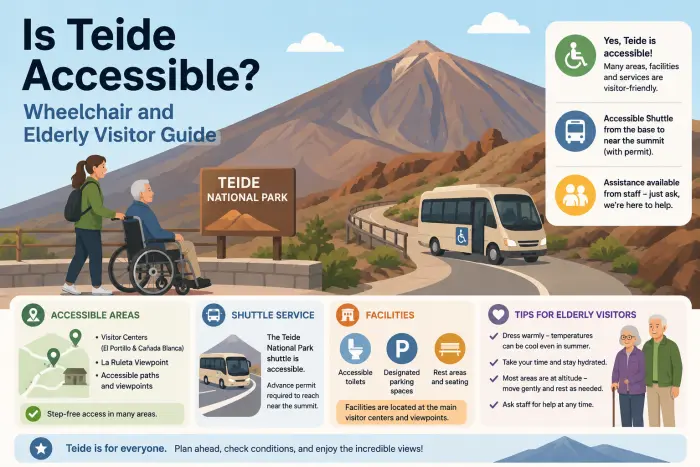
Can you still experience Teide without the cable car if you use a wheelchair?
Genuinely, yes, and it’s worth not writing off the whole mountain because the cable car specifically doesn’t work. Driving up to Teide itself is fully accessible — the road is a normal, well-maintained mountain route, and you can drive right up to the lower cable car base station at 2,356 metres, which already sits above the cloud layer on most clear days with views every bit as striking as what you’d get from higher up. One power-wheelchair user’s account of exactly this trip describes hiring an accessible van with a tail lift from Cicar specifically, driving up to the base station, and stopping at numerous laybys along the way to take in the scenery — genuinely one of the more accessible high-altitude experiences available anywhere in Europe, even without the cable car itself being an option.
What should elderly visitors (without mobility limitations) actually watch out for?
Altitude, mainly, even for visitors in otherwise good health. The base cable car station sits at 2,356 metres and the upper station at 3,555 metres — high enough that breathlessness, mild dizziness, or a headache are common, described consistently even by younger, fit visitors, and worth planning around rather than being surprised by. Acclimatising for a short while around the 2,000-metre mark before continuing higher, staying well hydrated, and avoiding a heavy meal beforehand are the practical steps most commonly recommended. Temperatures at the summit sit close to freezing regardless of the season at the coast, so warm layers matter more than they might seem to from a hot beach day lower down the island. None of this means older visitors should avoid Teide — most manage the trip completely comfortably — but treating altitude as a genuine factor to plan around, the same way you would for any high-mountain destination, is worth doing rather than assuming it’s a non-issue.
Are there any wheelchair-accessible trails or viewpoints at Teide?
Yes, a genuine option worth knowing about: the trail around Roques de García, near the visitor centre, is described as a mostly flat, wheelchair-accessible route leading to one of the park’s most photographed viewpoints, though the gravel surface is a little deeper in places than ideal, meaning manual wheelchair users may need some help on those specific stretches. Mirador Jardín is another accessible viewpoint worth building into a route, offering dramatic views back toward the mountain itself rather than from the summit looking out. Combining a stop at the visitor centre, a roll along the Roques de García trail, and the drive itself gives a genuinely full Teide day without ever needing the cable car.
Is an adapted or accessible rental car a realistic option?
Yes, and it’s worth arranging well before your trip rather than assuming you can sort it on arrival — accessible vehicles with features like a tail lift or hand controls are a smaller slice of any rental fleet and tend to need advance booking specifically for that vehicle type. Cicar, already one of the island’s most consistently well-reviewed local operators, has been used successfully for exactly this purpose by at least one documented traveller, giving full flexibility to drive the mountain roads and stop wherever suits rather than being tied to a tour bus schedule. If accessibility needs are a factor for your trip generally, it’s also worth reading what car hire looks like for older drivers specifically, since age-related rental terms and accessibility needs are related but genuinely separate considerations.
🚗 Discover Tenerife – Best Car Rental Deals
Compare top-rated suppliers, no hidden fees & free cancellation included.
What about the summit permit trail specifically?
Not a realistic option for wheelchair users or anyone with significant mobility limitations — the regulated trail to the actual summit is a genuine hike over uneven volcanic terrain at extreme altitude, and beyond the physical demands, it sits past the same cable car access point that’s already excluded for mobility reasons. For visitors focused on accessibility, the honest and genuinely rewarding target is the lower cable car station and the accessible trails around the visitor centre, rather than the summit itself — the views from 2,356 metres, above the clouds on a clear day, are remarkable in their own right without needing to reach the very top.
FAQ
Is the Teide cable car wheelchair accessible? No — the base station has a stairs-only entrance to the boarding platform, and official rules also exclude passengers with reduced mobility due to emergency evacuation requirements at altitude.
Can wheelchair users still visit Mount Teide? Yes — driving up to the lower cable car base station at 2,356 metres is fully accessible by road, and the nearby Roques de García trail and Mirador Jardín viewpoint offer accessible ways to experience the park without the cable car itself.
Are there medical conditions that prevent someone from riding the Teide cable car? Yes — cardiovascular or neurological disease, respiratory conditions, pregnancy, and reduced mobility are all officially restricted, due to the altitude risk and the operator’s evacuation-time requirements.
Is it safe for elderly visitors to ride the Teide cable car? Generally yes, for those without a relevant cardiovascular, respiratory, or mobility condition, though breathlessness and mild altitude effects are common even for fit older travellers — consulting a doctor beforehand is worth doing if there’s any underlying health concern.
Can I rent an accessible or adapted car for a Teide trip in Tenerife? Yes — accessible vehicles with features like a tail lift are available from some local operators, including Cicar, though it’s worth booking well in advance since these represent a smaller portion of any rental fleet.
How high is the accessible part of Mount Teide without using the cable car? The lower cable car base station sits at 2,356 metres, reachable entirely by road, already well above the cloud layer on most clear days with genuinely spectacular views.
Is the summit permit trail accessible for anyone with mobility limitations? No — it’s a genuine hike over uneven volcanic terrain at extreme altitude, beyond the same cable car access point already excluded for mobility and medical reasons.