There’s a case to be made that Teide National Park is the best reason to rent a car in Tenerife. Not the convenience, not the flexibility — specifically the experience of driving up to 2,356 metres through four completely different landscapes in under an hour, arriving at the foot of Spain’s highest volcano under your own steam, on your own schedule, with no tour guide narrating the window.
The alternative — the organised excursion from your resort — gets you there. But it gets you there on its timetable, with its stops, and with roughly 40 other people who also want the best spot at the Roques de García viewpoint at exactly the same moment.
This guide is for the rental car version of Teide. Four routes from different parts of the island, honest parking reality (not the official version), cable car ticket prices and booking process, summit permit requirements, what to wear, and the timing details that separate a relaxed Teide day from a frustrating one.
🗺️ The Four Routes to Teide by Car
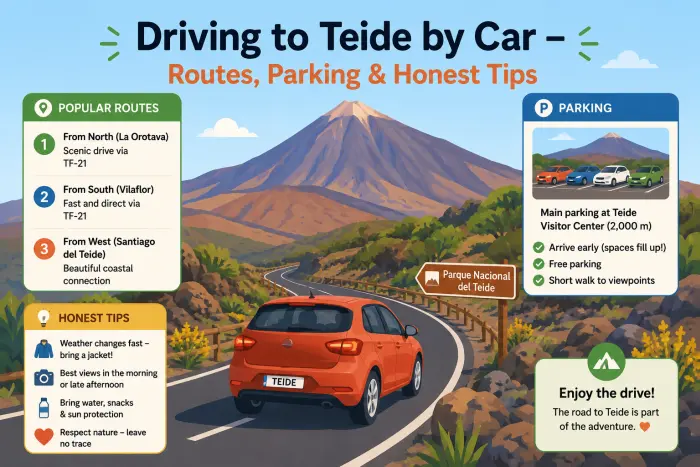
Teide National Park has four main access roads. Which one you take depends entirely on where you’re starting from. Each part of the island has its own route to visit the Teide National Park — here’s the complete breakdown:
| Route | Road | Starting Point | Distance | Drive Time | Best For |
|---|---|---|---|---|---|
| Vilaflor (South) | TF-21 | TFS Airport, Las Américas, Los Cristianos | ~60 km | 55–70 min | Most tourists from south |
| La Orotava (North) | TF-21 | TFN Airport, Puerto de la Cruz | ~45 km | 55–65 min | Scenic northern approach |
| La Esperanza (NE) | TF-24 | Santa Cruz, La Laguna | ~55 km | 60–70 min | Teide Observatory visitors |
| Chío (West) | TF-38 | Los Gigantes, Santiago del Teide | ~40 km | 45–55 min | West coast stays, Masca day trips |
Route 1 — TF-21 via Vilaflor (From the South) 🌵
The most-used route and the most dramatic in terms of landscape change. From the TF-1 motorway near TFS, you take the exit toward Vilaflor and join TF-21 heading north into the mountains.
The ascent begins almost immediately. Resort hotels give way to terraced farms, then fragrant Canarian pine forest, then the sudden, eerie transition into the volcanic caldera of Las Cañadas — a flat lava plain ringed by ancient crater walls, with Teide rising from the centre. This transition, from living green forest to alien grey rock, happens in the space of about 10 minutes of driving and is one of the most dramatic landscape changes you’ll experience on any road anywhere in Europe.
The TF-21 road at its highest point is one of the most photographed sections of road in Tenerife — a long straight stretch leading directly toward the volcano, framed by the rim of the caldera on both sides.
Route 2 — TF-21 via La Orotava (From the North) 🌿
The best route if you’re staying in Puerto de la Cruz, TFN area, or anywhere in the north. The northern approach via TF-21 passes through La Orotava — one of the island’s most beautiful towns, with 16th-century mansions, terraced botanical gardens, and a colonial-era main square worth stopping at on the way back down.
Beyond La Orotava, the road climbs through banana plantations and laurel-fringed hillsides before entering pine forest at altitude. La Caldera, a recreational area in the highlands of La Orotava, is a perfect stopping point on the way up — picnic tables, forest shade, and the sound of pine needles in the wind before you enter the volcanic zone.
If you can only drive Teide in one direction and must choose: north to south in the morning gives you the best light on the caldera. South to north in the late afternoon catches the most dramatic sunset angles on the rock formations.
Route 3 — TF-24 via La Esperanza (From the Northeast) 🔭
The northeastern approach is less visually dramatic than TF-21 but has its own appeal: it passes through the laurel forests of the Anaga foothills before climbing through pine forest to join the park at El Portillo — the northeastern entrance, home to the visitor centre and interpretation museum.
This route is particularly recommended if you’re interested in the Teide Observatory — the Izaña Astronomical Observatory sits along this road and is open for daytime visits. The observatory sits at over 2,000 metres and its location above the cloud layer makes it one of the best sites for astronomical observation in the world.
Route 4 — TF-38 via Chío (From the West) 🌊
The western approach via Chío is ideal for people who get carsick on curvy roads — it’s the gentlest gradient of the four options. Starting from Los Gigantes, Santiago del Teide, or anywhere along the west coast, TF-38 approaches the park from the southwest and enters near Boca Tauce.
Boca Tauce is one of the finest viewpoints on the entire island: at this point you stand at the rim of the ancient caldera and the whole volcanic plain stretches out before you, with Teide in the centre. The view in every direction from here — ocean to one side, volcanic rock to the other — is extraordinary.
This route is also the natural second half of a Masca day: drive to Masca in the morning, return via Santiago del Teide, continue up TF-38 to the park in the afternoon. Two of Tenerife’s greatest drives in one day.
🅿️ Parking at Teide — The Honest Reality
This is where most guides pull their punches. Here’s the unvarnished version.
The parking areas in the National Park have been kept to a small size as a conservation measure, and they cannot be extended. The main cable car car park — free to use — fills completely on clear days. “Completely” means by 9am to 10am on a sunny weekend in peak season. By mid-morning, cars are parked on road verges, in non-designated areas, and visitors who’ve driven an hour up the mountain are circling a full car park in frustration.
The main parking zones:
| Parking Area | Location | Capacity | Notes |
|---|---|---|---|
| Cable car base station | TF-21, km 43 | Medium | Free; first to fill on busy days |
| Roques de García | TF-21, km 41 | Small | Often full by 10am in season |
| El Portillo visitor centre | TF-24 entrance | Medium | Quieter, northeast side |
| Boca Tauce | TF-38 entrance | Small | Quieter, western side |
| Parador de Las Cañadas | Central park | Small | Hotel guests priority; limited visitor spaces |
| Restaurant Bamby | TF-24, near Montaña Blanca | Medium | Quieter; adds walking distance to cable car |
The honest timing advice 🕐 Arrive before 9am at the cable car car park for guaranteed parking. After 10am on a clear day in season, expect to circle. If you ultimately decide to come by car, it’s a good idea to arrive after 1pm — the official advice — but this means the cable car’s last ascent is approaching and you’ll have less time at the summit. The practical compromise: go very early (before 9am) or accept that you may need to park at El Portillo or Boca Tauce and drive to the cable car area.
Important rule: parking is only permitted in designated zones. Stopping outside marked areas is illegal inside the National Park and voids your rental car insurance entirely. Police do check and fines are issued.
🚠 The Cable Car — Prices, Booking & What to Expect
The cable car (Teleférico del Teide) rises from the base station at 2,356 metres to La Rambleta at 3,555 metres — a 10-minute ride covering nearly 1,200 metres of vertical gain. Entry to Teide National Park itself is free and unrestricted 24/7 — you can drive in and explore the open trails without charge. The cable car trip requires paid tickets, and the final summit trail now carries a separate conservation eco-tax as well.
Cable car prices (return ticket, non-residents):
🚗 Discover Tenerife – Best Car Rental Deals
Compare top-rated suppliers, no hidden fees & free cancellation included.
| Ticket Type | Adult | Child (3–13) | Notes |
|---|---|---|---|
| Return (up and down) | ~€29 | ~€15 | Standard ticket |
| One-way up | ~€23.50 | ~€11.75 | Descent on foot if you have summit permit |
| One-way down | ~€23.50 | ~€11.75 | Bookable at top station via QR code |
At the upper station, visitors are permitted to stay for up to 1 hour before returning descent begins. Plan a total visit duration of around 2–3 hours if including ascent, summit hike (if you have the permit), and descent.
Cable car opening hours:
- Winter/autumn (Jan–Mar, Oct–Dec): 09:00–17:00, last ascent 16:00
- Spring/summer (Apr–Sep): 09:00–18:40, last ascent 17:40
Book in advance. For the cable car, online booking is imperative. Demand is strong all year round, and slots fill up fast. Last-minute availability is rare in any season. Book through the official Teide cable car website (volcanoteide.com) at least 1–2 weeks ahead, more in peak season. Tour groups are given priority boarding at the queue — independent visitors with pre-booked tickets experience this frustration regularly.
What’s at the top: La Rambleta at 3,555m has a panorama terrace, the “Science and Legend” exhibition (included with cable car ticket), and views over the entire island and often all seven Canary Islands simultaneously. The ground around the top station is very difficult to walk on outside the designated terrace. Wind and cold are significant — bring a windproof jacket regardless of how warm it was at resort level.
🏔️ The Summit Permit — How It Works
The peak of Teide at 3,718 metres requires a separate permit. You must obtain two free permits: one via the Tenerife ON app for approved trails, and a separate summit permit via the National Parks website to access the final Telesforo Bravo Trail to Pico del Teide. Both permits are mandatory regardless of whether you travel by cable car or hike.
Key facts about the summit permit:
- Cost: the Telesforo Bravo summit trail now carries a conservation eco-tax, up to roughly €25–28 for non-residents, with reduced rates (around €3–6) for Canary Islands residents. This is separate from the free Tenerife ON app permit for the approach trails.
- Advance booking: up to 90 days ahead — they usually sell out, especially in spring and autumn. It’s best to plan 2–3 months ahead
- Daily limit: only 300 hikers per day are permitted on the summit trails across three time slots
- Access: from the top of the cable car, the final section to the crater rim is a short but steep walk
If you don’t have a summit permit, you can still go up by cable car to La Rambleta (3,555m) and enjoy the panorama — you just cannot access the final path to the volcanic crater rim. For most visitors, La Rambleta is more than enough: the view from 3,555m on a clear day is extraordinary.
🧥 What to Wear — The Detail Everyone Gets Wrong
The temperature at the cable car base station is roughly 10–12°C lower than at sea level. At the top, subtract another 5–8°C. Add wind — and Teide is almost always windy at altitude.
On a day when it’s 28°C in Playa de las Américas, it can be 10°C at the cable car station with a 20 km/h wind. People regularly arrive in shorts and flip-flops. The café and gift shop at the base station sell overpriced fleeces for exactly this reason.
What to bring:
- Windproof jacket (essential — not optional)
- Trousers or at least long leggings for the top station
- Closed shoes — the volcanic rock surface is uneven and sharp
- Sunscreen — UV radiation at 3,500m is significantly higher than at sea level; the sun feels more intense even when the air is cold
- Water — at least 1 litre per person
- Sunglasses
⚠️ Altitude note: Some visitors — particularly those with heart or respiratory conditions — experience altitude effects at 3,555m. The ascent by cable car is fast, and the body has less time to acclimatise than it would on a gradual hike. If you have any relevant health conditions, consult a doctor before booking the cable car. Most healthy adults have no issues — but headaches, slight dizziness, and shortness of breath are common and normal at this altitude.
⏱️ Drive Times to Teide from Main Resorts & Airports
| Starting Point | Route | Distance | Drive Time |
|---|---|---|---|
| TFS Airport | TF-21 via Vilaflor | ~60 km | 55–65 min |
| Playa de las Américas | TF-21 via Vilaflor | ~55 km | 50–60 min |
| Los Cristianos | TF-21 via Vilaflor | ~55 km | 50–60 min |
| Costa Adeje | TF-21 via Vilaflor | ~60 km | 55–65 min |
| Santa Cruz | TF-24 via La Esperanza | ~55 km | 60–70 min |
| TFN Airport | TF-24 or TF-21 | ~60 km | 65–75 min |
| Puerto de la Cruz | TF-21 via La Orotava | ~45 km | 55–65 min |
| Los Gigantes | TF-38 via Chío | ~40 km | 45–55 min |
| Masca | TF-38 via Santiago del Teide | ~35 km | 40–50 min |
🚗 Which Car for Teide?
If you’re planning to explore the mountains, don’t take the smallest cars. A more powerful engine will be more comfortable. This is particularly true on TF-21 — the southern approach is a sustained climb over 50+ kilometres, and a 0.9L engine will manage it but will be working hard, particularly with multiple passengers.
Recommendations by car type:
| Car | Suitable for Teide? | Notes |
|---|---|---|
| Mini (0.9L, e.g. Toyota Aygo) | ⚠️ Marginal | Fine in cooler months, struggles in summer heat with passengers |
| Economy (1.0–1.2L) | ✅ Fine | Comfortable on TF-21 at a relaxed pace |
| Small/Compact (1.0–1.5L) | ✅ Good | Best balance of economy and capability |
| Automatic (any category) | ✅ Excellent | Removes gear management on sustained gradients |
| SUV / 4×4 | ✅ Comfortable | More power, easier on steep sections — but all roads are paved |
For everything about which car suits Tenerife’s roads in general, see our guide to SUV and 4×4 hire in Tenerife and automatic car hire.
🔗 Related Pages on rentcarstenerife.com
- 🚗 Complete Tenerife car hire guide — island-wide overview of costs, companies and how to compare.
- 🛣️ Best roads to drive in Tenerife — TF-21 to Teide is Route 2 in our full ranked list of 7 drives. See how it compares to Masca, Anaga and the west coast.
- 🛣️ Driving in Tenerife — tips for first-timers — speed limits, mountain road advice, parking rules and the regulations that catch tourists off guard.
- ⚙️ Automatic car hire Tenerife — the sustained climb to Teide is one of the clearest use cases for an automatic gearbox on the island.
- 🚙 SUV & 4×4 hire Tenerife — more power, more comfort on the mountain roads. When it’s worth the extra cost.
- ✈️ Car hire at TFS — Tenerife South Airport — most Teide visitors pick up here. Full guide to the south airport car hire process.
- ✈️ Car hire at TFN — Tenerife North Airport — flying into the north? TF-21 via La Orotava is one of the finest approaches to Teide on the island.
🙋 Frequently Asked Questions — Driving to Teide by Car
Can I drive all the way to the top of Teide?
No — you can drive to the cable car base station at 2,356 metres, which is as high as any road goes. From there, the cable car takes you to 3,555 metres (La Rambleta). The final section to the summit crater at 3,718 metres requires a hiking permit and is done on foot. No road reaches the summit.
Is it free to drive into Teide National Park?
Yes — entry to Teide National Park itself is completely free and open 24 hours a day, 7 days a week. You can drive in, park in designated areas, and walk the open trails at no charge. The cable car requires a paid ticket. The final summit trail (Telesforo Bravo) now carries a separate conservation eco-tax on top of the free Tenerife ON permit — €15 for non-residents without a guide, €10 with a guide. The lower Montaña Blanca–La Rambleta trail costs €6 on weekdays and €10 on weekends for non-residents.
How long does it take to drive to Teide from the south?
From Playa de las Américas or TFS Airport, allow 55–65 minutes via TF-21 through Vilaflor. From Puerto de la Cruz in the north, allow the same via TF-21 through La Orotava. Add time for stops — the viewpoints on the approach are genuinely worth pulling over for, and a rushed Teide visit is a wasted one.
When is the best time to drive to Teide to avoid crowds?
Before 9am is the clear winner. Arriving at the cable car car park before 9am guarantees parking and means you’ll be in the queue before tour groups arrive. Weekday mornings are significantly quieter than weekends. If you can’t go early, arriving after 1pm means the main morning crowds are already there or leaving — but you’ll have less time before the cable car last ascent.
Do I need to book the cable car in advance?
Yes — strongly recommended. Demand is strong all year and last-minute tickets are scarce. Book through volcanoteide.com at least 1–2 weeks ahead in low season, 3–4 weeks in high season. The cable car operates on timed slots; your ticket specifies an ascent window.
Is the road to Teide dangerous?
No — TF-21 is well-maintained, clearly signed, and driven by thousands of visitors every day. The gradient is sustained and the bends are plentiful, but the road is wide by mountain standards and there are no particularly alarming sections. An economy or compact car handles it comfortably. The main practical challenge is not the road itself but parking at the top on busy days.
What should I wear to visit Teide?
At minimum: a windproof jacket and closed shoes. At 3,555 metres, temperatures are typically 10–15°C lower than at resort level, and wind is almost always present. People regularly arrive in shorts and sandals and are visibly cold within minutes of exiting the cable car. UV radiation is also significantly higher at altitude — sunscreen and sunglasses are essential even when the air feels cool.
Can the cable car close without warning?
Yes — the cable car closes in high winds, adverse weather, or for maintenance. These closures can happen with short notice and are announced on the official website (volcanoteide.com). If your visit is weather-dependent, check the site on the morning of your planned trip before driving up. A free permit or cable car ticket can usually be rescheduled if the closure is announced in advance.
Can I take my rental car inside Teide National Park?
Yes — all rental cars can access the park’s roads freely. The restriction is on off-road driving, which is entirely prohibited and voids your insurance immediately. All the main viewpoints, car parks, and attractions within the park are accessible on paved roads.
Plan the rest of your trip with our Tenerife by Car guide.