At some point during a long-stay visa, the maths starts nagging at you: you’re paying a monthly rental rate that, annualised, starts looking suspiciously close to what a used car actually costs to buy outright. Whether buying genuinely makes sense depends less on that headline comparison and more on a handful of Canary Islands-specific details that most generic “buying a car in Spain” guides don’t cover, because they’re written for the mainland.
Buying Locally: What the Process Actually Involves
Buying a used car from a dealer or private seller already registered in Spain is the straightforward route, and it’s worth separating clearly from importing your own car from home — a much heavier process covered further down.
To buy locally, you’ll need an NIE (your Spanish tax ID number for foreigners) and proof of address, both of which you should already have in hand as part of your residency paperwork. From there:
| Step | What’s Involved |
|---|---|
| NIE and proof of address | Required before any purchase can be registered in your name |
| Transfer tax (ITP) | Applies on used-car purchases from a private seller |
| Jefatura de Tráfico appointment | Register the change of ownership within 30 days of purchase |
| ITV certificate | Required if the car is due or overdue for its roadworthiness inspection |
| Insurance | Must be active before you drive the car at all — Spanish law requires at least third-party cover, and some ITV stations won’t even test an uninsured vehicle |
Many expats use a gestor — a licensed administrative agent — to handle this paperwork, particularly for the Jefatura de Tráfico appointment and tax filing, since the process is entirely in Spanish and the Canary Islands specifically have some restrictions on completing parts of it online that apply on the mainland. Budget for that service alongside the purchase price itself.
The Canary Islands Tax Advantage Worth Knowing About
This is the detail most Spain-wide expat guides miss entirely, because it’s specific to these islands: the Canary Islands operate under IGIC (Impuesto General Indirecto Canario) rather than mainland Spain’s VAT, and IGIC’s general rate sits considerably lower. For a new car bought locally, that difference can make buying new in Tenerife noticeably cheaper than the equivalent purchase on the mainland — worth factoring in if a new (rather than used) car is genuinely on the table for you.
Importing Your Own Car: Usually Not Worth It
If you’re tempted to bring your existing car over instead of buying locally, it’s worth understanding why most people who look into this seriously end up not doing it. Importing a foreign-registered vehicle permanently involves customs clearance, an ITV inspection to Spanish standards, and registration tax (Impuesto de Matriculación) — and without qualifying for a change-of-residence exemption on that registration tax, the total can run to 40% or more of the car’s value, which makes the maths fall apart quickly for anything but a genuinely irreplaceable vehicle. Even with the exemption, you’re managing customs paperwork, potential homologation certificates if your car wasn’t originally EU-spec, and a real timeline before you can legally drive it — all for a car you could likely replace locally for less hassle. For nearly everyone, buying used in Tenerife beats importing from home.
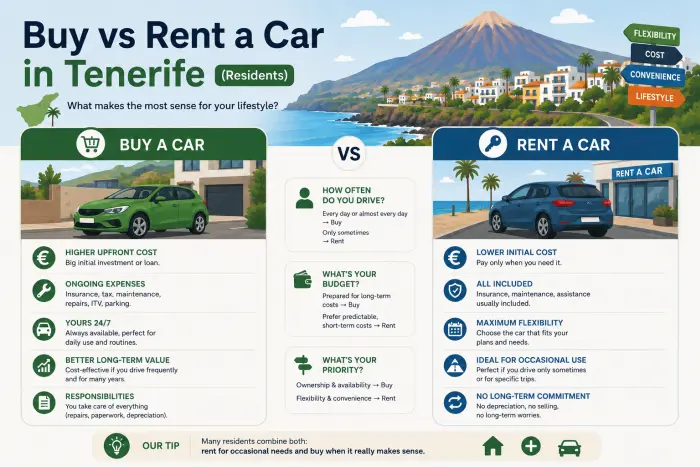
So: Buy or Keep Renting?
The honest break-even calculation depends on three things: how long you’re actually staying, how much daily use the car gets, and whether your licence situation is settled.
Renting still wins when:
- You’re inside your first six months and haven’t exchanged your licence yet — buying a car you might not be legally able to drive past that window is an easy way to tie up money in something sitting idle
- Your stay is genuinely uncertain — a one-year visa with no clear renewal plan
- You want zero exposure to ITV deadlines, insurance renewals, or eventual resale hassle when you leave
Buying starts to make sense when:
🚗 Discover Tenerife – Best Car Rental Deals
Compare top-rated suppliers, no hidden fees & free cancellation included.
- You’re a year or more into a settled stay, ideally already renewed or confident about renewal
- Your licence is sorted — either exchanged or the full Spanish test completed, so there’s no risk of buying a car you can’t legally drive
- You’re using a car daily rather than occasionally, where rental costs compound fastest
- You’ve priced out the total cost of buying (purchase, ITP, gestor fees, insurance, ITV) against 12+ months of rental and the numbers genuinely favour ownership
- You’re based in Santa Cruz and want access to a resident parking permit — only available to registered, owned vehicles, not rentals
Our long-term car hire guide is worth reading alongside this one — the monthly rates it covers are the other half of this comparison, and running your own numbers against them is more useful than any general rule of thumb.
Selling When You Eventually Leave
The other side of ownership worth planning for upfront: at some point, you’ll likely sell. Reselling a car in Tenerife follows the same process in reverse — a private buyer needs their own NIE to register the transfer, and you’ll need your registration documents in order and the ITV current at the point of sale, since a lapsed certificate makes a car harder to sell and legally risky to hand over. Local demand for used cars on the island is generally healthy, given how many residents and long-stay visitors are cycling through exactly this same buy-then-sell timeline, but it’s worth building a few weeks of runway into your departure plans rather than assuming a quick sale at the last minute. This is also where the rent-vs-buy maths closes the loop: factor in a realistic resale value, not just the purchase price, when comparing total ownership cost against a year or more of rental.
What Insurance Looks Like Once You Own
A rental car’s insurance is bundled into the rental agreement; owning a car means arranging your own policy, and there are a few specifics worth knowing. Spanish law requires at minimum third-party (terceros) cover before you drive at all, your NIE is mandatory on the policy, and insurers will want to see your Permiso de Circulación (registration certificate) and a valid ITV certificate before issuing cover. If you’re bringing years of no-claims history from your home country, it’s worth asking specifically whether a Spanish insurer will honour it — practice varies, and it’s not automatic everywhere. Keep that insurance current alongside your annual ITV inspection too — a lapsed policy can get your ITV appointment refused outright.
Frequently Asked Questions
Do I need an NIE to buy a car in Tenerife?
Yes — an NIE and proof of address are required to register a car purchase in your name, whether buying from a dealer or a private seller.
Is it cheaper to buy a new car in the Canary Islands than mainland Spain?
Often, yes, thanks to IGIC (the islands’ own indirect tax system) generally running lower than mainland VAT. This applies most clearly to new cars; used-car pricing depends more on the local resale market than the tax system.
Should I import my car from home instead of buying locally?
Usually not, unless you qualify for a change-of-residence exemption on Spain’s vehicle registration tax. Without it, import costs can reach 40% or more of the car’s value, on top of customs clearance and an ITV inspection to Spanish standards — buying used locally is simpler and typically cheaper for most people.
Can I buy a car before I’ve exchanged my driving licence?
Legally, yes — owning a car and being licensed to drive it are separate questions. The risk is buying a car you then can’t legally drive once your original licence’s Spain-validity window closes, so it’s worth timing a purchase around your licence situation rather than against it.
How long does registering a used car purchase take?
The change-of-ownership appointment at the Jefatura de Tráfico needs to happen within 30 days of purchase. In practice, using a gestor to manage the paperwork tends to be faster and less error-prone than navigating it independently, especially given some Canary Islands-specific restrictions on completing parts of the process online.
What insurance do I need before driving a car I’ve bought?
At minimum, third-party (terceros) cover, active before you drive at all. Your insurer will need your NIE, your Permiso de Circulación, and a valid ITV certificate as part of setting up the policy.
Will a Spanish insurer honour my no-claims history from home?
It depends on the insurer — practice varies, and it isn’t automatic everywhere. Worth asking directly when getting quotes, since a recognised no-claims history can meaningfully affect your premium.
Running Your Own Numbers
There’s no universal answer here — the calculation genuinely depends on your specific timeline, licence status, and how much you’ll actually use a car day to day. What’s worth taking from this: don’t let the headline “rental adds up to more than buying” comparison make the decision for you without factoring in the Canary-specific tax advantage on new cars, the real cost of importing versus buying local, and — most importantly — whether your licence situation is settled enough that ownership makes sense yet.