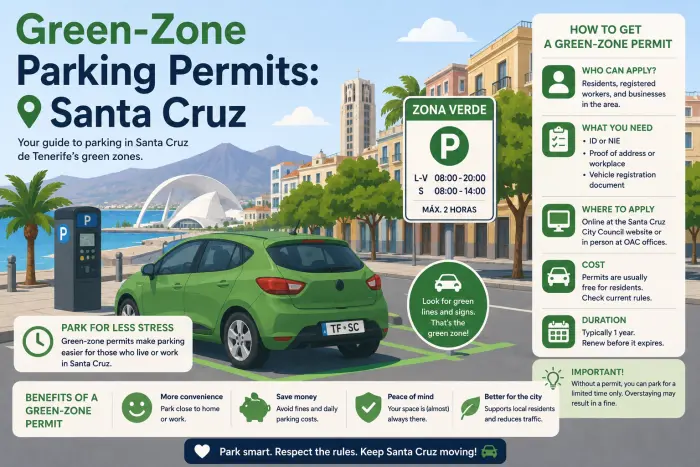
Somewhere between the tourist blue-zone parking meter and owning a reserved private space sits an option most visitors never hear about, because it isn’t for them: a resident parking permit. Santa Cruz introduced its Zona de Estacionamiento Regulado (ZER) — a structured, zoned parking system — through 2026, and buried inside it is a genuinely useful detail for anyone settling into the city long-term: registered residents can apply for a green-zone permit at preferential rates, a tier that simply isn’t available to tourists paying at the meter.
What the ZER System Actually Looks Like
Santa Cruz’s regulated parking now runs across thirteen zones in the city centre, each governed by the same colour-coded logic used across much of Spain, adapted to local specifics:
| Zone | Colour | Who It’s For | How It Works |
|---|---|---|---|
| Rotation | Blue (ORA) | Anyone, tourists included | Pay at the meter or via app; short-stay, encourages turnover |
| Resident | Green | Registered residents only | Preferential rates via a resident authorisation card — not available to visitors |
| Unregulated | White line | Anyone | Free, but limited and disappears fast in the centre |
Enforcement generally runs Monday to Friday, split across a morning and afternoon window, plus Saturday mornings — with Sundays and public holidays free across the board. As with any system still working through full implementation, it’s worth checking the Ayuntamiento’s current mobility pages for the exact zone boundaries and hours before assuming the rules are already fully in force on a specific street.
Don’t Confuse This With the ZBE
This is worth being precise about, because the two systems sound similar and are easy to conflate. The ZER (parking zones, covered here) governs where and how you pay to park. The ZBE — Santa Cruz’s separate low-emission zone, covered in our ZBE explained guide — governs whether your vehicle can enter certain areas at all, based on its emissions label, and isn’t expected to be enforced until 2029. They’re both Santa Cruz initiatives, both use similarly technical Spanish acronyms, and both matter more to residents than tourists — but they’re solving different problems, and conflating them is an easy mistake to make when researching either one.
How to Actually Get a Resident Permit
The resident authorisation (autorización de residente) isn’t automatic — it’s granted specifically to someone empadronado (registered) at an address within the relevant zone’s designated area. That word — empadronamiento — is the same municipal registration step covered in our digital nomad car hire guide as the trigger for your six-month driving licence exchange deadline. In practice, this means the resident parking permit and the licence exchange clock start from largely the same administrative moment, which is worth knowing if you’re mapping out your first few weeks of paperwork after arriving.
To apply, you’ll generally need:
- Proof of empadronamiento at an address within the zone
- Identification (DNI, NIE, or passport)
- Vehicle registration documents showing you as the registered keeper or primary user
- Confirmation you’re up to date on the municipal vehicle tax (IVTM) if you already own a car locally, plus a current ITV certificate — permit applications lean on the same paperwork
Only one resident authorisation is typically granted per person and address, though a resident permit can coexist with a separate reduced-mobility parking authorisation at the same address if that applies to you. The permit carries an annual fee, with reported discounts for ECO or zero-emission vehicles — another point where our electric and hybrid vehicle guides become relevant if you’re deciding what to buy or rent long-term with this specifically in mind.
Why This Matters More Once You’ve Bought Rather Than Rented
A resident parking permit is tied to a specific registered vehicle, which means it only becomes genuinely useful once you’ve settled into ownership rather than cycling through rental bookings. Our buy vs rent guide for residents covers the broader financial decision, but this is a specific, concrete point in that decision’s favour if you’re planning to live centrally in Santa Cruz long-term: owning a registered car and holding a green-zone permit removes the daily parking cost and hunt entirely, in a way that renting — where the car isn’t registered to your residential address — simply can’t replicate.
🚗 Discover Tenerife – Best Car Rental Deals
Compare top-rated suppliers, no hidden fees & free cancellation included.
What This Means If You’re Still Renting
If you’re in your first months and still working through the Spanish driving test or your licence exchange, a resident parking permit isn’t available to you yet regardless of your empadronamiento status, since a rental car isn’t registered to your address the way an owned vehicle is. During this period, you’re working within the same blue-zone rules as any tourist — our general parking in Tenerife guide covers the standard system, and it’s worth budgeting for paid blue-zone parking as a genuine ongoing cost during this transitional stretch, rather than assuming residency alone unlocks the resident rate immediately.
A Realistic Order of Operations
If you’re settling in Santa Cruz specifically and want the resident permit eventually, here’s a sensible sequence rather than trying to do everything at once: register your empadronamiento as soon as you have a fixed address, since it starts both your licence exchange clock and your eventual permit eligibility. Handle the driving licence question next — whether that’s the direct exchange your nationality qualifies for, or the fuller Spanish test route — since you’ll need a valid licence before a car purchase makes practical sense. Once you’re settled on car ownership, register the vehicle to your residential address, confirm the municipal vehicle tax is current, and only then apply for the resident permit itself. Trying to skip ahead to the permit application before the underlying registration and vehicle ownership pieces are in place just means a rejected or delayed application.
Frequently Asked Questions
What is the ZER in Santa Cruz?
The Zona de Estacionamiento Regulado is Santa Cruz’s structured parking zone system, covering thirteen zones across the city centre with blue (paid rotation), green (resident), and occasional white (free) parking, enforced on a set weekday and Saturday-morning schedule.
Is the ZER the same as Santa Cruz’s low-emission zone?
No — they’re separate systems. The ZER governs parking payment and resident access; the ZBE governs which vehicles can enter certain areas based on emissions, and isn’t expected to be enforced until 2029. Both are worth knowing about, but they solve different problems.
Can tourists get a green-zone parking permit in Santa Cruz?
No — green-zone resident permits require empadronamiento (municipal residency registration) at an address within the relevant zone, which tourists don’t have.
Do I need to own a car to get a resident parking permit?
Effectively, yes — the permit is tied to a specific vehicle registered to you at your residential address, which a standard rental car isn’t. This makes the permit relevant mainly once you’ve moved from renting to owning.
How does empadronamiento connect to my driving licence situation as a digital nomad?
Both processes are triggered by the same registration step. Empadronamiento starts your six-month window to exchange your foreign driving licence for a Spanish one, and it’s also the requirement for a resident parking permit — worth handling early for both reasons at once.
What happens if I park in a green zone without a resident permit?
Green-zone bays are reserved specifically for permit holders, and parking there without authorisation is treated the same as any other parking violation — expect a fine. Stick to blue-zone paid parking or free white-line spots until you have your permit sorted.
Does the resident permit apply anywhere else in Tenerife, or just Santa Cruz?
The ZER system described here is specific to Santa Cruz de Tenerife. Other towns and resort areas across the island run their own separate parking arrangements — our general parking in Tenerife guide covers the island-wide colour-coded basics that apply outside Santa Cruz’s specific resident-permit system.
One More Piece of the Residency Puzzle
The resident parking permit is a small detail next to the driving licence exchange or the decision to buy a car outright, but it’s exactly the kind of practical thing that’s easy to miss until you’re circling the same block for the third time. Once your empadronamiento and vehicle registration are sorted, it’s worth applying for sooner rather than later — it’s one less daily cost to think about once the rest of your residency paperwork is settled.