Once you own a car in Tenerife rather than renting one, a new item joins your annual admin list that most visitors never think about: the ITV, Spain’s mandatory roadworthiness inspection. It’s not optional, it’s not a formality you can quietly skip, and missing it carries real consequences — from a fine to having your car immobilised roadside. Here’s what actually changes once you’re the one responsible for keeping a vehicle legally on the road, rather than handing that responsibility back to a rental desk at the end of your trip.
What the ITV Actually Checks
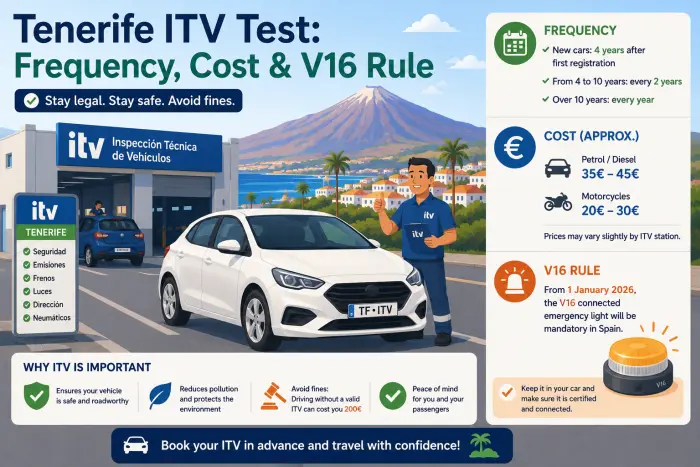
The Inspección Técnica de Vehículos is Spain’s equivalent of the UK MOT or a similar roadworthiness test elsewhere — a periodic inspection confirming your car still meets minimum safety and emissions standards. Inspectors check brakes, suspension, steering, lights, emissions, tyres, and general bodywork integrity, cross-referencing your registration plate and chassis number against your documentation before assessing the vehicle itself.
How Often You Actually Need One
Frequency scales with the car’s age, not a fixed calendar date:
| Vehicle Age | ITV Frequency |
|---|---|
| 0–4 years | Exempt — no inspection required |
| 4–10 years | Every 2 years |
| Over 10 years | Every year |
Since most residents buying locally end up with a used car — our buy vs rent guide covers why that’s usually the more sensible route than importing — there’s a reasonable chance your first ITV as a new owner comes up sooner than four years away. Worth checking your specific car’s registration date and due window as one of the first things you do after taking ownership, rather than discovering it’s overdue by accident.
The New Requirement Most Guides Haven’t Caught Up With Yet
Since January 2026, Spain requires a DGT-homologated V16 connected beacon — a connected emergency warning light that replaces the old roadside warning triangle — and ITV inspectors now check for it specifically. Arrive without one, and you fail on that point alone, regardless of how the rest of the car performs. They’re inexpensive and widely available — typically €20–€50 from major retailers — but it’s exactly the kind of small, easy-to-miss requirement that catches new residents out simply because it’s recent enough that a lot of general “buying a car in Spain” content hasn’t updated to reflect it yet.
What It Costs and Where to Go
Pricing varies by autonomous community, and the Canary Islands set their own rates through the region’s ITV network (Applus+ operates the stations here) — worth checking the current published price list directly rather than assuming a mainland figure applies, since costs across Spain’s regions differ meaningfully. Whatever the exact figure, know that a valid insurance policy is checked electronically as part of the process — if your cover has lapsed, the station can refuse the inspection outright, which makes sure your insurance renewal date and your ITV due date don’t quietly slip past each other unnoticed.
Booking and Timing
You can complete your ITV up to one month before its due date without affecting your next inspection cycle, which gives some flexibility around travel plans or a busy period. Booking two to three weeks ahead is a sensible habit generally, and genuinely necessary during peak periods — January and the summer months see stations get busy island-wide, and a last-minute booking attempt can leave you legitimately unable to get an appointment before your current certificate expires.
Many residents use a gestor for this, the same kind of licensed administrative agent covered in our buy vs rent guide for handling registration paperwork — typically an additional €30–€70 on top of the inspection cost itself, in exchange for not having to track the process solo in a second language.
What Actually Happens at the Station
If this is your first ITV, the process itself is more mechanical than bureaucratic. You drive the car into a testing bay, where an inspector runs through the checks in sequence — lights and indicators first, then brakes and suspension on a rolling test bed, followed by an emissions check with the engine running, and a visual pass over tyres, bodywork, and the chassis number against your paperwork. You typically stay with the car throughout rather than handing it over and waiting elsewhere, and the whole process usually takes well under an hour for a standard passenger car with no issues. At the end, you receive either a pass certificate valid until your next due date, or a written breakdown of any defects found, categorised by severity.
Bring your registration document (permiso de circulación), the vehicle’s technical sheet, and your previous ITV certificate if you have one — a gestor, if you’re using one, will typically have already confirmed you have everything needed before the appointment itself.
🚗 Discover Tenerife – Best Car Rental Deals
Compare top-rated suppliers, no hidden fees & free cancellation included.
What Happens If You Miss It
This is worth taking seriously rather than treating as a minor administrative slip. Driving with an expired ITV is classed as a serious traffic offence under Spanish law, carrying a standard fine of €200, reduced to €100 if paid within 15 days. Beyond the fine, police can immobilise the vehicle at the roadside until a valid ITV is obtained — meaning an expired certificate isn’t just a paperwork problem, it’s a genuine risk of being stranded wherever you happen to be stopped. The expired status also gets recorded in the DGT’s database, which can complicate selling or transferring the car later, so letting it lapse creates a problem that outlasts the immediate fine.
There’s no grace period once the due date passes — the safest approach if you’re already overdue is booking an appointment immediately rather than continuing to drive and hoping you don’t get stopped.
If You Fail
Not uncommon, and not the end of the process. You’ll receive a report categorising any issues found — minor defects are noted but don’t fail the car outright, while more serious defects require repair and a retest, typically within two months, usually at around half the original inspection cost. Preparing ahead helps more than people expect: checking lights, tyres, brakes, and fluid levels a week before your appointment catches a meaningful share of the issues that would otherwise fail on the day.
How This Connects to the Rest of Your Residency Paperwork
A valid ITV certificate isn’t just about staying legal on the road — it’s a prerequisite elsewhere in the resident car-ownership picture. Our Santa Cruz resident parking permit guide covers how a current ITV certificate is one of the documents required alongside your vehicle registration when applying, which means letting your ITV lapse can quietly block a parking permit application you didn’t realise depended on it. If you’re still working through your driving licence exchange or the Spanish test rather than owning a car yet, none of this applies to you directly — but it’s worth knowing what’s coming once you do make the move from renting to ownership.
Frequently Asked Questions
How often do I need an ITV inspection in Tenerife?
It depends on your car’s age: exempt for the first four years, then every two years until the car turns ten, then annually after that.
What happens if I drive with an expired ITV?
You risk a €200 fine (reduced to €100 if paid within 15 days), and police can immobilise your vehicle at the roadside until you get a valid inspection. The expired status also gets logged in the DGT database, which can complicate a future sale.
Do I need a V16 beacon to pass the ITV?
Yes, since January 2026 — inspectors check for a DGT-homologated V16 connected beacon specifically, and its absence fails the inspection regardless of the rest of the car’s condition. They cost roughly €20–€50 from major retailers.
Can I get my ITV done early if I’ll be travelling on the due date?
Yes — you can complete the inspection up to one month before it’s due without it affecting your next inspection cycle.
What if my car fails the ITV?
You’ll get a report detailing the issues. Minor defects don’t fail the car outright; more serious ones require repair and a retest, usually within two months and typically at around half the original cost.
Do I need valid insurance to get an ITV inspection?
Yes — insurance is checked electronically as part of the process, and stations can refuse the inspection if your cover has lapsed.
Is the ITV the same everywhere in Spain, or does the Canary Islands version differ?
The core inspection and frequency rules are set nationally, but pricing and station operators vary by autonomous community — the Canary Islands run their own network with their own published rates, worth checking directly rather than assuming a mainland figure.
One More Box to Tick, Not a Reason to Avoid Ownership
None of this is a reason to lean toward renting indefinitely if buying otherwise makes sense for your situation — it’s simply one more item on the annual checklist that comes with owning rather than renting. Once you know your car’s due date, book with the same lead time you’d give any other appointment during a busy period, keep your insurance current alongside it, and the ITV becomes routine rather than something to dread.