Two words at the collection desk are worth genuine caution: “don’t worry.” A gauge that reads less than full, and a member of staff waving it off with some version of “don’t worry, just bring it back at the same level” or “don’t bother filling it, it’s already accounted for.” Said verbally, with nothing written down, this specific reassurance has cost travellers real money when they hand the car back to a different person, at a different location, who has no record of any such agreement. Separately, a prepaid fuel tank sold at the desk, at a price that can run two to three times the local pump rate, is one of the most consistently documented markups in Tenerife car hire.
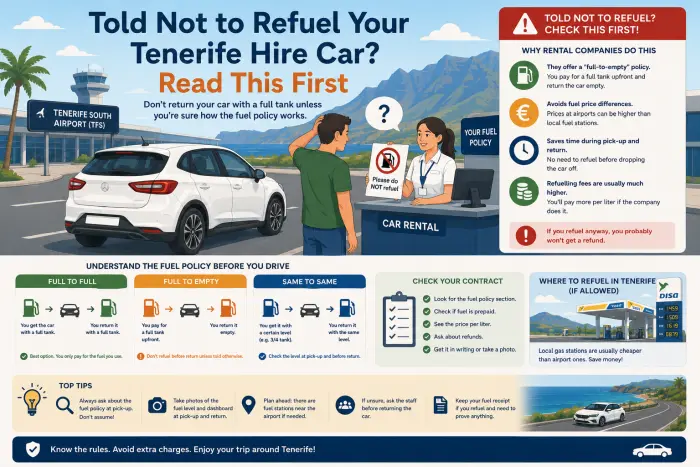
The two things to watch for: first, a prepaid fuel arrangement (sometimes called FUF, full-to-full, or a “fuel service”) where you pay for a full tank upfront at a price well above the pump rate, then are asked to return the car close to empty, wasting fuel you already paid for. This specific scheme has been documented at Tenerife’s own airports, and the actual markup reported by travellers ranges from roughly double to triple the local pump price. Second, and separately, any verbal instruction along the lines of “don’t worry about the fuel level, it’s fine” that isn’t written on your paperwork is a genuine risk, since a different member of staff at return has no way of knowing an exception was ever agreed. The fix for both is the same: choose full-to-full over any prepaid option wherever it’s genuinely offered, and get anything agreed verbally written onto the paper agreement before you drive away, not just spoken and forgotten.
⛽ The Prepaid Fuel Trap, Documented at Tenerife Airports Specifically
Independent traveller reports describe a specific scheme, sometimes referred to by the acronym FUF (full-to-full prepaid), that has been noted at both of Tenerife’s airports: you’re sold a full tank of fuel at the point of collection, at a price notably higher than the local pump rate, and then instructed to return the car “as empty as possible,” since any unused fuel isn’t refunded. The practical effect is that you’re paying for fuel you can’t fully use, unless you time your last few kilometres with unusual precision, and the price you paid for that tank in the first place was already inflated well above what filling it yourself would have cost.
One detail worth knowing specifically: some travellers have found that collecting from a location away from the airport terminal itself avoids this particular scheme, since it appears to be applied more consistently at airport desks than at other pickup points. If avoiding it matters to you and your itinerary allows it, this is worth weighing against the convenience of an airport collection.
📊 How Big Is the Markup, Really?
Reported figures vary, but the pattern is consistent enough to take seriously:
| What Was Reported | Approximate Markup Over Pump Price |
|---|---|
| A tank charged at roughly three times the local per-litre rate | ~3x |
| A tank refilled afterward for roughly half of what was charged | ~2x |
| A forced “fuel service” surcharge applied even with a full tank and a fuel receipt presented at return | Charged regardless, disputed afterward |
These are traveller-reported figures rather than official company pricing, and markups vary by company, location, and time, but the consistent theme across independent reports is that prepaid fuel is very rarely the cheaper option, and is frequently reported as meaningfully more expensive than simply managing your own fuel stops.
🗣️ Why “Don’t Worry, Just Bring It Back the Same” Is a Genuine Risk
This is a different problem from the prepaid fuel markup, and arguably a more dangerous one, because it depends entirely on trusting a verbal promise that has no record anywhere. A documented pattern looks like this: at collection, a staff member notices the tank isn’t full, and instead of correcting it or noting it, simply tells the customer not to worry and to return it at the same level. The customer, trusting the reassurance, doesn’t ask for this in writing. At return, often at a different location or with different staff entirely, no exception is on file, and the customer is charged in full for a “missing” tank of fuel they were told not to worry about, sometimes not discovering the charge until they’re already home and reviewing a card statement.
The fix is simple and non-confrontational: if any variation to the standard fuel policy is verbally agreed, whether it’s about the starting fuel level, a gauge that seems inaccurate, or anything else, ask for it to be written on the paper agreement or confirmed by email before you drive away. A staff member who’s genuinely offering a fair accommodation has no reason to refuse writing it down; reluctance to do so is itself worth noticing.
📸 Photograph the Fuel Gauge, Every Single Time
This is the single most effective habit against both problems described here, and it costs nothing:
- Photograph the fuel gauge at collection, clearly showing the needle or digital reading, alongside the odometer.
- If the tank isn’t full and nobody corrects it, get that fact noted on the agreement itself, not just acknowledged verbally.
- Photograph the fuel gauge again at return, before handing over the keys, ideally with a timestamp visible.
- Keep your own fuel station receipts from the trip if you’re on a full-to-full policy, in case the return level is ever disputed.
This is the same habit covered in more depth in our collection and inspection checklist guide, and it applies to fuel exactly as much as it does to bodywork and existing damage.
✅ Full-to-Full Is Almost Always the Better Choice
Given a genuine choice at booking or at the desk, full-to-full, collecting the car full and returning it full yourself, is consistently the option that avoids both problems described in this guide. It removes the prepaid markup entirely, and it removes any ambiguity about starting fuel level, since “full” is a state you can verify yourself rather than trusting a verbal assurance. If a prepaid option is presented as the only choice, or as somehow unavoidable, it’s worth asking directly whether full-to-full is genuinely available, since it frequently is even when a prepaid option is offered first or more prominently.
🚗 Discover Tenerife – Best Car Rental Deals
Compare top-rated suppliers, no hidden fees & free cancellation included.
🧾 Read the Actual Fuel Policy Wording Before You Sign
Our rental agreement explained guide covers how to read the fuel policy section of your specific agreement properly. The exact wording matters here more than almost anywhere else on the document: confirm whether you’re on full-to-full, a prepaid arrangement, or another variant, and make sure it matches what you were told verbally at the desk, not just what you assumed based on your original booking confirmation. This is exactly the kind of detail that can differ between what a broker’s confirmation implies and what the actual supplier’s paperwork states.
⚠️ If You’re Already Facing a Disputed Fuel Charge
If a fuel-related charge has already appeared, whether from a prepaid tank markup you didn’t expect or a “don’t worry about it” promise that wasn’t honoured:
- Contact the company in writing first, referencing your rental agreement and any photos or receipts you have.
- Dispute the charge with your card issuer if the company doesn’t resolve it satisfactorily, our dispute and complaint guide covers the full escalation process.
- Include your fuel gauge photos and any fuel station receipts as evidence, since these are exactly what makes a fuel dispute resolve quickly rather than becoming a drawn-out argument.
✈️ Does This Differ Between Tenerife’s Two Airports?
The prepaid fuel pattern has been reported at both airports, so the same caution applies regardless of which one you’re using. See our Tenerife South Airport and Tenerife North Airport guides for the wider logistics of each terminal, but the fuel policy habits covered here apply equally at either one.
✅ Checklist for Fuel Policy Protection
- Choose full-to-full over any prepaid option wherever it’s genuinely available.
- Get any verbal fuel exception written down before you drive away, never rely on a spoken assurance alone.
- Photograph the fuel gauge at both collection and return, alongside the odometer.
- Keep fuel station receipts for the duration of your rental if you’re managing your own refuelling.
- Read the actual fuel policy wording on your specific agreement, not just your assumption from the booking confirmation.
- Dispute in writing, with evidence, if a fuel charge appears that doesn’t match what you agreed or experienced.
❓ Frequently Asked Questions
Is prepaid fuel a scam in Tenerife? It’s a legitimate, disclosed option at many companies, but it’s consistently reported by travellers as more expensive than managing fuel yourself, with markups reported as high as two to three times the local pump price. It’s legal, but rarely the cheaper choice.
What should I do if staff tell me not to worry about the fuel level at collection? Ask for that specifically to be written on the agreement or confirmed by email before you drive away. A verbal reassurance with nothing on record can be disputed or forgotten by the time you return the car, especially at a different location or with different staff.
Is full-to-full always available, even if a prepaid fuel option is offered first? Often yes, even when a company presents prepaid fuel as the default or more convenient choice at the desk. It’s worth asking directly whether full-to-full is available if you’d prefer it.
Has this prepaid fuel pattern actually been reported in Tenerife specifically? Yes, independent traveller reports describe this scheme being applied at Tenerife’s airports specifically, sometimes under the acronym FUF, with some travellers noting it was avoided by collecting from a location away from the airport terminal.
What evidence do I need if I want to dispute a fuel charge? Photographs of the fuel gauge at both collection and return, ideally with the odometer visible in the same shot, and any fuel station receipts from during your rental if you managed your own refuelling.
Can a rental company charge me for fuel even if I returned the car full? Reported cases describe exactly this happening under certain forced “fuel service” surcharges, even when a full tank and a receipt were presented at return. This is exactly the kind of charge worth disputing with your evidence in hand.
Does it matter which of Tenerife’s two airports I collect from? The prepaid fuel pattern has been reported at both, so the same precautions apply regardless of which airport you’re using.
Is it cheaper to fill up myself before returning the car? Almost always yes, compared with a prepaid fuel arrangement. Managing your own refuelling and choosing full-to-full is the option most consistently reported as the better value across independent traveller experiences.
🏁 Final Verdict: Photograph the Gauge, Get Anything Verbal in Writing
Fuel policy disputes in Tenerife car hire are avoidable with two simple habits: choose full-to-full over a prepaid tank wherever you genuinely can, and never let a verbal exception to the fuel policy go unrecorded. A photograph of the gauge at both ends of your rental, and a written note for anything agreed verbally at the desk, resolve the overwhelming majority of disputes before they ever have the chance to start.
👉 Compare car hire deals in Tenerife from companies with clear, fair fuel policies. This guide is part of our full Tenerife car hire guide — for the rest of the small print worth reading before you travel, see our hidden fees guide.