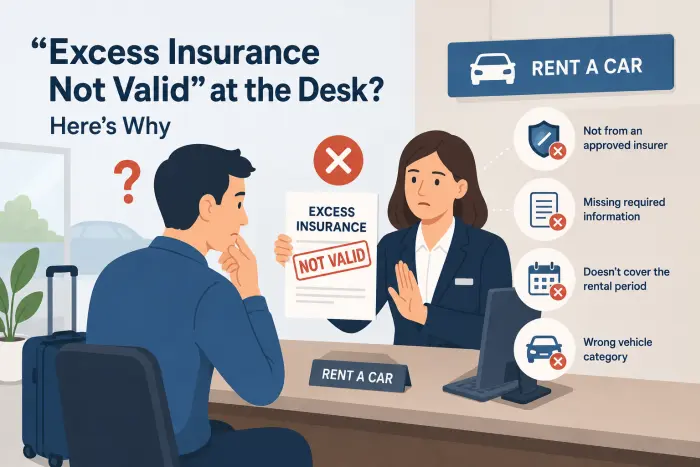
Yes, this happens, and no, it doesn’t mean your third-party excess insurance is worthless, it means the desk is drawing on a real structural difference between two products and using it as leverage. Your standalone policy reimburses you after you’ve paid the excess to the rental company; it was never designed to stop the company from charging you or holding a deposit in the first place. A desk that says “not valid here” is often technically correct about that distinction, while using it to pressure you into buying their own cover on top, sometimes with your keys or your patience as the thing being tested.
What’s Actually True
- 📋 Third-party excess insurance is a claim-and-reimburse product, you pay the rental company first, then claim the money back from your insurer, it was never a waiver the desk itself recognizes.
- 🚫 The rental company can still require its own deposit and its own excess liability regardless of any external policy you hold, that’s not a scam, it’s how the two products are structured.
- 💶 Real cases exist of companies demanding extra money on top of a purchased third-party policy under pressure tactics, including a documented case where OKMobility sought an additional €350 despite existing cover.
- 📸 Your best protection is documentation at pickup and drop-off, since a dispute over “validity” almost always becomes a dispute over evidence afterward.
- 🧾 You are never legally required to buy the desk’s own waiver just because you already hold third-party cover, even if that’s how the conversation is framed.
Is the Desk Lying When They Say Your Insurance “Isn’t Valid”?
Not necessarily, though the framing is often misleading. Third-party excess insurance and the rental company’s own waiver are structurally different products: the waiver reduces or removes what the company itself charges you upfront, while third-party cover reimburses you afterward for an excess you’ve already paid. When a desk says your policy “isn’t valid here,” they usually mean it doesn’t stop them from charging your card, which is technically true, it was never designed to. The problem is when this true statement gets used to imply your policy is worthless or fraudulent, which it isn’t, and that’s where the conversation can tip from a legitimate clarification into an uncomfortable upsell attempt.
Why Would a Rental Company Push Back on Valid Third-Party Cover?
Because their own waiver product is generally far more profitable than what a broker earns from selling you a policy elsewhere. Genuine documented cases show real pressure at the counter, including a reported instance where OKMobility demanded an additional €350 from a customer who had already purchased third-party excess cover, using the threat of not releasing the car as leverage. This isn’t universal, most transactions go smoothly, but it’s common enough that BVRLA, the UK’s trade body for vehicle rental, has publicly clarified the structural difference specifically because so much confusion (and pressure) stems from it. The clarification exists precisely because brokers selling cheap third-party cover rarely explain this limitation clearly at the point of sale, leaving travelers genuinely surprised when a desk pushes back months or years after they bought the policy.
| What You Have | What It Actually Does | What It Doesn’t Do |
|---|---|---|
| Rental company’s own waiver | Reduces or removes what they charge you directly | N/A, this is their product |
| Third-party excess insurance | Reimburses you after you’ve paid the excess to the rental company | Stop the company charging your card or holding a deposit |
| Standard car insurance (home) | Rarely covers rental excess at all | Prevent any rental company liability |
What Should You Actually Do If This Happens at the Counter?
Stay calm, ask for the specific clause in the rental agreement that requires their own cover, and document the conversation if you can. You’re not obligated to purchase the desk’s waiver simply because they’ve questioned your third-party policy, but you are obligated to accept that they can still hold a deposit and charge you the excess if something happens, since your policy reimburses you rather than preventing that charge. If the pressure continues past a reasonable point, it’s worth knowing your formal complaint options rather than caving to an upsell you didn’t plan for. Staying polite but firm, and asking specifically what contractual term requires their cover, tends to de-escalate this faster than arguing about whether your policy is “real.”
Does This Mean Third-Party Excess Insurance Is a Bad Idea?
No, it just means you need accurate expectations about what it does. It’s genuinely worth having for most travelers, since it’s typically far cheaper than the desk’s own waiver and covers the same underlying risk, a large excess charge if the car is damaged. The trade-off is that you’re managing a claim afterward rather than avoiding the charge entirely upfront, which is a meaningfully different experience at the counter than simply saying yes to the desk’s own product, and it’s a trade-off worth going in prepared for rather than discovering mid-conversation.
Is This Connected to How the Deposit Itself Works?
Yes, and understanding the connection helps explain why the pressure happens at exactly this moment. The deposit held on your card at pickup is separate from any insurance product, third-party or otherwise, it’s the rental company’s own security against damage, and it exists whether or not you have external cover. When a desk questions your third-party policy, they’re often really asking you to either accept a higher deposit hold or buy their waiver to reduce it. If a large deposit hold is what you’re actually trying to avoid, a genuine no-deposit rate tackles that directly, rather than relying on excess insurance of any kind to solve a problem it was never designed for. Knowing this distinction upfront means you’re not caught off guard by the sequence: policy questioned, deposit or waiver offered as the “solution.”
🚗 Discover Tenerife – Best Car Rental Deals
Compare top-rated suppliers, no hidden fees & free cancellation included.
How Do You Avoid This Situation Entirely?
Photograph and video the car thoroughly at pickup, keep your third-party policy documents accessible on your phone rather than buried in an email, and know the difference between this and outright booking fraud, which is a separate, more serious problem involving fake listings rather than a legitimate company pushing an upsell. The same handover documentation habits that protect you against disputed damage claims also strengthen your position if a desk tries to pressure you over insurance validity, since a well-documented pickup makes any later dispute far easier to resolve in your favor.
FAQ
Is it legal for a rental company to refuse my third-party excess insurance? Yes, in the sense that they’re not obligated to treat it as their own waiver. They can still hold a deposit and charge the excess directly; your policy simply reimburses you afterward rather than preventing that charge.
Should I buy the desk’s own waiver if I already have third-party cover? Usually not, this typically means paying twice for the same underlying protection. The desk’s own waiver only makes sense if you’d rather avoid the upfront charge entirely and skip the claims process afterward, which is a fair preference to have, just one worth choosing consciously rather than being talked into under time pressure at the counter.
What should I do if a company demands extra money despite my existing policy? Ask for the specific contractual basis for the charge, document the conversation, and pay under protest if you must to get your keys, then pursue a formal complaint and your insurer’s claims process afterward.
Does my credit card’s built-in rental cover face the same issue? Often, yes, similarly to standalone third-party insurance, card-based cover is usually claim-and-reimburse rather than a desk-recognized waiver, worth checking your card’s specific terms before relying on it exclusively.
Is this the same thing as a rental scam? No, this is a legitimate company using a real structural distinction as leverage, which is different from outright booking fraud involving fake listings or non-existent cars. Both are worth understanding, but they require different responses, one is a pricing pressure tactic and the other is theft dressed up as a booking.
How do I prove my third-party policy is genuine if the desk questions it? Have your policy documents, including the insurer’s name and policy number, readily accessible on your phone rather than in an email you’d need signal to retrieve. Most legitimate policies also include a claims phone number the desk can verify if needed.
Will my third-party insurer actually reimburse me if I do end up paying the desk’s charge? In most genuine cases, yes, provided the damage or charge falls within your policy’s terms and you file the claim with proper documentation. This is exactly why photographing the car and keeping your paperwork organized matters so much at pickup and return, a claim with clear before-and-after photos and a dated rental agreement moves through most insurers’ processes far faster than one relying on memory alone.