Search for driving rules in Santa Cruz de Tenerife right now and you’ll find a genuinely confusing mix of claims — some sites describe a low emission zone as already fully in effect, others don’t mention it at all, and neither version is quite accurate. The honest picture sits in between: Santa Cruz’s city council has formally approved a Zona de Bajas Emisiones (ZBE) covering the historic centre, and it’s set to start coming into force progressively from August or September 2026. What almost nobody mentions clearly is the other half of that timeline — the cameras and infrastructure needed to actually issue fines won’t be operational for roughly 18 months, meaning enforcement realistically doesn’t begin until July 2029.
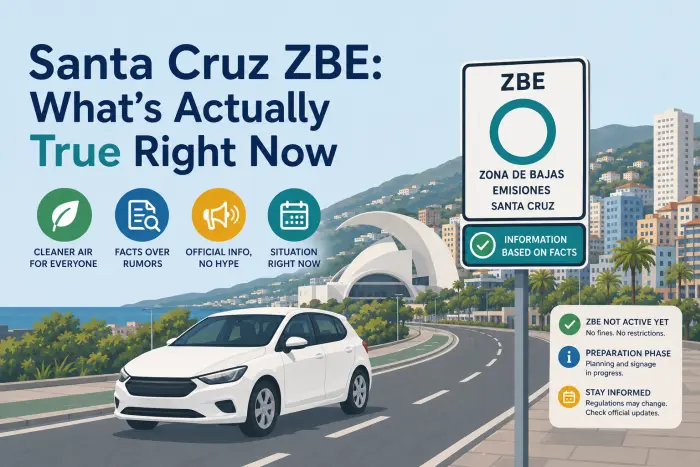
What’s Actually True Right Now
- Santa Cruz’s city council formally approved the ZBE ordinance, with the zone beginning to come into force progressively from August or September 2026 once published in the official provincial gazette.
- Fines will not be issued until July 2029 — the camera and enforcement infrastructure needed to actually detect and penalise non-compliant vehicles takes around 18 months to become operational.
- The zone covers Santa Cruz’s historic and commercial centre, bounded by Calle Méndez Núñez, Rambla de Santa Cruz, and Avenida de Anaga, including most of the El Toscal and Zona Centro neighbourhoods.
- Restrictions, once enforced, will apply Monday to Saturday, 7:00am to 8:00pm — outside those hours and on Sundays, the zone won’t restrict access regardless of your vehicle’s emissions category.
- This is actually the council’s second attempt — an earlier version of the ordinance was declared legally void by the Canary Islands’ High Court in 2025 over a defective impact assessment, which is part of why the timeline has shifted repeatedly.
Is the Santa Cruz low emission zone actually in effect right now?
Legally, the ordinance itself is approved and beginning to take effect — but “in effect” and “enforced” are two genuinely different things here, and it’s worth not conflating them. The zone’s rules and boundaries are now official, and the council intends to start the progressive rollout from August or September 2026. Practically, though, nothing changes for a visiting driver in the immediate term, because the actual enforcement mechanism — the camera network needed to read plates and issue fines — isn’t expected to be operational until around 2029. Some third-party rental sites have started describing the zone as simply “implemented,” which is technically true of the ordinance but genuinely misleading about what it means for anyone driving through central Santa Cruz today.
Where exactly does the ZBE cover, and when do the restrictions apply?
The zone sits within Santa Cruz’s historic and commercial core, bounded by three of the city’s main streets — Calle Méndez Núñez, Rambla de Santa Cruz, and Avenida de Anaga — and covers most of the El Toscal and Zona Centro neighbourhoods, an area with a high concentration of residential buildings, shops, and government offices. Once restrictions are actually being enforced, they’ll apply Monday through Saturday, 7:00am to 8:00pm — outside that window, and on Sundays entirely, the zone doesn’t restrict access based on your vehicle’s emissions category. This is worth remembering if you’re planning a visit to Santa Cruz as part of a wider island itinerary, since the restricted hours leave plenty of flexibility around them even once enforcement genuinely begins.
| Date | What happens |
|---|---|
| 2025 | First version of the ordinance declared legally void by the Canary Islands’ High Court |
| 2026 | Revised ordinance formally approved by Santa Cruz’s city council |
| Aug–Sep 2026 | Zone begins coming into force progressively |
| ~18 months after entry into force | Camera and enforcement infrastructure expected to become operational |
| July 2029 | Fines for non-compliant vehicles expected to actually begin |
Which vehicles are allowed in without restriction?
Once enforcement genuinely starts, vehicles carrying Spain’s environmental sticker categories of ECO, C, or B will have access, alongside zero-emission vehicles specifically. A meaningful set of automatic exemptions also applies regardless of sticker category: vehicles registered to residents living within the ZBE boundary (worth knowing alongside our separate resident parking permit guide, which covers the related but distinct ZER parking-zone system), mobility-reduced-access (PMR) vehicles, taxis, regular public transport, emergency services, and utility, cleaning, and roadside assistance vehicles. Historic-plated vehicles regulated under Spain’s separate classic vehicle rules are also exempt. For a standard rental car — almost always a reasonably new, mainstream model — the practical expectation is that most will already fall within an eligible sticker category once the system is fully live, though this is worth reconfirming closer to 2029 rather than assuming today’s fleet composition will match exactly what’s in place by then.
Does a foreign rental car need an emissions sticker to enter?
This is the detail that matters most for a visiting renter, and it isn’t fully resolved in public information yet. Spain’s environmental stickers (the coloured “distintivo ambiental” system) are designed around vehicles registered in Spain, which naturally covers the entire Tenerife rental fleet, since every rental car on the island carries Spanish plates. Foreign-registered vehicles brought to the island independently would be a separate question, but this doesn’t affect the overwhelming majority of visitors, who are driving a locally registered rental car regardless of which international brand’s name is on the booking. As the enforcement system gets closer to actually going live, it’s worth checking with whichever car hire company you’re booking for their specific guidance, though given the multi-year runway before fines start, this isn’t an urgent concern for a trip happening any time soon.
When will fines actually start being issued?
Not for years yet — July 2029 is the date consistently cited across official coverage of the ordinance, tied specifically to how long the necessary camera and detection infrastructure takes to install and certify. This is the single most important fact missing from a lot of the current online chatter about Santa Cruz’s ZBE, and it’s the reason this article exists rather than assuming the zone works like a fully operational system already. If you’re planning a Tenerife trip anywhere in the next few years, this specific restriction realistically won’t affect you — though it’s worth being aware the zone exists and understanding its boundaries, since local reporting and enforcement details will likely evolve as the 2029 date approaches.
Why did the first attempt at this zone get thrown out by the courts?
Spain’s Canary Islands High Court declared the original 2025 version of Santa Cruz’s mobility ordinance legally void, specifically because the council submitted a required regulatory impact assessment that the court found to be essentially empty and disconnected from the actual law it was meant to support. This forced the council to rewrite the technical assessment and resubmit the ordinance, which is part of why the current 2026 approval represents a genuinely fresh legal process rather than simply picking up where the earlier attempt left off — and it’s a useful piece of context for understanding why online information about this zone has been inconsistent and sometimes contradictory over the past year or so.
🚗 Discover Tenerife – Best Car Rental Deals
Compare top-rated suppliers, no hidden fees & free cancellation included.
Should you actually avoid driving into central Santa Cruz right now?
No — there’s no practical reason to change your driving plans for a Tenerife trip happening any time soon based on this specific ordinance. The zone’s restrictions won’t be enforced until 2029 at the earliest, and even once they are, the affected hours (Monday–Saturday, 7am–8pm) and area (the historic and commercial centre specifically, not the wider city or island) leave plenty of room to visit Santa Cruz without complication. The genuinely useful takeaway is understanding the zone exists and roughly what it covers, so that if you’re reading conflicting claims elsewhere about whether it’s “in effect,” you know both halves of the real answer — approved and beginning to formally exist, yes; actually fining anyone, not for years yet.
FAQ
Is Santa Cruz de Tenerife’s low emission zone currently being enforced? No — the ordinance has been approved and is beginning to formally take effect from August or September 2026, but fines aren’t expected to start until July 2029, once the required camera infrastructure is operational.
Where exactly is Santa Cruz’s ZBE located? The historic and commercial centre, bounded by Calle Méndez Núñez, Rambla de Santa Cruz, and Avenida de Anaga, covering most of the El Toscal and Zona Centro neighbourhoods.
What hours will the Santa Cruz low emission zone restrictions apply once enforced? Monday to Saturday, 7:00am to 8:00pm — the zone won’t restrict access outside those hours or on Sundays.
Does my rental car need a special sticker to drive into central Santa Cruz? Not currently, and not for several years — since fines aren’t expected until 2029, this isn’t an active concern for a visiting renter’s trip in the near term.
Why was Santa Cruz’s low emission zone delayed in the first place? An earlier version of the ordinance was declared legally void by the Canary Islands’ High Court in 2025 due to a defective impact assessment, forcing the council to rewrite and resubmit it.
Are taxis and emergency vehicles exempt from the Santa Cruz ZBE? Yes — along with public transport, mobility-reduced-access vehicles, utility and cleaning vehicles, and roadside assistance vehicles, once the zone is actually enforced.
Will Santa Cruz’s ZBE affect a short holiday visit to the city? No, not for the foreseeable future — with fines not expected until 2029, a visit any time soon is unaffected by this specific restriction.