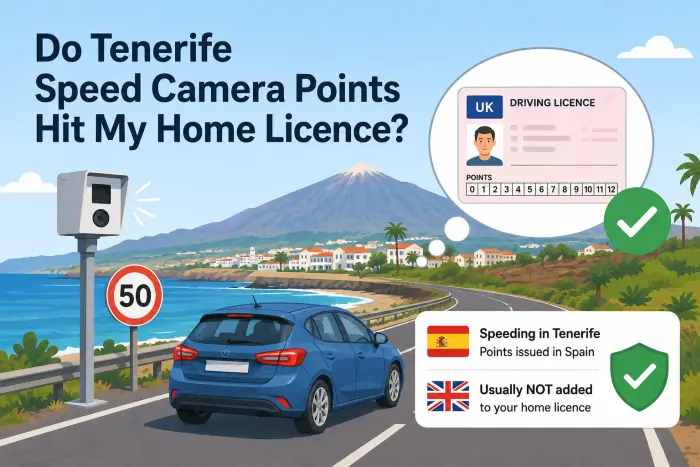
For most visitors driving a rental car around Tenerife, no — the points side of Spain’s traffic penalty system only applies to licences actually issued by Spain, so a camera flash on the TF-1 doesn’t touch a UK, US, Canadian, Australian or most other foreign licence directly. What it does touch is your wallet: the fine itself is real, it follows the car’s registration back to the rental company, and the company will pass the bill on to you along with their own administration fee. The confusion between these two separate consequences — a points deduction versus a straightforward monetary fine — is exactly what sends people searching in a slight panic after they’ve seen a flash in the rearview mirror on the way back from Teide.
It’s worth being precise about this rather than just reassuring, because the details genuinely differ depending on where your licence was issued, and getting it wrong in either direction causes real problems — either needless worry for the rest of your trip, or, worse, assuming a fine can simply be ignored because “the points don’t apply to me anyway.”
What Actually Lands on You
- Foreign (non-Spanish) licences never lose points under Spain’s system — there’s no mechanism that reaches back to a UK, US, Canadian, Australian or EU/EEA licence.
- The fine itself is still completely real and still needs paying — it follows the car’s plate to the rental company, then to you as the identified driver.
- A separate €30–€50 admin fee from the rental company is common on top of the DGT’s own fine, charged straight to the card used at pickup.
- Notices commonly arrive weeks to months after the trip ends — that delay is normal bureaucratic lag, not a sign anything’s gone wrong.
- The only scenario where points genuinely apply is a licence actually issued by Spain — a small minority of Tenerife’s visiting drivers.
How does Spain’s points system actually work, and who does it apply to?
Spain runs a demerit-points model through the DGT (Dirección General de Tráfico), starting most drivers on 12 points and deducting a set number for each infraction — speeding by a significant margin, using a phone while driving, or driving without a seatbelt are the most common ones tourists run into. If a driver’s points reach zero, their licence is suspended and they have to retake parts of the exam to get it reinstated. Crucially, this points ledger is tied to a Spanish driving licence specifically — it isn’t a database that reaches out and adjusts a UK DVLA record, a US state DMV record, or a Canadian provincial one. The points system and the fine system are legally separate mechanisms, and only the first one is licence-specific.
What actually happens when a rental car is caught by a fixed or mobile camera?
The camera captures the vehicle’s number plate, not the driver’s face in most cases, so the initial notice goes to whoever the car is registered to — the rental company, not you personally. Spanish law requires the registered keeper to identify the actual driver at the time of the offence within a set window, which is exactly why your rental agreement includes a clause authorising the company to pass your details (from the licence and card you provided at pickup) on to the traffic authority. Once you’re formally identified as the driver, the fine transfers to your name, and if you happen to hold a Spanish licence, any applicable points are deducted from it at that point — but for the vast majority of Tenerife’s visitors, driving on a foreign licence, that particular consequence simply doesn’t have anywhere to land.
| Licence type | Fine | Points |
|---|---|---|
| Spanish-issued licence | Applies, per the DGT’s official scale | Deducted from the 12-point balance |
| EU/EEA licence (non-Spanish) | Applies | Not deducted — no cross-border points-sharing system in place |
| UK, US, Canadian, Australian, other foreign licence | Applies | Not deducted — no mechanism exists to apply Spanish points abroad |
Will the fine actually show up immediately, or weeks after you’re home?
Almost always the latter, and this is where most of the frustration actually comes from. Between the camera capturing the plate, the rental company processing the driver-identification request, and Spain’s postal and administrative timelines, it’s common for a notice to land through your letterbox anywhere from a few weeks to a couple of months after you’ve already flown home and largely forgotten about the trip. This is a separate mechanic from the points question but often gets tangled up with it in people’s minds — the delay feels ominous, when really it’s just bureaucratic lag, the same process that applies to a parking ticket received after a hire car has already been returned.
Does this differ for EU licence holders compared with non-EU visitors?
Not in any way that changes the core answer, though the reasoning differs slightly. The EU has discussed, on and off for years, harmonising penalty-points systems across member states to make cross-border enforcement more consistent, but no working system currently exists — an Irish or German licence holder speeding in Tenerife faces exactly the same “fine yes, points no” outcome as someone driving on a US or Australian licence. The only genuine exception is a licence actually issued in Spain, which is a small minority of Tenerife’s visiting drivers and, realistically, mostly relevant to residents rather than tourists.
What’s the admin fee rental companies charge on top of the fine? 💶
This is often the part that actually stings more than the ticket itself. Once a rental company has processed your details through to the DGT and forwarded you the fine, most add their own administration charge for the paperwork involved — typically somewhere in the €30–€50 range, charged directly to the card used at pickup, separate from and on top of whatever the DGT itself is charging. It’s worth checking your rental agreement’s specific wording on this before you fly, since the fee varies noticeably by company, and it’s the sort of detail that’s easy to skim past at the counter when you’re focused on the deposit and insurance conversation instead.
Can the points situation ever change if you later move to Spain or apply for a Spanish licence? 🇪🇸
In a roundabout way, yes, though it’s a genuinely rare scenario for anyone reading this as a holiday driver. If you eventually become a Spanish resident and exchange your foreign licence for a Spanish one, or apply for one directly through the DGT, you start that new Spanish licence with its own fresh points balance — historic fines from a rental car years earlier don’t retroactively attach points to a licence that didn’t exist yet. Any unpaid fines, however, are a different matter entirely and can complicate a residency or licence-exchange process if they’ve gone to collections in the meantime, which is one more reason it’s worth actually paying a legitimate Tenerife traffic fine rather than assuming distance makes it disappear.
🚗 Discover Tenerife – Best Car Rental Deals
Compare top-rated suppliers, no hidden fees & free cancellation included.
What should you actually do if a fine arrives after your trip?
Read it properly before doing anything else — check the date, location and alleged speed against your own memory or trip notes, since genuine disputes do happen, particularly around Tenerife’s habit of shifting speed limits every few kilometres on stretches of the TF-1. If it looks legitimate, most Spanish traffic fines offer a 50% discount for prompt payment (usually within 20 days of the notice), though paying at that reduced rate typically means accepting the offence and giving up your right to appeal — worth knowing before you rush to pay if you genuinely think there’s been a mistake, similar to the reasoning behind asking calmly for the complaints form rather than accepting the first version of events you’re given. If you do want to dispute it, that process runs through the DGT directly, separately from whatever the rental company is chasing you for on their own administration fee.
For anyone particularly anxious about speed enforcement on this island specifically, it’s worth reading up on how Tenerife’s cameras and enforcement zones actually work alongside the legal position on radar-detector apps, since the two questions — what the fine costs, and whether it touches your home licence — are genuinely separate pieces of the same worry, and knowing both takes the edge off a lot of unnecessary in-trip stress.
FAQ
Will a Tenerife speeding fine affect my UK driving licence? The fine itself is valid and needs to be paid, but no points are deducted from a UK licence — there’s no mechanism linking Spain’s points system to the DVLA.
Can I be banned from driving in Spain because of points on my foreign licence? No — since Spain’s points system doesn’t apply to your foreign licence at all, there’s no points balance to reach zero on. A Spanish driving ban would only be relevant to a licence actually issued in Spain.
Do rental companies report every camera fine to my home country? No — the rental company’s obligation is to identify you to the Spanish DGT as the driver; there’s no separate reporting mechanism to your home country’s licensing authority for a standard speeding offence.
How long after my trip could a Tenerife speeding fine arrive? Commonly a few weeks to a couple of months, depending on the rental company’s processing time and Spanish postal timelines — it’s normal for it to arrive well after you’ve returned home.
Is it true I can just ignore a Tenerife speeding fine if I live abroad? Not safely — unpaid fines can be sent to collections, may affect a future car hire booking with the same company, and can complicate matters if you ever apply for Spanish residency or a Spanish licence later on.
Does an International Driving Permit change any of this? No — an IDP is a translation document alongside your existing licence, not a separate licence with its own points balance, so it doesn’t change how the fine or points situation works.
What’s the fastest way to know if a fine I’ve received is legitimate? Cross-check the date, location and details against your own trip records, and consider the DGT’s official fine-lookup service directly rather than relying solely on a letter or email that could, in rare cases, be a phishing attempt impersonating a genuine notice.