A device that’s completely legal to use in your home country can be a genuinely expensive mistake the moment you drive it out of a Tenerife rental car park. Spain draws a sharp legal line between three categories of technology that most drivers lump together as “avoiding speed cameras,” and only one of them is actually allowed. Getting this wrong isn’t a grey area or a rarely-enforced technicality, the penalties scale up fast, and simply having the wrong device in the car, switched off or not, can be enough.
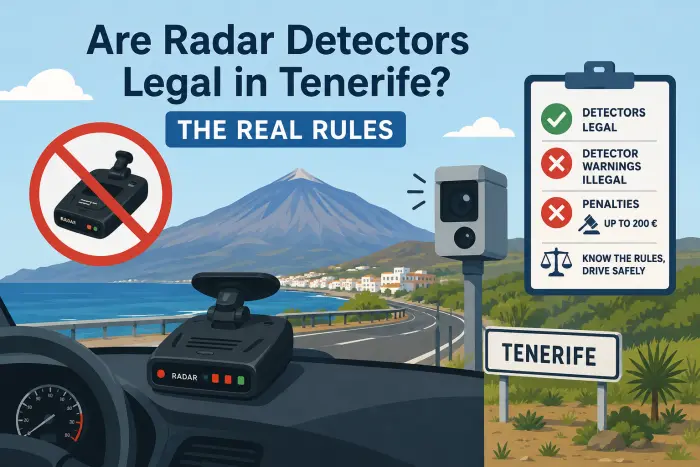
The three-tier rule: radar jammers, devices that actively block or interfere with police radar signals, are outright banned in Spain, carrying a fine of up to €6,000 and six points off a Spanish licence, and merely having one in the car, even switched off, is enough to trigger it. Active radar detectors, which passively scan for police radar frequencies, were more recently outlawed too, carrying a €200 fine and three points. What remains genuinely legal are GPS-based warning apps and devices, Waze, Google Maps’ built-in camera alerts, and dedicated gadgets like the OOONO CO-DRIVER or Coyote, since these rely on a crowd-sourced or publicly listed database of camera locations rather than detecting an actual radar signal. If you’re bringing a hardware radar detector from home, leave it there entirely; if you’re relying on your phone, stick to mainstream navigation apps rather than anything marketed specifically as a “radar detector.”
⚖️ The Three Categories, Side by Side
| Device Type | What It Does | Legal in Spain? | Penalty If Caught |
|---|---|---|---|
| Radar jammer (inhibidor) | Actively blocks or interferes with police radar signals | No — banned outright | Up to €6,000 and 6 points, for possession alone |
| Active radar detector (detector) | Passively scans for police radar frequencies to warn you | No — banned | €200 and 3 points |
| GPS warning app/device (avisador) | Uses a crowd-sourced or public database of known camera locations | Yes | No penalty for legitimate use |
The distinction that actually matters legally isn’t “does it warn me about a camera”, it’s how it gets that information. A device that intercepts an actual police radar signal is treated completely differently from an app that simply checks your GPS position against a list of known camera locations.
🚫 Radar Jammers: Never Bring or Use These
This is the category with the harshest penalty, and it’s worth being unambiguous about it: a radar jammer actively interferes with the equipment police use to measure speed, which Spain treats as a serious offence rather than a driving infraction. Simply having one in the car, in the glovebox, the boot, unconnected and switched off, has been enough to trigger the maximum fine in reported cases. If you own one of these at home, the only sensible choice is to leave it there; there’s no legal way to bring or use it in Tenerife.
🚫 Active Radar Detectors: Also Illegal, Lower Penalty
This is the category that catches out travellers from countries where standalone radar detector hardware is legal and commonly sold, which includes a meaningful number of visitors from outside the EU. A device that passively scans for police radar frequencies and alerts you when one is nearby was more recently outlawed in Spain specifically, separate from the jammer ban. The penalty is lower than for a jammer, but still real, a fine and points deduction that applies to Spanish licences and can create complications for visiting drivers depending on their home country’s own enforcement arrangements with Spain. If you’re bringing your own device from home rather than relying on your phone, check specifically whether it’s a passive detector rather than a GPS-based warning gadget before you pack it.
✅ What’s Actually Legal: GPS-Based Warning Apps and Devices
The good news is that the practical solution most drivers actually want, some warning before a known camera, remains completely legal, provided it works the right way:
- Waze and Google Maps both include speed camera alert features that rely on a combination of publicly listed fixed camera locations and crowd-sourced reports from other users, not actual radar detection. Both are legal to use in Spain.
- Dedicated GPS warning gadgets like the OOONO CO-DRIVER or Coyote work on the same principle, checking your position against a known-locations database rather than intercepting a police signal, and are legal for the same reason.
- Standard GPS navigation itself is always legal, regardless of any camera-alert feature, provided the device is properly mounted and doesn’t obstruct your view. See our car hire with GPS guide if you’re deciding between an in-car unit and your own phone for navigation generally.
📍 One Subtlety Worth Knowing: Fixed vs Mobile Camera Locations
Spain draws a further distinction that affects what these apps can legally show you. Fixed speed cameras are permanently installed and publicly listed by Spain’s traffic authority, so sharing or displaying their exact location is completely legal, this is the bulk of what Waze and Google Maps show you as a specific point on the map. Mobile radar units, set up in unmarked vehicles or on tripods and moved daily, are treated differently: publishing their precise real-time location is itself a punishable offence, which is why apps typically show a general “mobile zone” or “control area” rather than an exact pin for these. This is a restriction on publishing the information, not on the app itself, and it’s the reason app alerts near a mobile unit feel vaguer than the specific warnings you get for a fixed camera.
🚗 What This Means for Your Tenerife Hire Car Specifically
A few practical points that apply directly to a rental:
- If you’re bringing a hardware radar detector or jammer from home, don’t. Leave it at home entirely rather than risking it in checked luggage or the car, possession alone can be enough to trigger a penalty.
- Rely on your phone’s mainstream navigation app rather than seeking out anything specifically marketed as a “radar detector” app, since the legal distinction is about mechanism, not marketing.
- Make sure you actually have working data for Waze or Google Maps to function properly, see our eSIM and mobile data guide if you haven’t sorted this out before your trip.
- A hire car’s own built-in GPS, where offered, is a completely separate, unrelated feature and carries no legal concern of this kind at all.
- This is separate from speed limits themselves — our speed limits and fines in Tenerife guide covers the actual limits and penalty structure, which apply regardless of whether you’re using any warning app at all.
🌙 Does This Change at Night or on Rural Roads?
No, the legal distinction between jammers, detectors, and GPS warning apps applies the same way regardless of time of day or road type. If you’re driving after dark, our driving in Tenerife at night guide covers the genuinely different considerations that do apply then, none of which relate to radar detection specifically.
🚗 Discover Tenerife – Best Car Rental Deals
Compare top-rated suppliers, no hidden fees & free cancellation included.
✅ Checklist Before You Drive
- Leave any hardware radar detector or jammer at home entirely — don’t pack it, don’t bring it.
- Use Waze or Google Maps for camera alerts, which rely on legal, public/crowd-sourced data.
- Confirm your phone has working data before you rely on any app for camera alerts.
- Don’t seek out apps specifically marketed as “radar detectors” — check how they actually source their alerts, not just the name.
- Remember speed limits still apply regardless of any warning app — an alert doesn’t change what’s legal to drive at.
- If in doubt about a specific device, check whether it detects an actual radar signal (illegal) or checks a location database (legal) before bringing it.
❓ Frequently Asked Questions
Is it legal to use Waze for speed camera alerts in Tenerife? Yes. Waze relies on a combination of publicly listed fixed camera locations and crowd-sourced user reports rather than detecting an actual police radar signal, which is why it remains legal in Spain, including Tenerife.
Can I bring my radar detector from home to use in a Tenerife hire car? No — active radar detectors that scan for police radar frequencies are illegal in Spain, carrying a €200 fine and a points deduction. Radar jammers are banned outright with a far higher penalty. Leave both at home.
What’s the difference between a radar detector and a radar jammer? A radar detector passively scans for and alerts you to police radar signals. A jammer actively interferes with or blocks those signals. Both are illegal in Spain, but a jammer carries a significantly more serious penalty than a detector.
Can I get fined just for having a radar jammer in the car, even if it’s switched off? Yes, potentially. Reported cases show that simply possessing a jammer, even unconnected and switched off, can be enough to trigger the maximum penalty, since the device itself is prohibited, not just its active use.
Are GPS navigation apps with speed camera alerts different from radar detectors legally? Yes, fundamentally. GPS-based apps check your location against a known database of camera locations; they don’t detect an actual radar signal, which is the legal distinction that keeps them permitted while hardware detectors are banned.
Why does Waze sometimes show a vague “zone” instead of an exact camera location? This applies specifically to mobile radar units, which move daily and aren’t publicly listed. Publishing their precise real-time location is itself an offence in Spain, so apps show a general area rather than an exact point for these, while fixed, permanently installed cameras are shown precisely since their locations are public.
Does my hire car’s built-in GPS have any radar detection legal issue? No — a standard in-car GPS navigation unit is an entirely separate, unrelated feature and carries no legal concern of this kind, regardless of whether it happens to also show camera alerts sourced the same way apps do.
Do these rules apply differently at night or on quieter roads? No, the legal distinction between jammers, detectors, and GPS warning apps applies consistently regardless of time of day or road type across Tenerife and the rest of Spain.
🏁 Final Verdict: Know the Mechanism, Not Just the Marketing
The line between a legal and an illegal speed camera warning tool in Tenerife comes down entirely to how the device actually gets its information, not how it’s marketed or what it’s called. Leave any hardware radar detector or jammer at home, rely on mainstream apps like Waze or Google Maps for camera alerts, and the whole question stops being a risk and simply becomes a normal part of driving here.
👉 Compare car hire deals in Tenerife and drive with confidence about what’s actually legal. This guide is part of our full Tenerife car hire guide — for the general basics of the road, see our driving in Tenerife guide, and if a fine does arrive after your trip, see our parking or speeding fine after return guide.