Most people who visit Tenerife never make it to Anaga. They’re in the south — the resorts, the beaches, the organised excursions — and the northeastern tip of the island stays invisible to them, wrapped in its perpetual green haze.
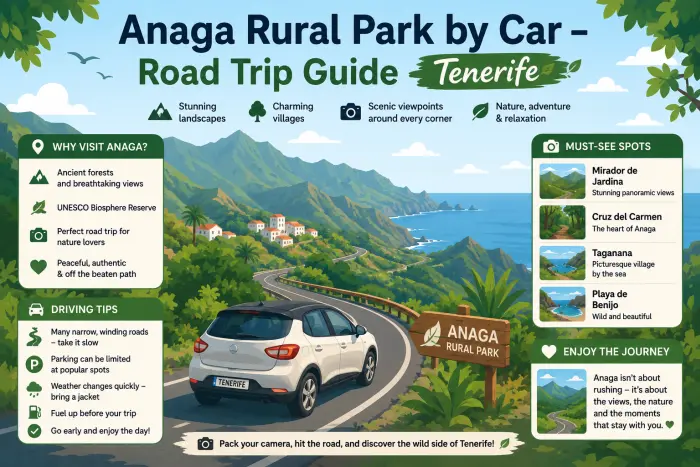
This is, from a certain perspective, excellent news for anyone who does go.
Anaga Rural Park is a UNESCO Biosphere Reserve covering 140 square kilometres in the northeastern corner of Tenerife — home to one of the world’s last remaining laurisilva forests, traditional mountain villages, and wild black-sand beaches. The mountains formed from a volcanic eruption between 7 and 9 million years ago, making the Anaga massif one of the oldest geological formations in the Canary Islands. It is, in the opinion of those who know it, as essential a destination as Teide National Park — just considerably less visited.
The key word in all of that is “less visited.” The bus from Santa Cruz reaches Taganana, but if you take the bus you’re limited to specific drop-off points — which means you can only visit one side of the park, and it’s more challenging to access the more remote trails. A rental car changes everything. It lets you drive the ridge road, stop at viewpoints on your own schedule, descend to the coastal villages, and follow the road to Benijo beach before anyone else arrives.
This guide is the complete road trip version of Anaga — three routes, the viewpoints that actually matter, the beaches, the villages, and honest advice on roads, timing, and which car to take.
🗺️ Understanding Anaga — Before You Drive In
There is no “park entrance” or “park gate” at Anaga Rural Park. You don’t pay to enter, you don’t queue, and there’s no visitor centre you have to pass through. The park is simply there — accessed via several roads that wind up from the surrounding towns and across the massif.
The TF-12 main road crosses Anaga Rural Park from west to east, from San Cristóbal de La Laguna to the north coast. It winds through the mountain range between ravines and crests, and serves most of the main points of interest. Think of TF-12 as the spine of the park — most of the viewpoints, village turnoffs, and trail heads branch from it.
Three main roads give you three distinct experiences:
| Route | Road | Direction | Best For |
|---|---|---|---|
| 1. Ridge Road | TF-12 | La Laguna → Chamorga (east) | Viewpoints, forest, classic Anaga |
| 2. Coast Road | TF-134 | Taganana → Benijo (north coast) | Beaches, fishing villages, drama |
| 3. San Andrés Loop | TF-11 + TF-121 | Santa Cruz → San Andrés → Igueste | Golden beach, coastal villages |
The classic route departs clockwise from San Cristóbal de La Laguna via the TF-12 road. We’d recommend doing exactly that — but this guide gives you all three options so you can choose based on your starting point and what you want from the day.
🛣️ Route 1 — TF-12 Ridge Road: La Laguna to Chamorga (The Classic)
Starting point: San Cristóbal de La Laguna (5 min from TFN Airport) Distance: ~30 km to Chamorga | Time: 45–60 min driving, 4–6 hours with stops Difficulty: ⭐⭐⭐ Medium — narrow in places, sustained curves
This is the route that defines Anaga for most visitors. We recommend starting at Santa Cruz de Tenerife and travelling to San Andrés. A worthwhile detour is to continue along the coast on TF-121 to Playa de las Teresitas. From here, head back to San Andrés and continue on the TF-12 and TF-134 up to Benijo.
The TF-12 climbs from La Laguna through the outskirts of the city and then, almost without warning, enters the forest. Within 10 minutes of leaving urban Tenerife you’re inside a laurel canopy so dense and mossy it’s genuinely otherworldly — the light filters green, the air is cool and damp, and the road narrows to single-lane in places.
The viewpoints you must stop at:
Mirador de Jardina — offers beautiful views of the fertile valley of La Laguna and Mount Teide in the distance. This is the first major viewpoint heading east from La Laguna — pull in early before the car park fills. On a clear morning, Teide visible from here across the valley is one of the finer views on the island.
Mirador Cruz del Carmen — can be accessed from the parking lot at the Anaga Park Visitor Centre. You’ll see the city of San Cristóbal de La Laguna and Mount Teide in the distance. The visitor centre here is small but excellent — maps, trail information, and context for the laurisilva ecosystem. Worth 20 minutes of your time.
Fairy Tunnel (Túnel de las Hadas) — a magical, moss-covered path that feels like something out of a fairy tale. It’s part of the Laurisilva Forest, with lush green trees creating a mystical, almost enchanted atmosphere. The trail is short and accessible from the road — one of those stops that looks modest on paper and is extraordinary in person.
Mirador Pico del Inglés — located at 967 metres, it delivers views of layered ridges and rugged mountains extending to the ocean. This is the highest accessible viewpoint from the main road and on a clear day you can see both the north and south coastlines simultaneously — one of the genuine panoramic surprises of the island.
Beyond the viewpoints, the road descends toward Chamorga — the most remote village accessible by car in Anaga. Known for its remote feel and cave houses carved into rock, it offers a unique insight into traditional living arrangements still in use today. From Chamorga, trails head toward Roque Bermejo beach — one of the most isolated beaches in Tenerife, reachable only on foot.
🌊 Route 2 — TF-134 North Coast Road: Taganana to Benijo (The Drama)
Starting point: Taganana village (via TF-12 descent from ridge) Distance: ~8 km | Time: 20–30 min driving, 2–4 hours with stops Difficulty: ⭐⭐⭐ Medium-Hard — narrow, steep descent, passing places required
This is another Anaga mountain drive on paved, good quality road all the way — with amazing views. The viewpoints might not be as famous as the ones on the main road, but many drivers like them even more.
Taganana is the natural starting point for the coast road. The quaint village of Taganana, with its white-washed houses and steep terraced vineyards, offers a glimpse into traditional Canarian life. Phone networks and electricity came very late to Taganana, which contributed to the lack of tourism in the area. Park in the upper part of the village — the streets inside are extremely narrow and steep.
From Taganana, the road descends to the coast through a series of tight bends with the Atlantic opening up ahead. Three beaches appear in sequence:
| Beach | Access | Swimming? | Notes |
|---|---|---|---|
| Playa de Roque de las Bodegas | By road, short walk | ⚠️ Check conditions | Small harbour, seafood restaurants, popular with locals |
| Playa de Almáciga | By road | ⚠️ Strong currents | Black volcanic sand, rocks dotting the shoreline, Anaga mountains as backdrop |
| Playa de Benijo | By road + steep staircase | ❌ Rough waves | Known for its dramatic rock formations, wild waves, stunning sunsets and rugged coastline |
The sea can be rough on this coast, so take care when approaching the shore. The beaches here are not the calm, sheltered coves of the south — they’re Atlantic-facing, exposed, and extraordinarily beautiful precisely because of it. Swimming is possible at Almáciga in calm conditions; at Benijo it’s rarely advisable, but the setting is worth the drive regardless.
The Benijo viewpoint is the real reward. It’s one of the most beautiful viewpoints in Anaga — treating you to incredible views of Benijo Beach and the rugged Anaga coastline. Park at the top, walk to the mirador, and spend as long as you want looking at one of the finest coastal views in the Canary Islands.
Timing advice 🌅 Benijo faces northeast — the light is best in the morning. By early afternoon the cliffs cast shadows on the beach. For the famous sunset at Benijo, the light catches the western faces of the rock formations, not the beach itself.
Where to eat on the coast: Restaurante El Frontón in the village of Benijo is the best recommended restaurant in the area — fresh fish caught that morning, with mesmerising views of the nearby beaches and cliffs. The terrace is small, so arrive early for a prime seat.
🏖️ Route 3 — San Andrés Loop: The Accessible Entry Point
Starting point: Santa Cruz de Tenerife Distance: ~18 km loop | Time: 30–40 min driving, 2–3 hours with stops Difficulty: ⭐⭐ Easy-Medium — wider roads, more traffic near Las Teresitas
From Santa Cruz, take the TF-12 road, which leads directly into the park — a journey of about 20 minutes. This is the most accessible entry for anyone staying in Santa Cruz or arriving at TFN and wanting a half-day introduction to Anaga without committing to the full ridge road.
🚗 Discover Tenerife – Best Car Rental Deals
Compare top-rated suppliers, no hidden fees & free cancellation included.
Playa de las Teresitas — a golden sandy beach north of Santa Cruz — is the most kid-friendly beach on the Anaga Peninsula. It’s not typical of Anaga’s wild character (the sand was imported from the Sahara, and there’s a protective breakwater), but it’s one of Tenerife’s finest beaches and makes an excellent first stop before heading into the massif.
From Las Teresitas, continue along the coast road to San Andrés — a small fishing village with excellent seafood restaurants right on the water. San Andrés is famous for its golden sandy beach and is a popular place for seafood lovers.
Igueste de San Andrés lies just outside the park boundaries on the southeast coast of the massif. Nestling at the end of a narrow ravine between sheer cliffs, this small fishing village has preserved its isolated, unspoilt character. The road to get there is narrow and ends at the village — it’s a dead end, so you’ll return the same way. That’s not a problem: the cliffs above the road on the return trip are magnificent in afternoon light.
🚗 What Car Do You Need for Anaga?
This matters more in Anaga than almost anywhere else in Tenerife.
Whilst the roads are narrow, steep, and winding, driving through Anaga hills is a great experience. But narrow and steep means your vehicle choice affects the experience directly.
| Car Type | Anaga Suitable? | Notes |
|---|---|---|
| Mini / City car | ✅ Best choice | Small footprint — ideal for narrow lanes and passing |
| Economy (Fiat Panda, Toyota Yaris) | ✅ Excellent | Perfect balance of size and capability |
| Compact (Seat Ibiza, VW Polo) | ✅ Good | Manageable — be cautious on tightest sections |
| Mid-size (Seat Leon) | ⚠️ Use caution | Width is a real consideration on TF-134 |
| Large SUV | ❌ Not recommended | TF-134 to Benijo is too narrow for large SUVs comfortably |
| Automatic | ✅ Excellent | Frequent stops and starts on steep village lanes — automatic is genuinely easier |
Due to its mountainous terrain, Anaga’s roads feature numerous curves and changes in elevation — drive carefully and allow enough time to enjoy the journey at a relaxed pace.
The specific road to avoid in a large vehicle: TF-134 from Taganana to Benijo. The paved road ends at Benijo Beach — and the stretch before it has several sections where passing requires one vehicle to reverse to a passing place. In a compact car this is manageable; in a large SUV it becomes genuinely stressful.
For more on choosing the right vehicle for Tenerife’s roads, see our guide to automatic car hire in Tenerife.
⏱️ How Long Does an Anaga Road Trip Take?
Allow at least half a day (3 to 4 hours) for a drive with a few stops at viewpoints. For a more complete visit including hikes, villages and beaches, book a full day.
Here’s how to structure your time:
| Trip Length | What You Can Cover | Best Route |
|---|---|---|
| Half day (3–4 hrs) | Ridge road viewpoints + Taganana | Route 1 to midpoint |
| Full day (6–8 hrs) | Ridge road + coast + Benijo beach | Routes 1 + 2 combined |
| 2 days | Everything + hiking trails | All 3 routes + overnight stay |
We recommend dedicating 2 days to exploring the area during your Tenerife trip. If you only have one full day, the combination of Route 1 (morning: ridge road viewpoints, Chamorga) and Route 2 (afternoon: Taganana, coast road, Benijo) covers the essential Anaga experience without feeling rushed.
🌿 The Laurisilva Forest — Why It Matters
Most visitors to Tenerife don’t know what laurisilva is. Driving through Anaga, they will feel it — the sudden drop in temperature, the strange quality of the light, the sense that something ancient is close by.
The Anaga Rural Park was classified as a UNESCO Biosphere Reserve in 2015 in acknowledgment of the fact that it is home to a vast range of endemic species. The laurisilva — subtropical laurel forest — was once widespread across southern Europe and North Africa before the last ice age. It survives today only in the Canary Islands and Madeira. The park encompasses the Anaga Massif, with 22,000 residents in charming villages that engage in traditional agricultural and herding activities, helping to maintain the area’s agricultural diversity.
This is what makes Anaga different from every other scenic drive on the island. Teide is dramatic. Masca is stunning. But Anaga is genuinely ancient — a living remnant of a world that existed before the ice ages changed everything.
📋 Practical Tips Before You Drive
Go on a weekday. Anaga gets busy at weekends, particularly Cruz del Carmen and the Benijo viewpoint. On a Tuesday or Wednesday morning, the ridge road is largely empty.
Start early. The light in the forest is best before 11am. The coastal viewpoints catch morning light from the east. And the car parks — particularly at Cruz del Carmen and Benijo — fill by mid-morning at weekends.
Bring more food and water than you think. The villages have restaurants, but they’re small and busy. There are no shops inside the park. Pack lunch, snacks, and at least 1.5 litres of water per person.
Download offline maps. Mobile signal in the deeper parts of Anaga — particularly the road to Chamorga and parts of TF-134 — is patchy. Download the area on Google Maps or Maps.me before you leave Santa Cruz.
Don’t leave valuables in the car. As with all rental cars in Tenerife — leave nothing visible. Anaga car parks are generally safe but rental cars are recognisable targets.
The El Pijaral trail requires a permit. Only the El Pijaral trail (Bosque Encantado) requires a free but compulsory permit, to be booked in advance. All other viewpoints and most trails are freely accessible without booking.
🔗 Related Guides on rentcarstenerife.com
- 🚗 Complete Tenerife car hire guide — island-wide overview: costs, companies, insurance and how to compare properly before you fly.
- 🛣️ Best roads to drive in Tenerife — Anaga features as Route 3 in our full 7-route ranking. See how it compares to Masca, Teide and the west coast.
- 🛣️ Driving in Tenerife — tips for first-timers — speed limits, mountain road advice, parking rules and the regulations that catch tourists off guard.
- ⚙️ Automatic car hire Tenerife — the village lanes of Anaga are one of the clearest use cases for an automatic gearbox on the island.
- ✈️ Car hire at TFN — Tenerife North Airport — TFN is 5 minutes from La Laguna — the ideal starting point for the Anaga ridge road. Pick up your car here.
- ✈️ Car hire at TFS — Tenerife South Airport — staying in the south? Allow 90 minutes to reach Anaga — make it a full-day trip.
- 🚗 Do you need a car in Tenerife? — Anaga is the clearest example of why a car transforms what’s possible on this island. Bus access exists but is limited.
🙋 Frequently Asked Questions — Driving Anaga Rural Park
Can you drive through Anaga Rural Park in a rental car?
Yes — all the main roads through Anaga Rural Park are paved and open to rental cars. There is no entrance fee, no permit required for driving, and no restriction on access. The roads are narrow and winding in places — particularly TF-134 on the north coast — so a smaller car is recommended. Driving off paved surfaces voids your rental insurance entirely.
How long does it take to drive through Anaga Rural Park?
Allow at least half a day (3 to 4 hours) for a drive with a few stops at viewpoints. For a more complete visit including hikes, villages and beaches, book a full day. If you want to combine the ridge road with the coast road and beach stops at Benijo, allow 6–8 hours minimum. Two days is the recommendation for anyone who wants to hike as well as drive.
What is the best road to drive in Anaga?
The TF-12 ridge road from La Laguna is the classic and most rewarding — viewpoints, forest, and village access all in one route. For drama and coastal scenery, the TF-134 from Taganana to Benijo is extraordinary. The viewpoints on the coast road might not be as famous as the ones on the main road, but many drivers like them even more.
Is Anaga Rural Park worth visiting from the south of Tenerife?
From the popular tourist areas in the south like Costa Adeje or Playa de las Américas, drive north on the TF-1 highway — the journey takes approximately 1.5 hours. For a full day, yes — absolutely worth it. Anaga is genuinely unlike anything else on the island and offers a complete contrast to the south’s resort experience. Start early, combine the ridge road and coast stops, and allow the full day.
What is the best time to visit Anaga Rural Park by car?
Morning — for the light in the forest and the coastal viewpoints. Weekdays for quieter roads and car parks. The park is beautiful year-round, but misty mornings in the laurel forest (common in autumn and spring) are particularly atmospheric. Avoid weekend afternoons at the main viewpoints — Cruz del Carmen and Benijo fill up.
Do I need a permit to visit Anaga Rural Park?
Access to the park and the vast majority of its trails and lookouts is completely free. Only the El Pijaral trail (Bosque Encantado) requires a free but compulsory permit, to be booked in advance. No permit is needed for driving, parking at viewpoints, or visiting the villages.
Can I take a large SUV to Benijo Beach in Anaga?
Not recommended. The TF-134 from Taganana to Benijo is narrow and has several sections requiring passing-place reversals when vehicles meet. A compact or economy car handles it comfortably. A large SUV will manage but requires considerably more care and patience — particularly if you encounter another vehicle on the tighter bends.
Are there restaurants in Anaga Rural Park?
Yes — several excellent ones. Restaurante El Frontón in Benijo is the best recommended restaurant in the area — fresh fish caught that morning, with mesmerising views. Roque de las Bodegas has Restaurante La Ola, known for fresh seafood and octopus. Taganana has Casa Picar for local Canarian dishes including papas arrugadas. All are small — arrive early or expect to wait.
Pair this with the other drives in our Tenerife road-trip guide.