Around three million people visit Teide National Park every year, which works out to roughly 8,200 visitors a day on average — and the overwhelming majority of them arrive in the same narrow window, between 9am and 4pm, exactly when the tour buses run and the cable car queue is at its worst. None of that is a coincidence; it’s simply when most people’s schedules and day trips happen to line up. The genuinely useful insight, once you actually look at how the crowds, weather and light change across the day and the year, is that the best time to visit rarely overlaps with when everyone else does.
Timing It Right
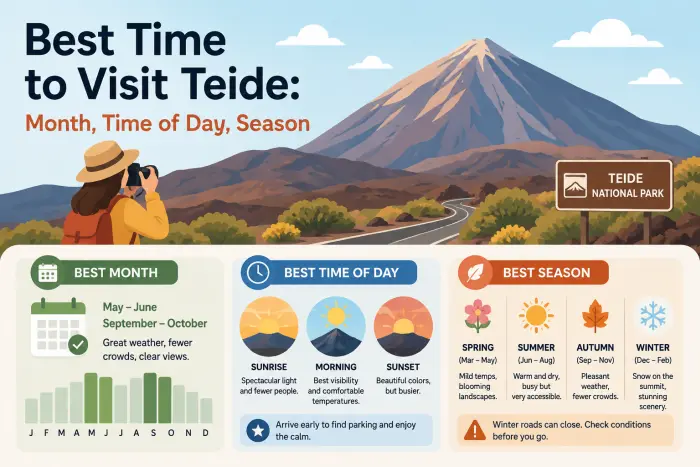
- Late afternoon, roughly two hours before sunset, is consistently described as the best single window of the day — the tour buses have mostly left, the light turns the volcanic landscape a deep orange-red, and you can stay through sunset itself.
- May through October offers the most reliable weather across the island generally, with June standing out as a genuine sweet spot for long daylight hours and settled conditions.
- The famous “sea of clouds” — a white carpet of cloud sitting below the summit while you stand in full sun above it — depends on a stable trade-wind inversion, which is more consistent in summer but can appear at other times of year too.
- Winter (December–February) carries the highest risk of snow and cable car closures, but also the thinnest crowds, easier summit permit availability, and some of the clearest, most dramatic days of the year when conditions cooperate.
- If stargazing is part of your plan rather than just the daytime visit, June specifically combines long, warm evenings with sunset around 9pm and reliably dark, settled skies.
What’s the actual best month to visit Teide?
If you want the most reliably good weather with the least risk of a washed-out or wind-cancelled day, May through October is the strongest overall window, and within that range June tends to get singled out specifically for its combination of long daylight hours, generally settled high pressure, and a lower chance of the more oppressive heat that August can bring at lower altitudes (the summit itself stays cool regardless of the season, since 3,700 metres doesn’t share the coast’s climate). September and October are a close second, adding the benefit of thinning summer crowds and some of the clearest air of the year once the Saharan dust season eases off — worth checking our guide to calima and driving conditions if dust haze is a concern for your specific dates.
What time of day should you actually go, and why does everyone get it wrong?
Most visitors arrive in the mid-morning to early-afternoon window simply because that’s when day trips and tour itineraries are built around, and it’s exactly the period when the park is busiest — tour buses, the longest cable car queues, and the most crowded viewpoints all cluster in that same stretch. Arriving around two hours before sunset instead flips that entirely: the majority of day-trippers have already left or are heading back down, the light turns the caldera’s volcanic rock into deep reds and oranges that don’t show up the same way at midday, and you get to finish the visit watching an actual sunset over the clouds rather than driving back down in flat afternoon light. The cable car does stop running before dark — check current hours before you plan around it, since they shift seasonally — but the park itself and its main viewpoints stay accessible well into the evening.
What’s the “sea of clouds” phenomenon, and when do you actually see it?
This is one of Teide’s genuinely distinctive features and it’s worth understanding rather than just hoping to get lucky. The Canary Islands sit under a persistent trade-wind temperature inversion, which traps a layer of cloud at a relatively low altitude while the air above — including the entire upper section of Teide — stays clear and sunny. When that inversion is well-established, you get the striking effect of standing in full sunshine looking down at an unbroken white carpet of cloud below you, often with only the very tips of neighbouring peaks poking through. It’s more consistently present during settled high-pressure periods, which lean toward summer and early autumn, but it isn’t exclusive to any single month — checking a recent weather forecast for cloud-base height a day or two before your visit is a more reliable predictor than the calendar alone.
| Season | Weather reliability | Crowd level | Notable feature |
|---|---|---|---|
| Winter (Dec–Feb) | Higher snow/closure risk | Lowest | Uncrowded, easier permits, dramatic snow-capped views |
| Spring (Mar–May) | Improving, still variable | Moderate, rising | Good shoulder season, permits still reasonable |
| Summer (Jun–Aug) | Most reliable | Highest | Sea of clouds most consistent, longest stargazing evenings |
| Autumn (Sep–Nov) | Very good, clearing dust | Thinning after August | Clear air, quieter than summer, still warm |
Is winter worth considering, despite the snow risk?
Genuinely yes, if you go in with the right expectations. Winter brings a real chance of snow and ice on the upper mountain, and cable car and road closures do happen more frequently during this period — worth reading in full if you’re planning a winter visit, since it covers the closure mechanics this piece doesn’t repeat in depth. What winter also brings is the thinnest crowds of the year, noticeably easier availability for the summit permit, and, on the clear days that do happen, some of the most dramatic and uncrowded views on the mountain — a snow-dusted volcanic landscape under a bright winter sun, with a fraction of the usual foot traffic. The tradeoff is real and worth being honest about: you’re accepting more day-to-day uncertainty in exchange for a much quieter, occasionally spectacular experience.
Does the best time change if you’re going for stargazing specifically?
Yes, meaningfully. Stargazing at Teide has its own best window, running roughly May through September for the most reliable clear nights, with July and August delivering the highest number of completely clear nights of the year — at the cost of the most crowded viewpoints at sunset, before everyone else heads back down. June stands out again here specifically: sunset lands around 9pm, giving you a long, comfortable evening at altitude before full darkness, and the settled early-summer weather pattern tends to hold reliably. If a clear, dark sky matters more to your trip than avoiding daytime crowds, June through August is the stronger window even though it overlaps with the busiest general tourist season.
How do cable car hours change by season?
They shift meaningfully enough to plan around rather than assume. Winter operating hours typically run shorter, commonly 9am to 5pm, while summer hours extend later, often to around 6:40pm, giving you more flexibility to combine a late-afternoon arrival with an actual cable car ride before it closes for the day. Since these hours can vary by specific dates and conditions, checking current cable car times and booking ahead is worth doing close to your actual visit date rather than relying on a general seasonal rule alone.
🚗 Discover Tenerife – Best Car Rental Deals
Compare top-rated suppliers, no hidden fees & free cancellation included.
So what’s the actual ideal combination — month plus time of day?
If you’re optimising purely for the calmest, most reliable overall experience: June, arriving around two hours before sunset, gives you settled weather, a strong chance at the sea-of-clouds effect, thinning crowds compared with peak July–August, and — if you stay past dark — one of the best stargazing windows of the year in the same trip. If your priority is avoiding crowds above almost everything else and you’re comfortable with more day-to-day weather uncertainty, a clear winter weekday afternoon offers a genuinely different, much quieter version of the same mountain. Either way, the time-of-day rule holds regardless of which month you pick: arrive late rather than with the morning rush, and you’ll have a noticeably better visit than most of the roughly 8,200 people doing exactly the opposite on any given day.
FAQ
What is the single best month to visit Teide? June is often singled out for the best overall combination of settled weather, long daylight, and a strong chance of the sea-of-clouds effect, with September and October close behind for quieter crowds and clear air.
What time of day has the fewest crowds at Teide? Roughly two hours before sunset — most day-trippers and tour buses have already left by then, and you get better light for photos plus the option to stay for sunset itself.
When can you see the “sea of clouds” at Teide? Whenever a stable trade-wind inversion is in place, which is more consistent during summer and early autumn’s settled high-pressure periods, though it can appear at other times too depending on conditions.
Is it worth visiting Teide in winter? Yes, if you accept more weather uncertainty — winter brings the thinnest crowds, easier summit permit availability, and some genuinely spectacular snow-capped views on the clear days.
Do Teide’s cable car hours change by season? Yes — typically shorter hours in winter (around 9am–5pm) and longer in summer (extending to around 6:40pm), worth checking directly close to your visit date.
Is June or August better for stargazing at Teide? Both offer reliably clear skies, but June’s earlier sunset (around 9pm) and slightly thinner crowds give it a practical edge over August, which sees the highest number of completely clear nights but also the most visitors.
Does the best time to visit Teide change if I want to reach the actual summit, not just the cable car station? Somewhat — permits for the regulated summit trail are noticeably easier to get outside the July–August peak, so a shoulder-season visit can meaningfully improve your chances of securing one.