Most people see the words “Teide” and “stargazing” together and assume it means booking a coach tour with a guide, a telescope, and a fixed pick-up time. You don’t actually need any of that. Teide National Park is an officially certified Starlight Reserve — one of the best places on Earth to see the night sky with nothing but your own eyes — and if you’ve already got a hire car, you can simply drive up, park at one of several well-known spots, and look up. No tour, no ticket, no guide required for the basic experience.
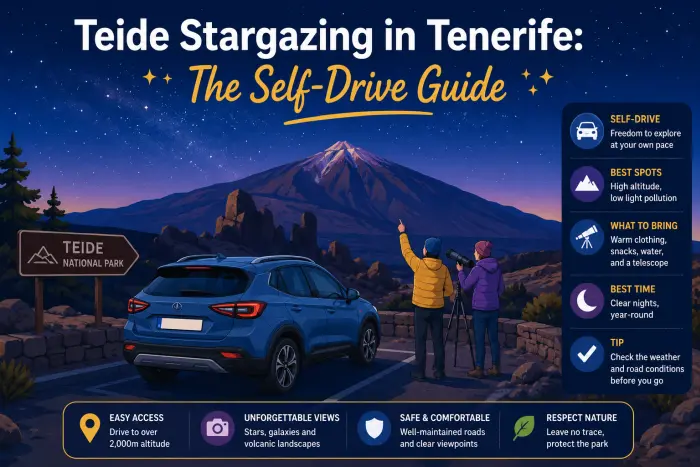
Quick steps: Teide National Park is a certified Starlight Reserve, and from its viewpoints you can see roughly 83 of the 88 officially recognised constellations on a clear night. No permit or booking is needed simply to park at a roadside viewpoint and stargaze — popular self-drive spots include the area around the cable car base station, Mirador El Tabonal Negro near the TF-21, and the open plain around Llano de Ucanca and Boca Tauce. Winter nights tend to be longest and clearest, while a clear night in August can reward you with the Perseid meteor shower. Bring warm layers regardless of the season — temperatures drop sharply after dark at this altitude — and check road conditions before heading up during the colder months, when ice or temporary closures are possible.
⭐ Why Teide Is One of the Best Stargazing Spots in the World
A few things combine to make this part of Tenerife genuinely exceptional for stargazing, not just “good for an island”:
- 🏆 Officially certified as a Starlight Reserve and Starlight Tourist Destination, a recognition given for meeting strict standards on light pollution control and sky quality.
- 🌌 Around 83 of the 88 officially recognised constellations are visible from the park on a clear night — an unusually high number for any single location.
- 🔭 The Teide Observatory sits high on the mountain’s slopes and is one of the world’s leading sites for solar and night-sky astronomical research, a strong signal of just how clear and stable the atmosphere is here.
- ☁️ The “sea of clouds” effect — a layer of cloud often sits below the park at a lower altitude, leaving the sky above completely clear even when the coast is overcast.
🚗 Do You Need a Tour, or Can You Just Drive Up Yourself?
Both are genuinely valid options, and which one suits you depends on what you actually want from the evening:
| Self-Drive | Guided Tour | |
|---|---|---|
| 💶 Cost | Just fuel and your existing hire car | A paid ticket, often including coach transport |
| 🕐 Flexibility | Go whenever skies look clear, stay as long as you like | Fixed pick-up and return times |
| 🔭 Equipment | Bring your own, or simply use the naked eye | Professional telescopes usually included |
| 🗣️ Guidance | None, unless you study the sky yourself beforehand | A Starlight-certified guide explains what you’re seeing |
| 🏛️ Observatory access | Not included | Some tours include a guided observatory visit |
If you mainly want to see a genuinely dark sky without spending the evening on a schedule, self-drive is hard to beat. If you want a guide pointing out exactly what you’re looking at, or access to professional telescopes and the observatory itself, a tour adds real value.
📍 Best Self-Drive Stargazing Spots In and Around the Park
| Spot | What Makes It Good | Notes |
|---|---|---|
| 🚡 Cable car base station car park | Wide open car park, easy to find, good all-round sky | Gets busier with daytime visitors leaving at dusk |
| 🌑 Mirador El Tabonal Negro (TF-21) | Open volcanic plain with Mount Teide behind you and the Guajara mountains ahead | Genuinely remote-feeling, very low light pollution |
| 🏜️ Llano de Ucanca / Boca Tauce | Flat, expansive plain, easy to pull off and set up | One of the most photographed stargazing spots on the island |
| 🌄 Mirador de Masca (Teno area) | An alternative away from Teide itself, with its own dark, clear skies | Good backup if Teide’s upper park is cloudy or crowded |
Whichever spot you choose, our driving to Mount Teide guide covers the route up in daylight conditions first, which is worth doing at least once before attempting the same roads after dark.
🌙 Best Time of Year and Night to Go
Longer, clearer nights generally fall in the winter months, when the skies tend to be at their darkest and most stable. If meteor showers interest you, a clear night around August can be rewarding thanks to the Perseids. Beyond the season, the single biggest factor on any given night is simply the moon: a few nights either side of a new moon give the darkest skies, while a bright full moon will wash out fainter stars regardless of how clear the air is. Our best time to visit Tenerife guide covers the broader seasonal picture if you’re planning a trip with stargazing as one part of a longer stay.
🧥 What to Bring and Wear
Teide National Park sits at altitude, and night temperatures up here are a different experience from the coast, even in summer:
- 🧥 Warm layers, including a proper jacket — it gets genuinely cold after dark, regardless of how warm the resorts were that same afternoon.
- 🔋 A torch or phone flashlight with a red-light mode if possible, to avoid ruining your night vision (and everyone else’s nearby).
- 🍫 Snacks and a hot drink in a flask — there’s nothing open up here once it’s dark.
- 📱 A fully charged phone, partly for photos and partly because signal can be patchy in parts of the park.
- 🧤 Gloves and a hat in the colder months — temperatures can drop close to freezing overnight at this elevation.
🛣️ Driving Up and Down at Night Safely
A few practical points specific to doing this after dark:
- 🌨️ Check road conditions before you go in winter. Snow and ice at this altitude can lead to temporary closures on the access roads.
- 🛣️ Drive the route in daylight first if it’s your first visit, so the road feels familiar by the time you’re doing it after dark.
- 🅿️ Use marked car parks and viewpoints rather than stopping on the road itself — our parking in Tenerife guide covers general parking habits that apply here too.
- 🚗 If you’re new to driving on the island generally, our driving in Tenerife guide and our best roads to drive in Tenerife guide both cover the wider context before you add “at night” into the mix.
- ⛽ Fill up beforehand. There’s nowhere to refuel once you’re up in the park.
- 🛣️ Pick your approach road based on where you’re staying. From the south, the route climbs through Vilaflor, the highest village in Spain, which also makes a sensible last fuel and toilet stop — it pairs naturally with a south Tenerife road trip day that finishes with stargazing after dark.
🔭 The Teide Observatory: Can You Visit at Night?
The Teide Observatory itself is a working scientific research facility, not a general tourist viewpoint, so visits are guided-only and need to be booked in advance rather than turning up on the night. If getting inside the observatory specifically matters to you, build that booking into your plans well ahead of time — it’s a separate experience from simply parking nearby and looking up at the open sky, which remains free and unrestricted.
🚗 Discover Tenerife – Best Car Rental Deals
Compare top-rated suppliers, no hidden fees & free cancellation included.
🌄 Alternative Spot If Teide Is Cloudy or Busy: Masca
Mount Teide’s upper park isn’t the only dark-sky option on the island. The Teno massif around Masca offers its own clear, low-light-pollution skies, and makes a solid backup plan if cloud has settled over the Teide area on a particular night, or if you’d simply rather combine stargazing with a different scenic drive than the one you’ve already done in daylight.
✅ Self-Drive Stargazing Checklist
- 🌙 Check the moon phase — aim for a few nights either side of a new moon for the darkest skies.
- ☁️ Check the weather and cloud forecast for the park specifically, not just the coastal resort forecast.
- 🧥 Pack warm layers, even if you’re coming straight from a warm beach afternoon.
- ⛽ Fill the tank before heading up — there’s no fuel available once you’re in the park.
- 🅿️ Pick a known viewpoint or car park rather than improvising a stopping spot on the road.
- 🔋 Charge your phone fully and bring a torch with a red-light setting if you have one.
- 🛣️ Drive the route once in daylight before attempting it after dark, especially on a first visit.
❓ Frequently Asked Questions
Do I need a permit to go stargazing at Teide? No — parking at a roadside viewpoint or car park within the national park to look at the night sky doesn’t require a permit. The only permit-related restriction in the park applies specifically to hiking the summit trail to Pico del Teide, which is a separate activity from stargazing at the viewpoints.
Can I drive up to Teide at night without a guided tour? Yes. The access roads remain open to the public, and several well-known viewpoints and car parks within the park are commonly used for independent stargazing, with no booking required.
What’s the best time of year for stargazing at Teide? Winter generally offers the longest, clearest nights. If you’re hoping to catch a meteor shower, a clear night in August can be rewarding thanks to the Perseids. The moon phase matters just as much as the season — aim for nights near a new moon.
Is it safe to drive up to Teide at night? Generally yes, on a clear night with no weather issues, though it’s worth checking conditions first, particularly in winter when ice or snow at altitude can affect the roads. Driving the route once in daylight before your first night visit is a sensible way to get familiar with it.
How cold does it get at Teide at night? Noticeably colder than the coast, even in summer, and temperatures can approach freezing overnight in the colder months given the altitude. Warm layers are essential regardless of when you visit.
Can I visit the Teide Observatory at night? The observatory is a working research facility and only offers guided visits, which need to be booked in advance. You can’t simply turn up at night and go inside, though the surrounding park remains open for stargazing at the public viewpoints.
Is Teide really one of the best places in the world for stargazing? Yes — it holds an official Starlight Reserve and Starlight Tourist Destination certification, and around 83 of the 88 officially recognised constellations are visible from the park on a clear night, which is genuinely exceptional for any single location.
Where else in Tenerife can I see a really dark sky if Teide is cloudy? The Teno massif around Masca offers another low-light-pollution area worth considering as a backup, with its own dramatic mountain scenery as a bonus during the drive there.
🏁 Final Verdict: Bring a Jacket, Not a Booking
Teide’s reputation as a world-class stargazing destination is entirely earned, and the best part is that you don’t need to pay for a coach tour to experience the core of it. Park at a known viewpoint, wrap up warm, and look up — the sky does the rest.
👉 Compare car hire deals in Tenerife so you have the freedom to chase a clear night whenever it comes. This guide is part of our full Tenerife car hire guide — for the daytime side of the mountain, see our best hikes in Tenerife and best viewpoints in Tenerife guides.