Yes, a calima genuinely changes driving conditions in Tenerife, sometimes dramatically, cutting visibility to a fraction of normal within a few hours as Saharan dust rolls in from North Africa. It’s not something most first-time visitors have heard of before booking a rental car, but it happens several times a year, and knowing what to actually do (rather than just “be careful”) makes a real difference if one rolls in during your trip.
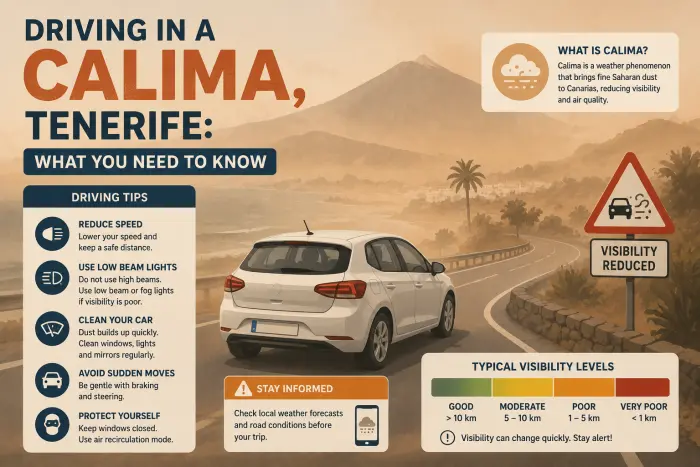
What You Need to Know
- 🏜️ A calima is a weather event where dust from the Sahara blows across the Canary Islands, hazing the sky, reducing visibility, and coating everything, including your rental car, in a fine layer of dust.
- 👀 Visibility can drop enough that distant landmarks, and sometimes even the neighboring islands, disappear from view entirely.
- 💡 Driving with dipped headlights on, even in daytime, is genuinely useful during a calima, since it helps other drivers see you sooner.
- ⛰️ Heading up in elevation, toward Teide or the northern hills, often puts you back above the dust layer and into clear air.
- 🚗 Rental cars handle a calima fine mechanically, this is a visibility and air quality issue, not a reason to avoid driving altogether, just a reason to adjust how you drive.
What a Calima Actually Is
The short version: it’s Saharan dust, carried across the Atlantic on southeasterly winds, and it’s a genuinely regular feature of life on Tenerife rather than some rare freak event. It shows up most often between late winter and early autumn, though it can technically happen at almost any time of year. Locals recognize it immediately: the sky turns a hazy yellow-orange, distant views vanish, and a thin film of dust settles on cars, balconies, and windshields within hours.
For most visitors, a mild calima is barely more than an inconvenience, a slightly gritty car and a slightly less clear photo from a viewpoint. A stronger one is a different matter, and it’s the stronger ones that genuinely affect how you should drive.
What Actually Changes When You’re Behind the Wheel
This is the part most general “what is a calima” articles skip entirely, because they’re written for people staying at a resort, not people navigating unfamiliar roads.
Visibility drops, sometimes sharply. On a strong calima day, you can lose sight of landmarks that are normally visible for miles. On coastal roads this is disorienting more than dangerous, since traffic is usually light and roads are wide. On the island’s narrower mountain roads, reduced visibility around bends becomes a genuinely relevant safety factor, not just an aesthetic one.
The air quality drop is real, not just visual. Fine dust particles affect people with respiratory conditions more than most travelers expect, and if you notice your eyes stinging or a scratchy throat while driving, that’s the calima, not a coincidence. Running the car’s air conditioning on recirculate rather than pulling in outside air helps noticeably.
Your windshield gets dusty fast. Wipers with only water tend to smear the dust into a film that’s harder to see through, not easier. If your rental has washer fluid topped up (worth checking at pickup, alongside the rest of the standard inspection checklist), use it generously rather than relying on wipers alone.
Where It’s Worse, and Where It Isn’t
Calima intensity isn’t uniform across the island, and this is genuinely useful for route planning if one hits mid-trip.
| Area | Typical Calima Impact |
|---|---|
| Southern coastal resorts (Costa Adeje, Los Cristianos) | Often hit hardest, since dust tends to settle lower and along the coast |
| Santa Cruz and the north coast | Usually affected too, though sometimes slightly less severe |
| Higher elevations (Teide, Vilaflor, the northern hills) | Frequently clear of the haze entirely, since the dust layer often sits below a certain altitude |
| Anaga’s forested ridges | Can stay clear even during a coastal calima, thanks to elevation and the laurisilva microclimate |
This is why locals often say the best move during a calima is simply to drive up. A trip toward Teide National Park that was already on your itinerary can turn into the best possible use of a hazy day, since you’re likely to climb straight out of the dust layer and back into clear skies within half an hour or so.
🚗 Discover Tenerife – Best Car Rental Deals
Compare top-rated suppliers, no hidden fees & free cancellation included.
Practical Driving Adjustments
None of this requires special equipment or unusual driving skill, just a few sensible adjustments to normal habits.
- Turn on dipped headlights, even in daylight. It costs nothing and makes your car noticeably easier for other drivers to spot in the haze.
- Increase following distance. Reaction time drops when visibility does, the same logic as driving in fog or heavy rain.
- Slow down on unfamiliar bends, particularly anywhere you’d normally be relying on seeing oncoming traffic early, like narrower mountain roads.
- Check your mirrors more often than usual. Dust on the rear windshield and mirrors reduces your own visibility of what’s behind you, not just what’s ahead.
- Keep your phone charged with offline maps ready, since a strong calima can occasionally affect mobile signal in already patchy areas, worth planning ahead in the same way you would for driving at night. Having an offline-capable data plan set up before you land removes one more thing to worry about if conditions turn hazy mid-route.
What Locals Actually Do
It’s worth borrowing a bit of local instinct here, since it tends to be more useful than generic advice. Residents don’t treat a calima as an emergency, but they do adjust their day around it without much fuss. If the coast is hazy in the morning, plenty of people simply flip their itinerary, saving the beach or seafront plans for later in the day when a calima has often thinned out, and using the clearer morning hours for a mountain drive instead. Locals also tend to keep sunglasses and a spare bottle of water in the car specifically for calima days, since the dry air and haze can be genuinely uncomfortable on longer drives, even if the driving itself stays manageable.
If you’re renting for a week or more and a calima rolls in partway through, it’s rarely worth reshuffling an entire itinerary around it. Most events pass within a day or two, and the island’s road network is compact enough that a single hazy afternoon rarely costs you more than a slightly less scenic drive than planned.
What If You Break Down During a Calima
Reduced visibility makes a roadside breakdown meaningfully more dangerous than usual, since other drivers have less time to spot a stopped vehicle. Spain’s rules changed at the start of this year: the reflective warning triangle is being phased out in favor of a V16 connected beacon, a small light placed on the vehicle roof that’s visible from much further away and doesn’t require you to walk into traffic to place it. If your rental doesn’t include one, pulling as far onto the shoulder as possible and turning on hazard lights immediately becomes even more important in low-visibility conditions. The general breakdown guidance for Tenerife applies here too, just with extra caution about being seen.
Is It Worth Changing Your Plans?
For a mild calima, honestly, no. Most visitors barely notice beyond a hazier horizon in their photos and a car that needs a wash before returning it. For a stronger one, it’s less about canceling plans and more about redirecting them, swapping a coastal drive for a mountain one, or simply allowing extra time and driving a little slower than you would on a clear day. Checking when to visit Tenerife more broadly is useful context if you’re trying to plan around calima season generally, though its timing isn’t predictable enough to guarantee avoiding one entirely.
FAQ
How long does a calima usually last? It varies considerably, anywhere from less than a day to nearly a week for a strong, persistent event. Most are on the shorter end, clearing within a day or two.
Is it dangerous to drive during a calima? A mild one barely affects driving at all. A strong one meaningfully reduces visibility and air quality, which is worth respecting with slower speeds and headlights on, but it’s not a reason to avoid driving altogether.
Will a calima affect my flight or rental car pickup? Strong calimas occasionally affect flight schedules due to visibility at the airport, which is worth checking directly with your airline if one is forecast around your travel dates. It generally doesn’t affect rental car pickup itself.
Does the dust damage the rental car? No, a coating of dust is cosmetic and washes off normally. Rental companies don’t charge for calima dust, though returning a visibly filthy car is still worth mentioning at drop-off just to avoid any confusion during the handover inspection.
Can I predict when a calima will happen before booking my trip? Not precisely, though forecasts usually give a few days’ warning once conditions start building. It’s not something you can reliably plan a trip around or avoid entirely.
Should I avoid driving to Masca or Anaga specifically during a calima? Not necessarily, higher elevations are often clearer than the coast during a calima. It’s worth checking a live forecast before setting off, since conditions do vary by area and by the day.
Is a calima the same as fog? No, though the visual effect can feel similar. Fog is condensed water vapor; a calima is airborne mineral dust, which also affects air quality and leaves a visible residue, something fog doesn’t do.