It surprises a lot of visitors planning a beach holiday: Mount Teide gets snow most winters, sometimes enough to close roads, draw crowds of locals up to see it, and trigger a genuinely organised response from the island’s authorities. This isn’t a freak, once-a-decade event — it’s a recurring seasonal pattern with its own access rules, and if your trip falls in the colder months, it’s worth understanding how it actually works before you plan a drive up the mountain.
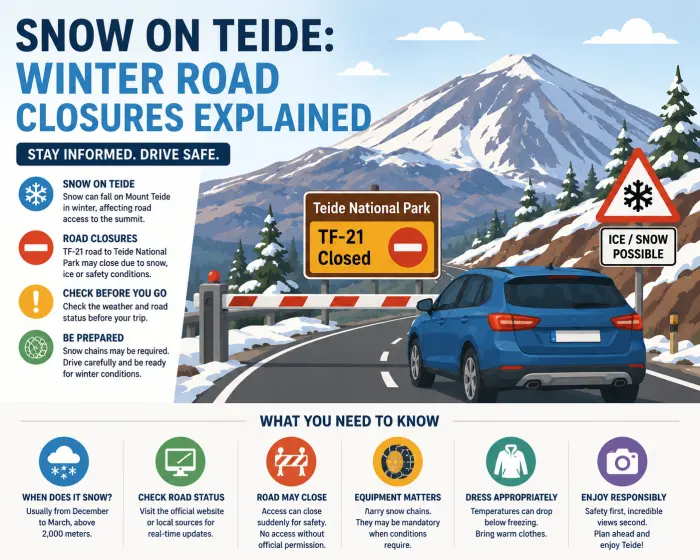
Quick steps: Mount Teide typically receives snow at some point most winters, generally between December and March. When a meaningful snowfall hits, Tenerife’s Cabildo (island council) temporarily closes or restricts the main access roads — the TF-21, TF-24, and TF-38 — until conditions are cleared and confirmed safe, sometimes within hours, sometimes over several days. Closures and reopenings are announced through the Cabildo’s official channels and the Tenerife On app, so check current status before driving up rather than assuming the road is open. During active snow events, access can be limited to specific hours or vehicle types, speed limits inside the park drop to 50 km/h, and stopping is only permitted in designated areas. Reaching the actual summit during snow is restricted to properly equipped mountaineers registered through the official app — a different, stricter system from the standard summit permit covered elsewhere on this site.
❄️ Yes, Teide Gets Snow — Here’s the Pattern
At over 3,700 m, Mount Teide’s upper slopes sit well above the altitude where Tenerife’s mild coastal climate applies. Winter storms moving through the Canary Islands regularly bring snow down to a specific altitude band on the mountain — sometimes a light dusting that melts within a day, occasionally a more significant fall that genuinely transforms the landscape and draws large numbers of residents and visitors up to see it. It’s common enough that the Cabildo maintains dedicated snow-clearing equipment specifically for the park’s high-altitude roads, treating it as a manageable annual event rather than an emergency each time it happens.
🗺️ Quick Reference: Roads That Close and Why
| Road | Route | What Typically Happens in Snow |
|---|---|---|
| 🛣️ TF-21 | Connects La Orotava (north) and Vilaflor (south) through the park, past the cable car | Most commonly affected; can close fully or restrict access to specific sections and hours |
| 🛣️ TF-24 | La Esperanza to Izaña | Frequently closed alongside the TF-21 during the same weather events |
| 🛣️ TF-38 | Chío to the cable car area | Sometimes closed from a specific point, depending on where snow and ice accumulate |
| 🛣️ TF-445 | Buenavista to the Teno Lighthouse | Occasionally closed as a preventive measure during the same storms, despite being a separate area from Teide itself |
None of these closures are permanent — they’re reviewed and lifted as conditions improve, sometimes reopening within a day. The point worth remembering is that any of them can close with relatively short notice during the winter months.
📵 What Happens When the Roads Actually Close
Closures aren’t always a simple “open or shut” situation. Depending on conditions and visitor demand, the Cabildo has used a range of measures during past snow events, including:
- 🚧 Full closure of specific sections until snowploughs and safety teams have cleared and inspected the road.
- 🕐 Time-limited access, allowing uphill travel only during a set morning window, with the afternoon reserved for visitors leaving the park.
- 🚌 Vehicle-type restrictions, such as permitting private cars while restricting coaches, or vice versa, depending on capacity and safety concerns at busy viewpoints.
- 🚏 Free shuttle bus services, occasionally introduced on the busiest snow weekends specifically to reduce private car congestion on the mountain.
- 🅿️ Designated-area-only parking, since vehicles stopping informally along the roadside to view or photograph snow have caused genuine traffic and safety problems during past events.
If you arrive expecting a quiet drive up and the road is operating under one of these controlled-access systems instead, it’s worth treating instructions from on-site staff and signage as final, rather than assuming normal rules apply.
📱 How to Check Before You Drive Up
The single most useful habit for a winter visit: check current road status before you set off, not after you’ve already started the drive. The Cabildo publishes live updates through its official channels and the Tenerife On app, both of which are far more reliable than assuming based on the weather at your hotel — conditions at sea level tell you almost nothing about what’s happening 2,000+ metres higher up.
🚐 Vehicle Restrictions That Apply Year-Round, Not Just in Snow
Separately from any weather-related closures, Teide National Park maintains a standing ban on certain vehicle types at all times: quads, buggies, enduro motorcycles, caravans, and motorhomes are not permitted inside the park. This is worth knowing if you’ve booked a campervan hire in Tenerife for your trip, since it means a standard hire car or your own vehicle is the only practical way to actually drive into the park itself, regardless of the season.
🥾 The Summit in Winter: A Different Permit Entirely
Our best hikes in Tenerife guide covers the standard free permit needed to hike to the actual summit of Mount Teide under normal conditions. During and after snow events, this changes: access to the summit is restricted specifically to properly equipped mountaineers, registered through the official Tenerife On app, with the standard permit system effectively superseded by a stricter, weather-specific process. If a winter summit attempt is part of your plans, treat this as a completely separate requirement from the standard permit, not an extension of it.
🚡 What This Means for the Cable Car
Our Teide cable car guide already covers how wind can affect the service generally. Snow and ice add another layer of weather-dependency on top of that, and during the most significant snow events, the road closures described above can affect whether you’re even able to reach the base station to use a booked ticket in the first place. If you’ve booked a cable car visit for the winter months, keep an eye on both the cable car’s own status and the wider road access situation, since either one can disrupt your plans independently of the other.
🚗 Discover Tenerife – Best Car Rental Deals
Compare top-rated suppliers, no hidden fees & free cancellation included.
🚗 If You Do Drive Up: What to Expect and Bring
| Condition | Summer | Winter (Snow Event) |
|---|---|---|
| 🌡️ Temperature at altitude | Cool, often windy | Can sit at or below freezing |
| 🛣️ Road surface | Dry, standard driving conditions | Potentially snow or ice-covered, subject to closure |
| 🚗 Vehicle needs | Standard hire car | No special equipment required if the road is open, since closures handle unsafe conditions directly |
| 🅿️ Parking and stopping | Normal rules apply | Restricted to designated areas only during active operations |
| 📱 Planning | Check general conditions | Check live road status immediately before setting off |
A standard hire car doesn’t need snow chains or any special equipment for a normal winter visit, since the road simply closes when conditions genuinely require them — your job is just to check status first, not to prepare your vehicle for snow driving. If you’re driving anywhere on the island after dark during winter, our driving in Tenerife at night guide covers the general precautions worth combining with any seasonal caution.
✅ Winter Teide Checklist
- 📱 Check the Cabildo’s current road status or the Tenerife On app before setting off, not the night before.
- ❄️ Expect possible closures between roughly December and March, even on an otherwise clear-looking day at sea level.
- 🅿️ Stick to designated stopping areas if snow is on the ground — informal roadside stops cause real safety problems.
- 🥾 Treat a winter summit attempt as a separate process, requiring registration through the official app rather than the standard permit.
- 🚡 Check both road access and cable car status separately if you’ve booked a cable car visit during winter.
- 🚐 Remember the standing vehicle ban on quads, buggies, and motorhomes applies regardless of season.
- 🧥 Pack warm layers for the visit itself, on top of checking access — it’s genuinely cold at altitude even without snow on the ground.
❓ Frequently Asked Questions
Does Mount Teide actually get snow? Yes, most winters, typically between December and March. Snowfall amounts vary considerably between events, from a light dusting to accumulations significant enough to close access roads for a day or more.
Which roads close when Teide gets snow? The TF-21 (connecting La Orotava and Vilaflor through the park), the TF-24 (La Esperanza to Izaña), and the TF-38 (Chío to the cable car area) are the roads most commonly affected, depending on where the snow and ice settle.
How do I know if the road to Teide is open in winter? Check the Cabildo’s official channels or the Tenerife On app for live status before setting off. Conditions at sea level give no reliable indication of what’s happening at altitude.
Do I need snow chains to drive to Teide in winter? No special equipment is required for a standard visit, since the roads are closed directly by the authorities when conditions genuinely require it. Your responsibility is checking current status, not equipping your vehicle for snow driving.
Can I still hike to the summit of Mount Teide if there’s snow? Only as a properly equipped mountaineer registered through the official Tenerife On app. This is a separate, stricter process from the standard free summit permit used under normal conditions.
Does the Teide cable car still run when there’s snow on the mountain? It can be affected independently of the road closures, so check both the cable car’s own operating status and the wider road access situation separately if you’ve booked a winter visit.
Can I bring a motorhome or campervan into Teide National Park? No — motorhomes, caravans, quads, buggies, and enduro motorcycles are banned within the park at all times, regardless of season or weather conditions.
Is it worth visiting Teide specifically to see snow? Many residents and visitors do exactly this during significant snowfalls, and it’s a genuinely striking sight. Just plan around the access restrictions described above, since these are exactly the events most likely to trigger controlled or restricted access.
🏁 Final Verdict: Check First, Then Go
Snow on Mount Teide is a real, recurring part of a Tenerife winter, not a rare anomaly, and the island’s authorities manage it with an organised, evolving system of road closures and controlled access rather than leaving visitors to figure it out. The only habit that actually matters here is checking current status immediately before you set off — do that, and a winter drive up the mountain is just as manageable as any other season’s.
👉 Compare car hire deals in Tenerife for a trip that works in any season. This guide is part of our full Tenerife car hire guide — for the rest of the route up, see our driving to Mount Teide and stargazing at Teide guides, and for the best season to plan your wider trip around, see our best time to visit Tenerife guide.