Buying a third-party excess insurance policy before your Tenerife trip is genuinely good value, but it doesn’t work the way a lot of first-time buyers assume. It doesn’t stop the rental company charging you the excess if something happens to the car — that charge lands on your card at the desk regardless of what insurance you’re holding. What the policy actually does is reimburse you afterward, through a separate claims process with its own paperwork, its own timeline, and its own specific rules about what counts as valid evidence. Understanding that sequence before you need it is the difference between a smooth reimbursement and a frustrating few months chasing one.
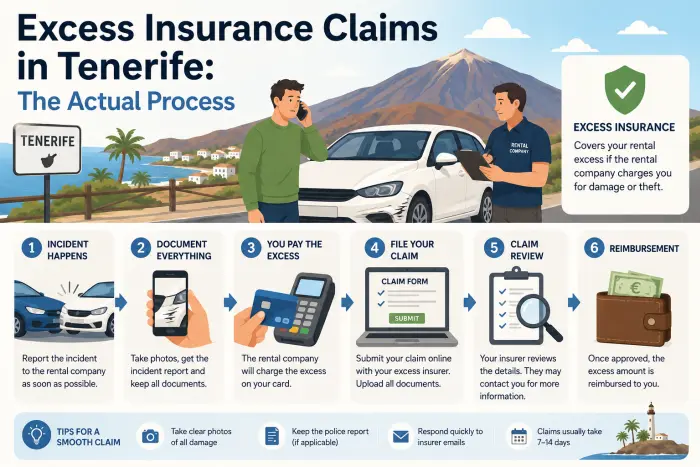
The Sequence, Plainly
- You pay the rental company’s excess charge first, out of your deposit or directly to your card, whether you have third-party insurance or not — the policy reimburses you after, it doesn’t prevent the initial charge.
- The single most common reason a claim gets rejected or delayed isn’t the damage itself, it’s paperwork completed at the wrong time — specifically, not filling out and signing a damage or accident report with the rental company at the moment of return.
- Expect to need: the signed damage/accident report from the rental company, your original rental agreement, an itemised invoice showing the excess charge, dated photos of the damage, and a police report for anything involving theft or a collision with another vehicle.
- Realistic timelines run from a few weeks for a straightforward, well-documented claim to two or three months for anything requiring back-and-forth with the rental company for missing documentation.
- If you’re covered by a company’s own zero-excess rate (like Cicar or Autoreisen’s standard cover) rather than a separate policy, there’s usually no separate claim to file at all — the whole point of that structure is that the charge never happens in the first place.
Do you have to pay the excess even if you have insurance?
Yes, in almost every case, and this catches people out more than any other part of the process. A third-party excess policy — the kind sold by Discovercars, a standalone insurer, or a comparison site at checkout — works as a reimbursement product, not a payment-prevention one. If your rental car is damaged, the company you rented from charges you the excess (or deducts it from your held deposit) exactly as if you had no insurance at all; your policy only comes into play afterward, when you submit a claim to get that money back. The only genuine exception is booking directly with a company whose zero-excess cover is built into the standard rate itself — Cicar and Autoreisen both work this way, which is precisely why there’s no separate claims process to describe for either of them: there’s simply nothing charged to reimburse.
What’s the single biggest reason claims get rejected or delayed?
Incomplete paperwork at the point of return, far more often than the damage itself being disputed. Every legitimate claim needs a signed damage or accident report completed with the rental company at the time the issue is identified — not a verbal acknowledgment, not an email sent days later, but a specific form filled out and signed on the spot. Skipping this step, even when the damage itself is completely genuine and undisputed, is consistently the reason claims stall or get rejected outright, because the insurer has no formal record that the rental company itself confirmed the incident at the time it happened. If you’re ever unsure whether a form is actually required, the safe assumption is yes — ask for it explicitly rather than accepting a verbal “don’t worry about it” at the counter.
What documents do you actually need to file a claim?
Five things consistently come up as the core requirements, and gathering them at the time of the incident — not after you’re home — makes the whole process considerably smoother. You’ll need the signed damage or accident report from the rental company, your original rental agreement showing your booking and cover details, an itemised invoice or receipt clearly showing the excess amount that was charged to your card, dated photographs of the damage (ideally including ones from your pickup inspection showing the car’s prior condition too), and, for anything involving theft or a collision with another vehicle, a formal police report. Photographing the car thoroughly at pickup — before anything’s happened — is worth treating as part of your claims preparation from day one, not just a pickup-day habit.
| Document | Why it matters |
|---|---|
| Signed damage/accident report | Proves the rental company itself acknowledged the incident at the time |
| Original rental agreement | Confirms your booking, dates, and excess amount |
| Itemised excess invoice | Shows exactly what you were charged and why |
| Dated photos (pickup + incident) | Establishes the car’s condition before and after |
| Police report (theft/collision) | Required for most policies when another party or crime is involved |
How long does the reimbursement actually take?
Realistically, weeks rather than days for even a straightforward claim, and it’s worth budgeting for that rather than expecting a quick turnaround. A well-documented claim with everything submitted correctly the first time can be processed in a few weeks; anything missing a document, requiring the insurer to go back to the rental company for confirmation, or involving a dispute over the damage itself can stretch to two or three months. This is exactly the gap we’ve flagged before as the real tradeoff of third-party cover versus a company’s built-in zero-excess rate — cheaper upfront, but with a genuine wait and some administrative effort if you actually need to use it.
Does the process differ if you booked through Discovercars specifically?
The core sequence is the same regardless of which platform sold you the policy: pay the rental company’s charge first, then submit a claim with your documentation to whoever underwrites the specific policy you bought. What can differ is exactly where you submit that claim and which contact details apply, since a platform-sold policy is often underwritten by a separate insurance partner rather than the platform itself — the confirmation email from your original purchase should specify exactly who to contact and what their claims process requires, which is worth locating and saving before your trip rather than searching for it after an incident’s already happened.
🚗 Discover Tenerife – Best Car Rental Deals
Compare top-rated suppliers, no hidden fees & free cancellation included.
Is it ever worth skipping the third-party policy entirely and just paying the rental company’s own zero-excess rate?
For some renters, genuinely yes, and it comes down to how much you value avoiding this entire claims process versus the cost difference. A company like Cicar or Autoreisen, where zero-excess is simply part of the standard rate, removes the claims process altogether — there’s no charge to reimburse because there’s no excess to begin with. A cheaper daily rate from a different company paired with a separate third-party policy can still work out less expensive overall, but it comes with the real possibility of a multi-week reimbursement wait if something does go wrong, which is worth weighing honestly against the price difference rather than assuming cheaper is automatically better.
FAQ
Do I still have to pay the rental company if I have excess insurance? Yes, in almost every case — third-party excess insurance reimburses you after the rental company charges you, it doesn’t prevent that initial charge from happening.
What’s the most common reason an excess insurance claim gets rejected? Missing or incomplete paperwork from the time of the incident, most often a damage or accident report that wasn’t formally signed with the rental company on the spot.
How long does an excess insurance claim take to pay out? A well-documented, straightforward claim can take a few weeks; anything requiring additional documentation or a dispute over the damage can take two to three months.
Do I need a police report to claim on my excess insurance? Usually yes, for anything involving theft or a collision with another vehicle — check your specific policy’s requirements, since this varies by insurer.
Is there a claims process if I book with Cicar or Autoreisen instead of buying separate insurance? No, generally not — both build zero-excess cover into their standard rate, so there’s typically no excess charge in the first place to reimburse.
Where do I submit an excess insurance claim if I booked through Discovercars? Check your original policy confirmation email — it specifies the underwriting insurer and the correct claims contact, which is worth saving before your trip rather than searching for after an incident.
What should I do immediately if my rental car is damaged in Tenerife? Contact the rental company right away, insist on completing a signed damage or accident report before you leave the desk, and photograph everything — these steps matter more to your eventual claim than anything you do afterward.