A late flight, a sunset hike that ran longer than planned, dinner that finished after dark — sooner or later, most visitors end up driving in Tenerife at night whether they planned to or not. The good news is that it’s generally just as manageable as daytime driving on the island’s main roads. A handful of things genuinely change after dark, though, and one of them is a recent legal update that affects the safety equipment in almost every hire car on the island, regardless of where you’re driving.
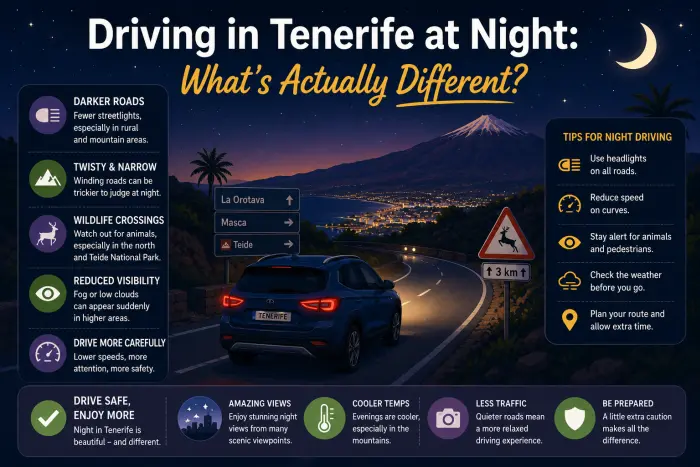
The short answer: night driving in Tenerife is safe on motorways and main roads, with the same general rules as daytime driving plus a few night-specific differences: headlights are legally required from sunset to sunrise, full beam must be dipped for oncoming traffic, and using your horn within towns at night is against the law — flash your lights instead if you need to signal. Rural and mountain roads are genuinely darker and less forgiving after dark, with occasional low cloud at altitude and the chance of animals on quieter stretches. One important update worth knowing about: Spain has recently replaced the traditional warning triangle requirement with a V16 emergency beacon for Spanish-registered vehicles — which includes virtually every hire car in Tenerife — so it’s worth confirming your rental already has one before you set off, especially for any after-dark driving.
🌃 What’s Genuinely Different About Driving at Night Here
Most of the basics covered in our general driving in Tenerife guide still apply after dark — same road rules, same priority systems, same roundabout etiquette. What actually changes at night comes down to a short list:
- 💡 Lighting requirements become mandatory, not optional.
- 🌑 Unlit stretches feel genuinely darker than most visitors expect, particularly once you’re away from resort areas and main towns.
- ☁️ Cloud and fog can settle at altitude, especially around the higher mountain roads.
- 🐾 The chance of an animal on the road increases slightly on quiet rural routes.
- 🚨 Your hire car’s roadside safety equipment is governed by a rule that’s recently changed — covered in detail below.
None of this should put you off driving after dark. It just means treating the same roads with a bit more caution than you would in daylight.
🚨 The New V16 Beacon Rule: Why It Matters for Your Hire Car
This is genuinely worth knowing, since it affects almost every rental vehicle on the island, not just the ones driving at night specifically:
| Old Rule (Warning Triangles) | Current Rule (V16 Beacon) | |
|---|---|---|
| 🔺 Device | Two physical triangles placed on the road | A flashing amber beacon placed on the vehicle’s roof |
| 🚶 Risk to the driver | Required walking onto the road or verge to place them | Designed to be placed from inside the vehicle, without stepping into traffic |
| 📍 Visibility | Visible from a shorter distance | Visible from much further away, in all directions |
| 🚗 Who it applies to | All vehicles previously | Spanish-registered vehicles — which includes essentially every Tenerife hire car |
| 🌍 Foreign-registered vehicles | N/A | Can still use their home country’s own approved warning device |
In practice, this means your hire car should already be equipped with an approved V16 beacon rather than (or alongside) a traditional triangle. It’s worth asking at collection if you’re not sure it’s included, particularly if you’re planning any driving after dark, since this is exactly the equipment you’d need in a breakdown or accident — see our hire car breakdown guide for the full process if that ever happens. A reflective hi-vis vest is still required if you do need to step out of the car for any reason, regardless of which warning device you’re carrying.
💡 Headlight Rules You Need at Night
| Situation | Rule |
|---|---|
| 🌅 Sunset to sunrise | Headlights mandatory at all times |
| 🚙 Oncoming traffic | Dip from full beam to avoid dazzling other drivers |
| 🌫️ Tunnels, fog, heavy rain | Dipped headlights required, even during the day |
| 📢 Wanting to signal another driver | Flash your headlights — using the horn at night within towns is not permitted |
These rules apply across Spain generally, and Tenerife’s roads — particularly the older sections through villages and town centres — don’t always have the level of street lighting visitors expect, which makes using headlights correctly more important here than it might feel on a brightly lit motorway back home.
🏔️ Mountain Roads, Fog, and the “Sea of Clouds” Effect
Tenerife has a genuinely unusual weather phenomenon worth knowing about if you’re driving up into the hills after dark: a layer of cloud often sits at a specific altitude band, meaning you can drive up through thick fog and emerge into completely clear, starlit conditions above it — or the reverse, depending on which direction you’re heading. This is part of what makes stargazing at Teide so spectacular, but it also means visibility on the approach roads can change quickly over a relatively short stretch of driving. If you’re heading up toward Mount Teide after dark, slow down through any cloud layer rather than assuming conditions will stay consistent for the whole climb, and check for any reported road closures in winter, when ice at altitude is occasionally a factor.
🐐 Watch for Animals on Rural Roads
Quieter rural and farming roads, particularly away from the main resort areas, carry a higher chance of an animal wandering across at night than a well-lit motorway does. This isn’t unique to Tenerife, but it’s easy to underestimate if you’re used to driving somewhere with consistent street lighting and fenced roadsides. Slow down on unlit rural stretches after dark, and treat any reflective eyes or movement at the edge of your headlights as a reason to ease off rather than assume it’s nothing.
🛣️ Which Roads Are Genuinely Better Left for Daylight
Most of the island’s roads are perfectly manageable at night, but a few are genuinely more rewarding — and more comfortable — driven for the first time in daylight:
- 🌄 The hairpin route to Masca, where narrow bends and limited passing space are far easier to judge with full visibility.
- 🌲 The dense, winding roads through Anaga, where laurel forest can make an already narrow road feel considerably darker than the time of day suggests.
- 🛣️ Several of the island’s other best (and most demanding) roads to drive, which are worth doing once in daylight before attempting after dark, simply so the road feels familiar.
None of these are off-limits at night — plenty of locals drive them every day — but a first attempt is far more enjoyable, and easier, with the scenery actually visible.
🚗 Discover Tenerife – Best Car Rental Deals
Compare top-rated suppliers, no hidden fees & free cancellation included.
✈️ Late Airport Pickups and Drop-offs
A late-arriving flight often means your first drive on the island happens in the dark, which is worth planning around rather than worrying about. Our Tenerife South Airport and Tenerife North Airport guides cover what to expect at each terminal regardless of time of day. One extra habit worth keeping for a night collection specifically: use your phone’s flashlight to check the car properly during your walkaround, since poor car park lighting can hide damage that would be obvious in daylight — our collection and inspection checklist guide covers this in more detail.
🍷 Drink-Driving and Fatigue After a Flight
Spain’s blood alcohol limits and the penalties for exceeding them are covered fully in our speed limits and fines in Tenerife guide, and they apply exactly the same after dark as during the day. The factor that catches travellers out more often at night isn’t alcohol — it’s simple fatigue after a long flight. If you’ve been travelling all day, a short break before driving, even just to refocus at the rental desk or in a well-lit parking area, is worth more than rushing straight onto unfamiliar roads tired.
✅ Night Driving Checklist
- 🚨 Confirm your hire car has an approved V16 beacon (or check what’s included) before any after-dark driving.
- 🦺 Locate the hi-vis vest in the car at collection, so you know where it is if you ever need it.
- 💡 Use headlights correctly — dipped for oncoming traffic and tunnels, never the horn at night in towns.
- 🌫️ Slow down through cloud or fog on mountain roads, especially around Teide.
- 🐐 Watch for animals on quiet rural and farming roads.
- 🌄 Drive unfamiliar mountain routes in daylight first, before attempting them after dark.
- 😴 Take a short break if you’re tired after a long flight, rather than driving straight from the airport exhausted.
❓ Frequently Asked Questions
Is it safe to drive in Tenerife at night? Generally yes, particularly on motorways and main roads. A few things genuinely differ from daytime driving — unlit rural stretches, occasional fog at altitude, and the chance of animals on quiet roads — so a bit more caution is worth applying after dark.
What is the V16 beacon, and does it affect my hire car? The V16 beacon is a flashing warning device that has recently replaced the traditional triangle requirement for Spanish-registered vehicles, which includes almost every hire car in Tenerife. It’s placed on the vehicle’s roof during a breakdown rather than on the road, reducing the need to step into traffic. Confirm your rental has one if you’re unsure.
Do I still need a reflective vest if my car has a V16 beacon? Yes. A hi-vis vest is still required if you step out of the vehicle for any reason during a breakdown or accident, regardless of which warning device you’re carrying.
Are headlights mandatory at night in Tenerife? Yes, headlights are legally required from sunset to sunrise, the same as anywhere else in Spain, along with dipped headlights in tunnels, fog, or heavy rain at any time of day.
Is it legal to use my horn at night in Tenerife? No — using the horn within towns at night is against the rules. Flash your headlights instead if you need to signal another driver or a pedestrian.
Which roads in Tenerife are better avoided at night for a first-time visitor? Narrow mountain routes like the road to Masca and the winding roads through Anaga are far easier to judge in daylight. They’re not off-limits at night, but a first attempt is considerably more comfortable with full visibility.
What should I do if my flight lands late and I need to drive straight from the airport? Take a short break before setting off if you’re tired, use your phone’s flashlight for a proper collection inspection in low light, and stick to main roads for your first drive rather than attempting an unfamiliar mountain route in the dark.
Does fog or cloud affect driving up to Mount Teide at night? Yes, occasionally. A band of cloud can sit at a specific altitude, meaning visibility can change quickly as you climb. Slow down through any cloud layer, and check for winter road conditions if ice at altitude is a possibility.
🏁 Final Verdict: Mostly the Same Rules, a Bit More Caution
Driving in Tenerife at night isn’t a fundamentally different experience from driving during the day — it just rewards a little extra caution on unlit rural roads, a slower pace through any mountain cloud, and knowing that your hire car’s roadside safety equipment has recently changed. Confirm the basics before you set off, and an after-dark drive is nothing to worry about.
👉 Compare car hire deals in Tenerife from companies that keep their fleets properly equipped. This guide is part of our full Tenerife car hire guide.