Most days, Tenerife’s roads give you nothing to complain about. You collect the car, roll down to Costa Adeje, climb towards Teide, wander along the north coast, and traffic never becomes a topic of conversation. Then comes the odd morning or afternoon when a motorway you crossed easily yesterday simply stops, and a half-hour drive turns into the story of your day. Those jams are not random. They have a direction, a clock and a short list of repeat offenders, and once you know the pattern you can avoid nearly all of it.
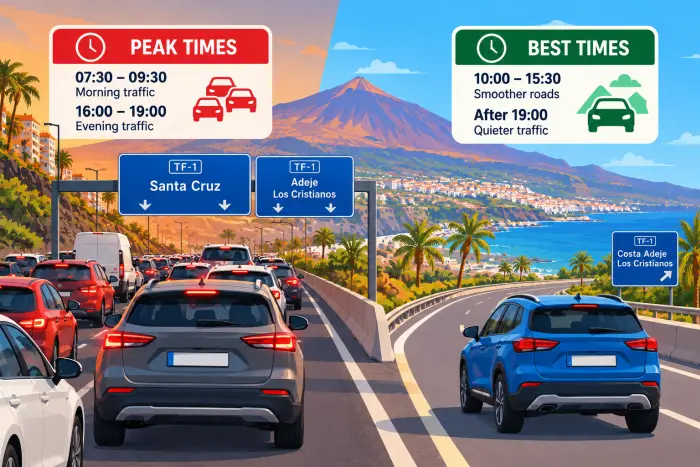
The pattern in one breath: on weekday mornings, roughly 7 to 9, the TF-5 and the TF-1 back up towards Santa Cruz, with the stretch around La Laguna the worst of it. In the south, the TF-1 around Guaza, Las Chafiras and the Las Américas junction tightens in the afternoon and seizes up whenever there is an accident. Mid-morning to early afternoon is the calm window. It only really hurts a visitor when a flight, a ferry or a booked time slot is waiting at the other end.
The north has one bottleneck, and it points at Santa Cruz
If Tenerife has a famous traffic problem, it is the TF-5 heading into the capital early in the morning. Recent figures from the Cabildo and the Transport Ministry put the busiest point around kilometre 12, near San Lázaro, and the neighbouring stretches (Padre Anchieta to the Guajara campus, Alcampo to the university hospital) carry roughly 100,000 vehicles a day or more. Local press has called the morning queues the worst anywhere in the Canaries. The island has something like 857,000 registered vehicles for a little over 900,000 residents, which goes a long way towards explaining it.
What turns this from a commuter problem into a visitor problem is geography. Tenerife North Airport sits right in the La Laguna knot, Puerto de la Cruz is the main base for the north coast, and Santa Cruz is where the Gran Canaria ferries leave from. Any plan that points you at the capital or the airport between about seven and nine on a weekday is a plan that points you into the queue. The University of La Laguna has even staggered the timetables of thousands of students, and the Cabildo and the university say that, along with other measures, this has trimmed travel times by around 10 per cent at 8:00 and up to 18 per cent at 9:00. That tells you, incidentally, where the heart of the peak sits.
A resident who blogs about island life tells the story better than a statistic. The family left home at seven on a Monday for an 8:30 ferry from Santa Cruz, a drive that normally takes about twenty-five minutes, and by 8:25 had only reached the hill down into the city. The queue that morning stretched back as far as El Sauzal. That account is some years old, and the road has not got quieter since; it is being widened precisely because it hasn’t.
Our guide to the transfer from Tenerife North Airport to Santa Cruz quotes 15 to 20 minutes, which is right for a quiet hour. On a weekday morning, treat that as the best case rather than the plan.
The other direction is a different story. Leaving the capital in the morning is usually far lighter, and nearly every report of long queues says “towards Santa Cruz”. Accidents can jam any lane, of course. On one recent Tuesday morning, two collisions, one at San Benito in La Laguna and one by the TF-4 link on the TF-1, both on the way into the city, produced queues on both motorways at the same moment.
The south is one motorway doing too much
Down south the picture is different but the cause is familiar: a single motorway carrying the airport, the resorts, the commuters and the delivery vans. Public Works figures put the TF-1 around Las Chafiras at about 90,000 vehicles a day, and that stretch is in the middle of a third-lane project. There is also a planned cut-and-cover tunnel under the TF-1 between Las Américas and Fañabé, which the Canarian government describes as a response to constant jams at certain times of day in the tourist municipalities. Our piece on the TF-1 roadworks explains what is being built and how much margin an airport transfer needs; this section is about the clock.
For visitors, the south tends to be kinder in the morning and tighter later. Canarian Weekly, reporting on a crash near Parque La Reina, treated afternoon congestion on that stretch as a given. Another report, from last November, describes a rear-end collision at 2:30 in the afternoon by Siam Park that froze traffic for several kilometres just as many people were leaving work. The rest of the pattern is accident-driven: several reports this summer have crashes near Guaza and Las Chafiras pushing southbound queues back towards Granadilla, and on one occasion all the way to the Tenerife South airport area.
So if you are driving from the airport to Costa Adeje on a weekday late afternoon, that is the moment you are most likely to notice the island’s traffic. An accident on that stretch matters far more than the time of day does.
The siesta squeeze and other small peaks
There is a smaller rhythm that visitors rarely hear about. After lunch many islanders head home or out, and another wave builds as the working day restarts. One long-time resident plans errands for around half past two, once the first rush has passed, and is on the way home before the second one builds roughly an hour and a half later. You don’t need to copy them, but a long lunch finished at 1:30 followed by a drive to the next town at 3:00 is not exempt from queues, however relaxed your holiday feels.
🚗 Discover Tenerife – Best Car Rental Deals
Compare top-rated suppliers, no hidden fees & free cancellation included.
Where it bites, at a glance
| Stretch | Typical trouble | What helps |
|---|---|---|
| TF-5, La Laguna to Santa Cruz | Weekday mornings towards the capital, roughly 7 to 9; residents single out Mondays | Leave well before 7 or wait until after 9:30; cushion any flight or ferry generously |
| TF-5 near San Lázaro and Padre Anchieta | Term-time mornings, when university traffic joins | Avoid La Laguna’s ring road at the start of the working day |
| TF-1, Las Chafiras to Las Américas | Weekday afternoons and evenings, plus any accident | Do airport and port runs before mid-afternoon or after the evening peak |
| TF-1, Güímar and Radazul sections | Rush hours, close to 100,000 vehicles a day | Same as the TF-5: avoid the commuter windows |
| Any stretch with an accident | Back roads fill almost as fast as the motorway | Stay put unless the live map shows a clear gain |
When something is waiting for you at the other end
The jams that matter are the ones with a deadline attached, and there are three kinds.
If you are staying on the north coast with an early flight from Tenerife North, you are pointed the same way as everyone heading to work. The cure is boring: set off earlier than the map says, and give yourself time in the car park at the other end. Our guide to returning a hire car at the airport covers what happens once you arrive, and it is a lot less stressful when you are not racing a boarding gate.
Ferries are the second kind. The Gran Canaria boats leave from Santa Cruz, so the morning TF-5 rule applies in full, and our page on dropping a hire car on another island covers the practical side of that crossing. Boats to La Gomera leave from Los Cristianos, in the south, where the TF-1 afternoon is the thing to watch; the details are in our guide to taking a hire car to La Gomera.
The third kind is the timed ticket: a cable car slot, a whale-watching departure, a restaurant booking you can’t move. Mountain roads are mostly spared the commuter flow, but your approach may not be. A Teide route that starts from La Laguna begins inside the morning knot, so check your starting point when you read our guide to driving to Teide.
One more thing, which locals and the news both bear out: leaving the motorway to dodge a jam usually moves the jam rather than cures it. When a car on its roof blocked the TF-1 one afternoon, drivers peeled off onto the back roads and those clogged too. Unless your live map shows a decisive saving, staying on the main road is often the calmer choice.
A two-minute check before you set off is worth more here than almost anywhere. The Cabildo’s road information centre publishes camera images from the main motorways, including the La Laguna stretch of the TF-5, and Google Maps or Waze will show live queues. If La Laguna itself is on your list, visit it by car outside the morning peak; the city is lovely, and a good deal nicer when you aren’t circling in traffic. For the basics beyond timing, see our general driving in Tenerife guide, which already mentions the weekday rush-hour windows.
So should any of this put you off renting a car?
No. Across most of the island, most of the time, the roads are easy and free of tolls. What this guide describes is two or three predictable pinch points, and nearly all of them can be handled by changing the time you leave rather than the way you travel. The cheapest fix is almost always an earlier alarm.
Questions drivers ask
What time is rush hour in Tenerife? On weekdays, roughly 7:30 to 9:00 in the morning and 16:00 to 19:00 in the late afternoon and evening, depending on where you are. The morning peak is concentrated towards Santa Cruz, and the afternoon one is most noticeable on the southern TF-1.
Which road is the worst for traffic? The TF-5 into Santa Cruz in the morning, especially around La Laguna, is the one local and national figures keep pointing to.
Is traffic bad in the south, around the airport and the resorts? It is usually manageable, but the TF-1 around Las Chafiras, Guaza and the Las Américas junction slows in the afternoon, and an accident there can push queues back towards the Tenerife South airport.
Will an accident delay my airport transfer? It can. Several reports this summer describe crashes that pushed queues back for kilometres. Leave a cushion on flight days and check a live traffic map before you set off.
Is it quicker to use side roads when the motorway is jammed? Rarely. Reports from past accidents show drivers leaving the motorway and clogging the smaller roads, and the saving is often small. Look at the live map before you commit.
Plan the morning drive like you would a train connection, with room for the unexpected, and Tenerife’s traffic stays what it should be on holiday: something you hardly notice.