Yes, there’s genuinely major construction underway on Tenerife right now, and it directly affects the route most visitors actually drive: the TF-1 between the airport and the southern resorts. A large-scale widening project is adding a third lane along key stretches, expected to run for several years, alongside separate work on the TF-5 in the north and a new tunnel that will eventually complete a full ring road around the island. None of this should stop you renting a car, but it’s worth knowing before you’re sitting in an unexpected queue on your way to the hotel, tired from a flight and wondering if you’ve somehow taken a wrong turn.
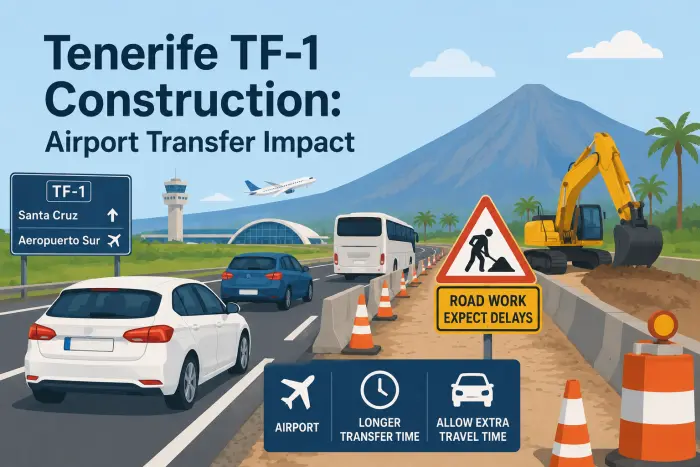
Here’s the Situation
- 🛣️ The biggest project is a third-lane widening of the TF-1 between Oroteanda and Playa de las Américas, the exact stretch most airport transfers to the south use.
- ⏳ This is a genuinely long-term project, running years rather than months, so it’s not something that clears up partway through a single trip.
- 🚗 The TF-5 in the north is also getting a third lane between Guamasa and San Lázaro, on a route that already carries well over 100,000 vehicles a day.
- 🕐 Traffic impact is heaviest during local rush hours rather than constant, so timing your airport transfer outside peak commuter times helps more than rerouting entirely.
- 🌉 A separate project, the Erjos Tunnel in the west, will eventually link the TF-1 and TF-5 directly, completing a long-planned ring road around the island.
Does This Actually Affect My Airport Transfer?
Yes, if you’re heading to a southern resort from Tenerife South Airport, since the TF-1 between Oroteanda and Las Américas is exactly the stretch under construction. This doesn’t mean the road is closed, work of this scale is generally phased to keep traffic moving, but it does mean the drive can take longer than a route planner without live traffic data might suggest, particularly during weekday rush hours. Building in extra time for this leg of the trip, rather than assuming the transfer will match a pre-roadworks estimate, is the practical takeaway here.
What Exactly Is Being Built, and Where?
Two separate major projects, plus a longer-term tunnel, are underway in different parts of the island right now, and it’s worth knowing them apart since they affect different regions and different types of trip. The table below breaks down what’s actually happening on each route, so you can quickly check whether your own planned drive touches any of them.
| Project | Route | What It Involves |
|---|---|---|
| TF-1 widening | Oroteanda to Playa de las Américas | Converting a single-lane stretch into a full dual carriageway with a third lane |
| TF-5 third lane | Guamasa to San Lázaro | Adding a third southbound lane on one of the island’s busiest roads |
| Padre Anchieta works | La Laguna | A pedestrian ring separating foot traffic from the more than 50,000 vehicles passing through daily |
| Erjos Tunnel | Santiago del Teide to El Tanque, western island | A new double-tube tunnel completing the island’s western ring road link |
Is There a Way to Avoid the Worst of the Disruption?
Mostly through timing rather than rerouting, since the TF-1 remains the most direct path south for most resorts. Traveling outside local rush hour, generally mid-morning through early afternoon on weekdays, tends to move more smoothly than the commuter peaks. If your flight lands during a known busy window, padding your transfer time by twenty to thirty minutes is a simple, realistic buffer rather than trying to plot an alternative route through smaller roads, which often ends up slower given how central the TF-1 is to the island’s south. Weekend arrivals, particularly Saturday mornings, tend to see noticeably lighter local commuter traffic than a Monday or Friday rush hour, which is worth keeping in mind if your travel dates have any flexibility at all.
What About the North of the Island?
The TF-5 work matters most if you’re staying around Puerto de la Cruz or exploring La Laguna, since both the third-lane project and the Padre Anchieta pedestrian works sit in this part of the island. The volume here is genuinely significant, well over 100,000 vehicles a day on the affected TF-5 stretch, so the same logic applies: it’s a timing consideration rather than a reason to avoid the north entirely. Visitors splitting a trip between north and south, or driving up for a day trip from a southern resort, are the ones most likely to notice the difference, since that route runs directly through the busiest part of the affected corridor.
Should This Change Whether You Rent a Car at All?
No, a car remains the most practical way to see Tenerife properly, roadworks or not. What it should change is your expectations around specific transfer times, particularly the airport-to-Costa-Adeje and airport-to-Los-Cristianos legs, which run directly through the affected TF-1 stretch. Beyond that specific corridor, the island’s wider road network remains unaffected, and normal driving conditions apply everywhere else, from the mountain roads in the north to the coastal routes further south. Nothing about the roadworks changes the fundamental case for having your own car on the island, it just means adjusting the specific numbers you’d mentally pencil in for that one stretch.
🚗 Discover Tenerife – Best Car Rental Deals
Compare top-rated suppliers, no hidden fees & free cancellation included.
How Do You Know Which Phase Is Active When You’re Actually There?
Construction of this scale rarely runs as one continuous closure, it moves through phases, different sections and directions get worked on at different times, which means the exact experience on the ground shifts over the life of the project. Local traffic apps like Google Maps and Waze pick up live congestion from these active work zones reasonably well, so checking either shortly before you set off gives a far more accurate picture than relying on a fixed expectation from before your trip. It’s a five-minute check that’s genuinely more useful here than for most ordinary drives, given how much a single phased closure can shift typical journey times on this specific stretch, especially straight off a long flight when patience is already running thin.
Will the Erjos Tunnel Change Anything for Visitors Soon?
Not immediately, this is a longer-horizon project that will eventually let drivers cross more directly between the TF-1 in the south and the TF-5 in the north through the island’s western side, rather than routing the long way around. It’s worth knowing about if you’re planning trips further out, since once complete it genuinely reshapes how the island’s ring road connects, but it’s not something affecting a visitor’s trip this year in the way the TF-1 widening already is. For now, treat it as a piece of context rather than a route you’d actually plan around, and keep an eye on local news closer to your travel dates if the western side of the island features heavily in your itinerary.
FAQ
Is the TF-1 closed because of the roadworks? No, the road remains open and in use, the work is being carried out in phases specifically to keep traffic flowing rather than closing the route outright. Expect slower movement through the affected stretch during busier hours, not a closure or diversion off the motorway entirely.
Which specific stretch of the TF-1 is under construction? The section between Oroteanda and Playa de las Américas, which is the same stretch most airport transfers to the southern resorts use.
Does this affect car rental pickup at the airport itself? No, pickup at the terminal isn’t affected, this is specifically about the drive south from the airport toward the resort areas, not the rental process itself, the counter, paperwork, and handover all work exactly as they always have.
How much extra time should I budget for my airport transfer? Twenty to thirty minutes extra during weekday rush hour is a reasonable, practical buffer. Outside peak commuter times, the impact is generally much smaller, so checking your arrival time against typical local rush hour windows before you fly is worth the two minutes it takes.
Is the TF-5 in the north also affected? Yes, a separate third-lane project is underway between Guamasa and San Lázaro, alongside pedestrian infrastructure work in La Laguna nearby.
Should I avoid renting a car because of these roadworks? No, a rental car is still the most practical way to explore the island properly. The roadworks are a timing consideration for specific routes, not a reason to change your overall travel plans or reach for taxis instead.
Will the roadworks be finished soon? No, this is a genuinely multi-year project rather than something clearing up within a single trip’s timeframe, so it’s worth treating as the current normal for the affected stretch rather than a temporary blip you just need to wait out. Planning around it now is more useful than hoping it resolves before your next visit.