🍷 At a Glance — Tenerife Wine Regions
DO (Appellation) Location Grape Varieties Known For Tacoronte-Acentejo Northeast (near La Laguna) Listán Negro, Listán Blanco Oldest DO, most awarded red wines Valle de la Orotava North (La Orotava) Listán Negro, Albillo Criollo Unique braided vine technique Ycoden-Daute-Isora Northwest (near Icod) Malvasía, Listán Blanco Dry whites, successor to historic Canary wines Abona South (Vilaflor) Listán Blanco, Malvasía Highest EU vineyards, elegant whites Valle de Güímar Southeast Listán Negro, Listán Blanco Dry reds and whites, less visited
Most visitors to Tenerife go home without knowing the island has five wine appellations. They’ve eaten at resort restaurants, drunk the house wine, and left without tasting one of the most geographically extraordinary wine cultures in Europe — vintages grown on volcanic soil at altitudes from sea level to 1,700 metres, from grape varieties that predate the phylloxera epidemic that destroyed most of Europe’s pre-19th-century vine stock.
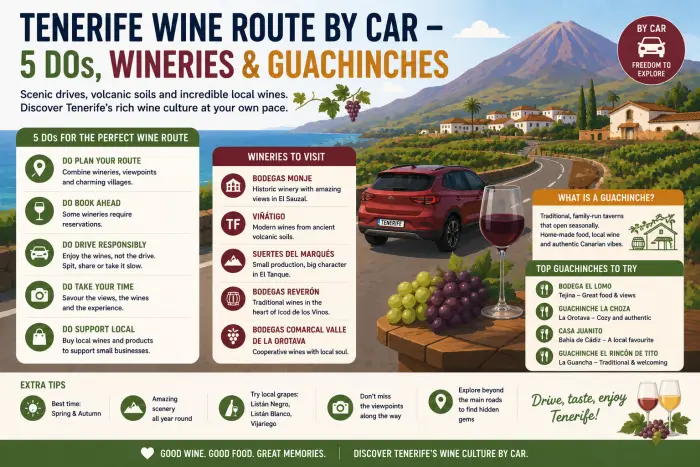
The Canary Islands were never infected by phylloxera, the root louse that devastated European viticulture in the 1860s–80s. The vines here are ungrafted — grown on their own roots, as all European vines were before the epidemic — making them among the oldest living wine vines on the planet. This is not a marketing claim. It’s a geological and agricultural fact that makes Tenerife wine genuinely unique in the world.
To experience any of it properly, you need a car. The wine country is in the north and west of the island — the green, less-touristed side that remains largely invisible to visitors who stay in the southern resorts. And on a wine route, one member of the group needs to not drink. Plan accordingly before you go.
🗺️ Understanding the 5 Wine Regions
Tenerife’s five Designations of Origin (DOs) each cover a distinct part of the island with different altitude, microclimate, and soil composition. Together they produce wines with fresh whites, robust reds, and dessert wines from indigenous varieties that grow nowhere else on earth.
1. Tacoronte-Acentejo — The Island’s Wine Capital
Tacoronte-Acentejo received DO classification in 1992, making it the Canary Islands’ oldest, and is regarded as the unofficial trendsetter of the islands, owing to its innovative approach to quality winemaking and emphasis on exports.
The region spreads across the northeastern slopes between La Laguna and the north coast — vineyards planted in terraces rising from 100 to 1,000 metres on volcanic soil with unusually low lime content. The primary grape is Listán Negro for reds, producing wines with fresh acidity and dark fruit character that have won international recognition well beyond Spain.
Key stops: Bodegas Monje at El Sauzal (tours and vineyard picnics available), Insulares Tenerife at Tacoronte, AFCAN at Tegueste. The town of Tacoronte itself is practically surrounded by vineyards and its Plaza del Cristo square is worth 20 minutes.
Guachinches: This region is the heartland of the guachinche — a uniquely Canarian institution. Guachinches are small, unlicensed-feeling family restaurants in wine-producing areas, where local farmers sell their own wine alongside simple Canarian food: stews, grilled meats, papas arrugadas, mojo. They appear on no major review platforms, have no signs visible from main roads, and are among the finest food experiences on the island. Throughout the Tacoronte area you’ll find a number of wineries and guachinche taverns where you can sample “country wine” made by local farmers using traditional methods. Ask locally or use a detailed offline map — they are worth finding.
2. Valle de la Orotava — World’s Oldest Wine Region on the Island
The Valle de la Orotava preserves a technique unique in the world: the Braided Cordon training system, in which the vine shoots are intertwined to form cords up to 15m long. It is a spectacular sight and is protected as Agricultural Heritage.
The valley produces wines at 400–800 metres altitude with Teide visible on the horizon above the vine rows. Reds from Listán Negro are the signature; whites from Albillo Criollo are increasingly acclaimed internationally. The combination of altitude, Atlantic influence, and volcanic soil creates a freshness unusual in wines from this latitude.
Key stop: Suertes del Marqués — an internationally recognised estate led by winemaker Jonatan García, considered one of the most important producers in the Canary Islands. Visits by appointment.
This wine route pairs naturally with a visit to La Orotava town — the colonial architecture and Jardines Victoria are 10 minutes from the main wine estates.
3. Ycoden-Daute-Isora — The Historical Wines of the Northwest
Located on Tenerife’s west coast, this region is known for dry white wines made from Malvasía and Listán Blanco grapes grown on the slopes of Mount Teide. These wines are the direct descendants of the “Canary wine” that Shakespeare referenced — the sweet Malvasía exported from Tenerife’s ports in the 16th and 17th centuries to England, France, and the Americas.
The region passes through Icod de los Vinos — whose name literally means “Icod of the Wines” — home to the Drago Milenario tree and a thriving local wine culture. The famous Bodega El Drago near the town centre produces wines from Malvasía with mineral character from the volcanic terroir.
4. Abona — The Highest Vineyards in the European Union
Located on Tenerife’s southern coast, Abona is home to the highest vineyard slopes in the European Union, producing high-quality white wines including some of the finest on the island.
The municipality of Vilaflor — Spain’s highest town at 1,400 metres — sits at the heart of this DO. The altitude creates dramatically different growing conditions from the coastal DOs: cool nights, strong UV at altitude, and soils with more volcanic character. The whites produced here have a freshness and mineral precision that surprises visitors expecting warm-climate wines.
Vilaflor is a natural stop on the route from the south to Teide National Park — combining the wine route with a Teide day makes for one of the most diverse day trips available from the southern resorts.
5. Valle de Güímar — The Quiet Southeast
The least-visited of the five DOs, Valle de Güímar sits on the southeastern slopes of the island with both red and white production from Listán Negro and Listán Blanco. The wines here are less internationally distributed but genuinely representative of traditional Canarian winemaking — unpretentious, mineral, and best experienced with food in a local restaurant rather than at an upmarket tasting room.
🚗 Discover Tenerife – Best Car Rental Deals
Compare top-rated suppliers, no hidden fees & free cancellation included.
🚗 Two Wine Routes by Car — North and South
Route A — The Full Northern Loop (Full Day)
This is the classic Tenerife wine route — covering Tacoronte-Acentejo and Valle de la Orotava in a single day from a northern base.
Puerto de la Cruz is the best base for wine tourism — you are 15–30 minutes away from the three northern DOs.
| Time | Stop | Notes |
|---|---|---|
| 9:00am | La Laguna → Tegueste | AFCAN winery, guachinche hunting begins |
| 10:30am | Valle Guerra → Tacoronte | Casa de Carta museum, Insulares Tenerife winery |
| 12:30pm | El Sauzal | Bodegas Monje — tour or vineyard picnic |
| 14:30pm | La Victoria de Acentejo | Local guachinche lunch — no reservations, just arrive |
| 16:30pm | La Orotava valley | Suertes del Marqués (by appointment), valley viewpoint |
| 18:00pm | Return to Puerto de la Cruz | 15 min |
Distance: approximately 65 km loop. Designated driver essential. Or reverse the roles — one person drives the morning, the other the afternoon, with tastings planned accordingly.
Route B — The Southern Wine Day (Half Day)
A route through the south: Vilaflor, the highest municipality in Spain, offers a different wine tourism experience thanks to its high-altitude vineyards. A visit to one of its wineries, a lunch in the village and a tour of its historical heritage are enough to enjoy a quiet getaway from Costa Adeje or Los Cristianos.
| Time | Stop | Notes |
|---|---|---|
| 10:00am | Leave southern resort | TF-1 → Arona → Vilaflor (45 min) |
| 10:50am | Vilaflor | Winery visit, altitude wine tasting |
| 13:00pm | Lunch in Vilaflor | Local restaurant — Spain’s highest town |
| 15:00pm | Optional: continue to Teide | 20 min further up TF-21 |
| 17:30pm | Return to resort | 45 min |
Distance: approximately 90 km return from Costa Adeje.
🍽️ The Guachinche — The Most Honest Food Experience in Tenerife
No wine route guide for Tenerife is complete without explaining guachinches properly. They are the reason experienced travellers return to the island year after year specifically for the food.
A guachinche is a temporary, informal restaurant opened by a wine-producing family during harvest season — originally to sell their wine alongside simple food. The tradition has evolved into something permanent in many families’ calendars, but the character remains: long wooden tables, food that changes with what’s available, wine served from unlabelled bottles at €1–€2 a glass, and the particular atmosphere of eating in what is clearly someone’s barn or farmhouse rather than a designed restaurant.
They exist almost entirely in the northern wine country — particularly around Tacoronte, La Laguna, La Victoria de Acentejo, and Tegueste. They are not on Google Maps, not on TripAdvisor, and rarely have a sign visible from the main road. The best way to find them: ask at any winery, ask at the local bar in any wine village, or look for hand-painted signs on secondary roads pointing up narrow lanes.
The food is always Canarian: ropa vieja (shredded beef stew), carne fiesta (marinated pork), costillas con papas (ribs with wrinkled potatoes), mojo verde and mojo rojo. Prices are remarkably low — a full meal with wine for two rarely exceeds €25.
💡 Practical Tips for Driving the Wine Route
Designated driver is non-negotiable. Tenerife’s drink-drive limit is 0.05% BAC — lower than the UK — and 0.0% for drivers with less than two years’ experience. Wine tastings at three bodegas add up quickly. Plan the route so that one person drives while the other tastes, then swap on a different day or a different section.
Book winery visits in advance. The major bodegas — Monje, Suertes del Marqués — accept walk-ins for some activities but pre-booking guarantees entry to guided tours and tastings. Most winery websites offer English-language booking.
Go on a weekday. The guachinches and smaller bodegas in the Tacoronte area are significantly quieter Monday to Thursday. Weekends attract Canarian families from Santa Cruz and La Laguna, which means fuller restaurants and less spontaneous conversation with the winemakers.
Carry cash. Many guachinches do not accept cards. €50–€80 cash is ample for a full wine day including tastings and lunch.
The Casa del Vino (El Sauzal) — the island’s wine interpretation centre — is a good starting point for orientation before driving into wine country. A well-curated exhibition on Tenerife’s five DOs, a shop with wines from all producers, and a restaurant with views over the north coast. Allow 1–1.5 hours.
🙋 Frequently Asked Questions — Tenerife Wine Route by Car
How many wine regions does Tenerife have?
Tenerife has five Denominations of Origin (DOs): Tacoronte-Acentejo, Valle de la Orotava, Ycoden-Daute-Isora, Abona, and Valle de Güímar. Together they produce wines from indigenous grape varieties — including Listán Negro, Listán Blanco, Malvasía, Albillo Criollo, and Negramoll — that grow nowhere else on earth and were never affected by the phylloxera epidemic that destroyed most pre-19th-century European vine stock.
What is a guachinche in Tenerife?
A guachinche is an informal family-run restaurant in Tenerife’s wine-producing areas, where local farmers sell their own wine alongside traditional Canarian food. They have no formal signage or review platform presence, serve house wine by the unlabelled bottle for €1–€2 a glass, and offer some of the most authentic eating on the island. They cluster around the Tacoronte-Acentejo wine region — particularly in Tacoronte, La Laguna, Tegueste, and La Victoria de Acentejo.
Which is Tenerife’s most famous wine region?
Tacoronte-Acentejo is the largest, oldest, and most internationally recognised — receiving DO status in 1992, the first in the Canary Islands. It produces primarily red wines from Listán Negro that have won awards in international competitions. For whites, the Abona DO in Vilaflor produces wines from the highest vineyards in the EU, with a freshness and mineral precision that surprises many visitors.
Can I do the wine route from the south of Tenerife?
Yes — the southern route through Vilaflor and the Abona DO is accessible in a half day from Costa Adeje or Las Américas (45 minutes each way). For the full northern wine route covering Tacoronte-Acentejo and Valle de la Orotava, allow a full day from the south — approximately 80–90 minutes driving each way. Staying overnight in Puerto de la Cruz makes the northern route significantly more relaxed.
Do I need to book winery visits in advance in Tenerife?
For major bodegas like Bodegas Monje and Suertes del Marqués — yes, particularly for guided tours and tastings with commentary. Many have English-language booking options on their websites. Guachinches require no booking and operate on a first-come basis. The Casa del Vino at El Sauzal is generally open without advance booking.