- The old orange warning triangle is no longer a valid roadside signal for Spanish-registered vehicles — that includes every rental car on the island, since they’re all plated locally.
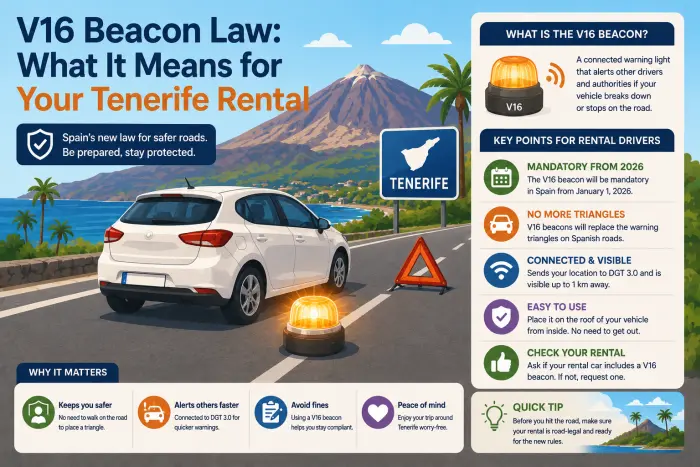
- In its place: a connected V16 beacon, a small flashing light placed on the car’s roof through the window that’s visible from up to a kilometre away, day or night.
- Missing the beacon carries an €80 fine; stepping out of the car without a reflective vest on is a separate €200 fine plus four points off the driver’s licence.
- The rental company, not you, is legally responsible for equipping the car correctly — but that doesn’t stop an officer issuing an on-the-spot fine to whoever’s behind the wheel if it’s missing.
- A quick check under the boot floor or in the glovebox at pickup, alongside your usual scratch-and-fuel inspection, is enough to confirm you’re covered before you ever need it.
Do Tenerife rental cars need to carry a V16 beacon now?
Yes — any car registered in Spain does, and that includes the entire rental fleet on the island, since every hire car here carries Spanish plates regardless of which international brand runs the counter. The rule isn’t specific to Tenerife or to rental cars particularly; it’s a nationwide change to how breakdowns and roadside incidents are signalled to other drivers. What makes it relevant to renters specifically is that most tourists have no idea it happened, arrive expecting the old triangle-in-the-boot setup, and only find out the rules changed if they’re unlucky enough to actually break down.
What replaced the warning triangle, and why?
The V16 beacon — a compact, battery-powered light that sits on the car roof, held in place magnetically or through the window frame, flashing amber and visible from roughly a kilometre away in normal conditions. It replaces the old system of physically walking out onto the road or verge to plant two triangles 50 metres apart, a routine that had been quietly causing its own accidents for years, particularly on faster roads where a driver getting out to place a triangle became a hazard in itself. Some approved models also include a geolocation chip that pings your position to Spain’s traffic authority automatically once activated, which speeds up emergency response on top of the visibility benefit.
| Old system | New system |
|---|---|
| Two warning triangles, placed 50m from the car | One V16 beacon, placed on the roof |
| Requires walking onto the road/verge | Placed through the window, no need to exit onto traffic side |
| Visible from a shorter distance | Visible from up to 1km |
| No longer valid for Spanish-plated cars | Mandatory for Spanish-plated cars |
If your rental car doesn’t have one, who actually gets fined? 💶
On paper, the rental company is responsible — Spanish consumer protection rules put the legal duty to equip the car correctly on the provider, not the renter, and a reputable company will cover or refund a fine issued for a missing item that was their responsibility to supply. In practice, though, a traffic officer at the roadside doesn’t stop to check who’s contractually liable before writing the ticket — the fine gets issued to whoever’s driving, and it’s then on you to claim it back from the rental company afterward with your rental agreement as proof. That’s a real gap between the law and the moment it’s enforced, and it’s exactly why checking at pickup, rather than assuming, is worth the thirty seconds.
Do you still need a reflective vest too?
Yes, and this part of the rule hasn’t changed. Every occupant who steps out of the car after a breakdown or accident outside a built-up area is legally required to be wearing a hi-vis vest before they open the door, not after they’re already standing on the road. The vest needs to be reachable from inside the car — glovebox or door pocket, not buried in a suitcase in the boot — since the law specifically requires it to be put on before exiting. Skipping it carries a separate €200 fine and a four-point deduction, on top of whatever penalty applies to the beacon itself.
What do you actually do at the roadside if you break down?
Stay in the car if you can, put your hazard lights on, and if you have the beacon, activate it and place it on the roof through the window rather than stepping outside first. If you genuinely need to exit — checking a tyre, waiting for assistance somewhere the car can’t safely stay in a live lane — put the vest on before you open the door, then move behind the barrier or well off the road surface rather than standing beside the vehicle. From there, call the number on your rental agreement rather than a random recovery service, the same rule that applies to any breakdown situation in a hire car — going outside the company’s own line is often what turns a straightforward call-out into a disputed charge afterward.
Does this apply to a UK or other foreign-plated hire car?
No — the V16 requirement is specifically tied to Spanish vehicle registration, so a car brought in on foreign plates (a self-drive import, for example) still uses the old triangle-and-vest system under its home country’s rules. This distinction doesn’t actually matter for the vast majority of Tenerife renters, though, since almost every hire car on the island is registered locally regardless of which international company’s logo is on the desk — if you’re picking up in Tenerife, you’re covered by the Spanish rule, full stop.
How do you check before you drive off the lot?
Fold this into the same pickup routine you’d already use for photographing scratches and checking the tyres — open the glovebox and the boot floor panel, and confirm you can actually see a beacon and at least one reflective vest, not just take the desk agent’s word for it. If either is missing, say so before you sign anything and ask for it to be added; a company that’s slow to sort this at the counter is a company you don’t want to be arguing with over a roadside fine three days into your trip.
🚗 Discover Tenerife – Best Car Rental Deals
Compare top-rated suppliers, no hidden fees & free cancellation included.
Spain now requires all Spanish-registered vehicles, including the full Tenerife rental car fleet, to carry a connected V16 emergency beacon instead of the traditional warning triangle, which is no longer a valid roadside signal for these vehicles. The beacon sits on the car roof and is visible from roughly one kilometre; missing one carries an €80 fine. A separate rule, unchanged by this update, requires a reflective vest to be worn before exiting the vehicle after a breakdown, with a €200 fine and four licence points for non-compliance. Legal responsibility for equipping a rental car correctly sits with the rental company, though a roadside fine is typically issued to the driver in the moment and reclaimed afterward. The rule applies only to Spanish-plated vehicles, which covers essentially all rental cars picked up on the island regardless of the international brand at the counter.
FAQ
What is a V16 beacon and why do I need one in my Tenerife rental car? It’s a connected flashing light placed on the car roof to signal a breakdown or accident, replacing the warning triangle for all Spanish-registered vehicles — which includes the entire Tenerife rental fleet.
Are warning triangles still legal in Spain? Not for Spanish-plated vehicles — they’re no longer a valid roadside signal. Foreign-registered cars driving in from another country can still use their home country’s system.
What’s the fine if my rental car doesn’t have a V16 beacon? €80 for the missing beacon itself, separate from the reflective vest requirement — though the rental company is the party legally responsible for equipping the car in the first place.
Do I still need to carry a reflective vest, or has the V16 beacon replaced that too? You still need the vest — that requirement hasn’t changed. It has to be put on before you step out of the car after a breakdown, not after.
If my rental car is missing the beacon and I get fined, can I get the money back? Usually, yes, if you raise it directly with the rental company with your agreement as proof — this is exactly the kind of situation where it’s worth asking calmly and clearly, the same way you’d push back on any charge you think isn’t fairly yours.
Where should the V16 beacon and reflective vest be kept in the car? Both need to be reachable from inside the cabin — glovebox or door pocket — not packed away in the boot, since the vest specifically has to go on before you open the door.
Does the V16 beacon rule apply to campervans and larger hire vehicles too? Yes — any Spanish-registered vehicle is covered by the same requirement, regardless of size or category.