Picture the Teide road on a Saturday morning. You’re twenty minutes into the climb, the hire car is behaving, and then a line of cyclists rounds the bend ahead, helmets and bright kit, two abreast, grinding up at a walking-pace-plus. Until this month, you’d have waited for a gap and gone around. From 1 October, the way you do that is different, and the rule doesn’t care that you’re on holiday.
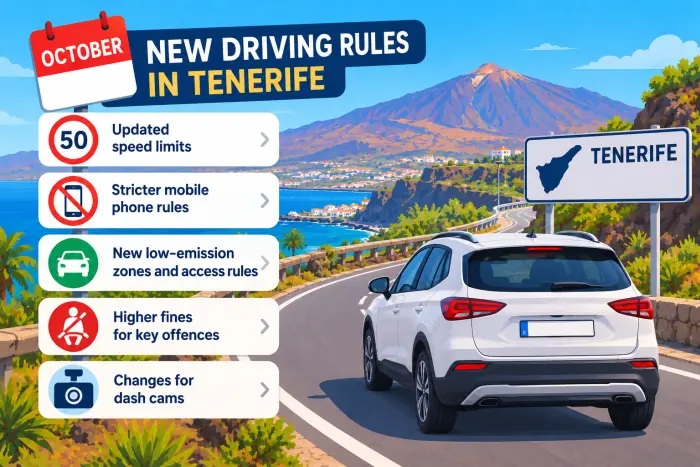
The short version: passing a cyclist outside built-up areas now means driving at least 20 km/h below the road’s speed limit for the whole manoeuvre, leaving 1.5 metres of space, and changing lanes completely on roads with more than one lane in your direction. In towns, Spanish summaries also mention keeping about 5 metres behind a bicycle, and in a jam on a motorway or dual carriageway you’re expected to pull aside to open a corridor for the emergency services. If a safe pass isn’t possible, you wait.
The changes come from Royal Decree 518/2026, which updated Spain’s general traffic regulations, and the DGT (the traffic authority) confirmed they took effect on 1 October. They apply across the country, so they cover the Canary Islands, and they apply to you whether your licence was issued in Madrid or Manchester.
The part that catches people out: 20 km/h below the limit
Most drivers already knew about the 1.5 metres. What’s new is the speed. When you overtake a cyclist, a pedestrian or similar road user outside a town, you have to be travelling at least 20 km/h below the limit of that stretch of road, before you start and for the whole manoeuvre. It’s measured from the posted limit, not from the speed you were doing. On a 90 km/h road, that means 70 at most. On a twisty mountain section signed at 50, it means 30.
That sounds fussy until you realise how it plays out. You’re not meant to accelerate past a cyclist in a rush and then settle back down. You slow down first, check the road, and go around at a controlled pace. If you can’t do that and still keep your distance, the rule is simply: don’t overtake yet.
The other two pillars haven’t changed much, but they matter. You must leave at least 1.5 metres between the car and the rider. And where the road has more than one lane in your direction, you can’t just drift over a bit. You need to change lane properly.
What this means on Teide, Anaga and the mountain roads
Tenerife is one of those islands that cyclists love, and the Teide climb in particular draws riders year-round. If you drive up to the national park, you’ll meet them. The same goes for the roads towards Masca and parts of Anaga, where you might find a few riders on a Sunday morning.
On narrow mountain roads, the practical effect is that you’ll spend more time behind cyclists than you used to. That isn’t the end of the world. Spanish and Canarian drivers are known for waiting patiently, and the new rules effectively make patience the legal default whenever the road won’t let you do the manoeuvre properly. Spanish guidance also notes that, with enough visibility and no oncoming traffic, a driver may cross a continuous line to leave the 1.5 metres, but the two conditions are essential: clear view, empty road. If there’s a bend, wait.
A couple of habits help. Leave extra time on the mountain roads (our guides to driving to Teide and the best roads to drive in Tenerife suggest when to go), and don’t treat a cyclist riding two abreast as rude: Spanish rules allow it in most cases.
Five metres: sources disagree on where it applies
There is a fourth number floating around, and it’s the one where the coverage is least consistent. Spanish driving-school and motoring sites place a five-metre gap behind a bicycle in built-up areas. English-language coverage from Tenerife describes five metres as the distance you should be clear of a cyclist before you move back into your lane after passing. We could not confirm the exact wording from the regulation itself, so treat both as sensible habits rather than as a legal quote: don’t sit on a rider’s rear wheel, and don’t cut back in the moment you’re level.
The practical benefit is the same either way. A bigger gap gives you more room to see the road and to judge whether you can pass at all.
Traffic jams now come with a duty
This one is aimed at motorways and dual carriageways, and in Tenerife that means the TF-1 and TF-5. When traffic is crawling or stopped, drivers are now expected to pull aside and open a corridor in the middle for ambulances, police and fire engines. On a two-lane carriageway, the left-lane cars move left and the right-lane cars move right, leaving the centre free. Where there are more than two lanes, Teneriffa News reports the corridor forms to the right of the left-hand lane.
🚗 Discover Tenerife – Best Car Rental Deals
Compare top-rated suppliers, no hidden fees & free cancellation included.
If you’ve sat in the slow lane crawl into Santa Cruz on a weekday morning, you know how real this scenario is, and our guide to Tenerife’s traffic and rush hours shows where it tends to happen. The advice is simple: when the queue slows to walking pace, don’t wait for someone to tell you. Edge to your side, leave the middle clear, and stay there until it all moves again.
Broken-down cars and roadside work
Another part of the reform covers passing a vehicle that’s stopped on the road, whether because of a breakdown, an accident, a tow truck, or road maintenance. Here, too, you must leave at least 1.5 metres and reduce your speed by at least 20 km/h compared with the limit. It’s the same principle: anything vulnerable or stationary in your lane means slow down first, then go around carefully.
If you ever need to flag a problem on a road yourself, the reflective warning triangle is no longer the main device Spanish press coverage points to, and the V16 beacon has taken its place. We cover what your rental car should carry in our V16 beacon guide.
Fines, points and what happens with a hire car
Spanish motoring press reports a fine of about €200 for failing to respect the cyclist-overtaking rules, along with up to six points on a Spanish licence under the rules in force before this reform. Treat those as reported figures rather than a quote from the tariff, and check the DGT’s own page if the exact amount matters to you.
For visitors, the points are the less relevant part, because they apply to Spanish licences. The fine is the part you’re likely to meet, and with a hire car it doesn’t go away when you fly home. The rental company receives the notice and passes it on to you, usually with an administration charge on top, sometimes weeks later. We explain how that works in our guide to speeding points and fines in a rental car, and our speed limits and fines page lists the other rules to keep in mind.
One more thing, if you’re hiring something with two wheels
The same reform tightened rules for e-scooters and motorbikes: e-scooter riders must be at least 15 and wear a helmet, motorcyclists need protective gloves and shoes that fully cover the foot, and riders of mopeds up to 125 cc need certified helmets, with a transition period for some of those. If you’re renting alongside the car, ask the company what they provide.
Quick questions
Do the new rules apply in Tenerife? Yes. The changes are national and took effect on 1 October, so they cover the Canary Islands too.
Can I overtake a cyclist on a solid line? Spanish guidance says a driver may cross a continuous line to keep the 1.5 metres, but only with enough visibility and no oncoming traffic. If either is missing, wait.
How fast can I go when overtaking a cyclist? At least 20 km/h below the limit of that stretch of road, so a maximum of 70 on a 90 km/h road. This applies outside built-up areas.
How close can I follow a cyclist? Spanish summaries mention about five metres behind a bicycle in built-up areas. The exact wording varies between sources, so leave generous room either way.
Do I have to make an emergency corridor in a traffic jam? On motorways and dual carriageways, yes: when traffic is stopped or at walking pace, vehicles pull aside to leave a central space for emergency services.
Will the rental company charge me if I’m fined? It will pass on the fine, typically with an administration fee, even after you’ve returned the car.
Last thing before you drive
These rules are only days old, and enforcement details can be clarified as the authorities publish more guidance. The DGT’s own page on the reform is the place to check if something here seems to have changed. In the meantime, the habit worth building is a simple one: slow down early, give cyclists room, and let the road dictate when you pass. On Tenerife’s mountain roads, that’s usually the faster way to the view anyway.