You return the car, hand over the keys, and hear nothing. Weeks later, back home, a charge appears on your card, or an email arrives with a photo of a scratch, a dent, a chip you don’t remember and definitely didn’t cause. This specific pattern, a damage claim raised well after return, with limited or unconvincing evidence, is common enough to have a well-documented, effective response, and the single biggest factor in whether it resolves quickly or drags on for months is something you either did or didn’t do at collection, months before the charge ever appeared.
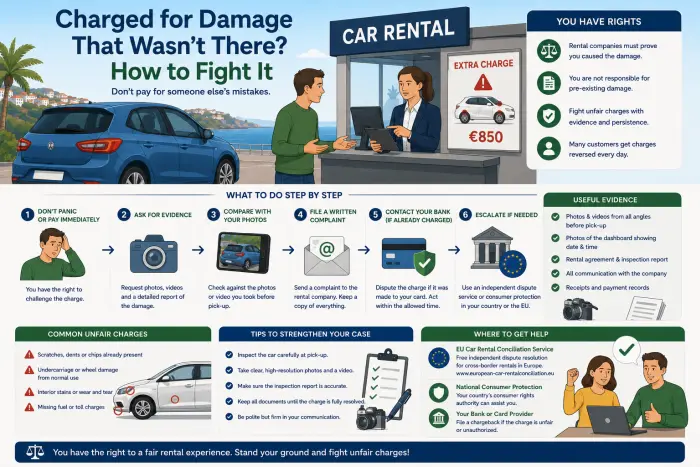
What the company actually has to prove: a rental company can’t simply assert damage and expect payment. To legitimately hold you responsible, they generally need to show clear, time-stamped photos of the specific damage, documentation that it wasn’t present before your rental began, an actual repair invoice rather than just an estimate, and reasonable proof the damage happened during your specific rental period rather than before or after it. If you have your own timestamped photos from collection and return, this is usually a fast, decisive dispute in your favour. If you don’t, it becomes considerably harder, though not necessarily impossible, particularly if the claimed damage is severe enough that the car couldn’t plausibly have been driven with it, or if the return happened through an unstaffed after-hours drop-box with nobody present to inspect the car at the actual moment you handed it back.
📸 Why Your Own Photos Decide This Dispute
This is worth stating as plainly as possible: a renter with genuine, timestamped photos from both collection and return is in an overwhelmingly strong position, and disputes in these cases are consistently resolved quickly in the renter’s favour, whether through the rental company backing down or a card issuer siding with the customer during a chargeback. A renter with no photos at all is in a considerably weaker position, forced to rely on logic, timing, and secondary evidence instead. If you haven’t already built this habit into every rental, our collection and inspection checklist guide covers exactly how to do it properly, and it is, without exaggeration, the single most effective protection against this entire category of dispute.
🧾 What the Company Must Actually Show You
If a damage charge appears, you’re entitled to ask for specific evidence before accepting it, and a legitimate claim should be able to produce all of the following:
| What to Request | Why It Matters |
|---|---|
| Clear, time-stamped photos of the specific damage | Vague, undated, or unclear photos are far weaker evidence than they’re often presented as |
| Confirmation the damage wasn’t noted at your collection | If it was already marked on your collection paperwork, it isn’t yours to pay for |
| An actual repair invoice, not just an estimate | A repair estimate alone doesn’t prove the work was done or what it actually cost |
| Proof the damage occurred specifically during your rental period | Particularly relevant if the vehicle was rented to other drivers between your return and the claim being raised |
A company unwilling or unable to provide these specifics when directly asked has a considerably weaker position than the initial charge or email might suggest.
🔍 The “Vehicle History” Request Worth Knowing About
One specific, less commonly known tactic is worth adding to your toolkit: if a damage claim surfaces weeks after your return, and especially if you strongly believe the damage wasn’t there when you handed the car back, you can request the vehicle’s rental history, sometimes called a utilisation log, for the period since your rental ended. If the same vehicle was rented out to other customers multiple times between your return and the claim being raised, this is a genuine basis to ask the company to demonstrate specifically why the damage should be attributed to you rather than to any of the other drivers who had the car in the meantime.
🌙 After-Hours and Drop-Box Returns: A Genuine Risk Factor
A recurring detail in disputed damage cases involves returns made outside staffed hours, keys left in a drop-box or with nobody present to inspect the vehicle at the actual moment of return. Without a staff member physically present to confirm the car’s condition when you handed it back, there’s no independent record of the vehicle’s state at that exact moment, only whatever the company notes whenever they eventually get around to inspecting it, sometimes hours or days later. If your return is happening after hours, this makes your own photographs considerably more important, not less, since they may be the only evidence establishing the car’s actual condition at the true moment of return. Our late return guide covers timing generally, but the after-hours drop-off scenario specifically deserves extra documentation on your part.
⚖️ Does This Damage Make Physical Sense?
One practical, common-sense check worth applying to any disputed claim: does the described damage make sense given how you actually used the car? A severely damaged window that would have made the vehicle undriveable, for instance, is difficult to reconcile with a rental that otherwise ran smoothly for a week with no reported issues. This kind of logical inconsistency has been enough, in documented cases, to support a successful dispute even without direct photographic evidence, though it’s a considerably weaker position than having your own timestamped photos in the first place.
💳 Disputing the Charge: What to Actually Do
- Request the specific evidence outlined above in writing before paying anything or accepting the claim.
- Compare it directly against your own collection and return photos, if you have them.
- Contact your card issuer about a dispute if the company’s evidence doesn’t hold up, most card networks allow a reasonable window, commonly around 60 days, to raise this, our dispute and complaint guide covers the fuller escalation process.
- Check whether excess insurance or credit card cover applies, since either may be able to help resolve or reimburse a charge even if it’s ultimately deemed valid.
- Keep a complete file of every communication, photo, and document related to the claim, building a clear paper trail in case the dispute takes time to resolve.
⚠️ A Chargeback Isn’t Always the End of It
Worth knowing honestly: winning a card dispute stops your bank’s involvement, but it doesn’t automatically stop a company from pursuing the same debt through other means, including a collections agency, in cases where they still believe the charge is valid. This isn’t a reason to avoid disputing a charge you genuinely believe is wrong, it’s a reason to keep your documentation organised even after a successful chargeback, in case you need to respond to a further collections notice with the same evidence later.
🔧 If the Damage Happened During an Accident, Not a Dispute
If you’re dealing with genuine damage from an actual incident during your rental, rather than a post-return charge you’re contesting, that’s a different process entirely, covered in our car accident guide. This guide is specifically about damage claims raised after the fact that you believe are inaccurate, exaggerated, or not actually attributable to your rental at all.
🚗 Discover Tenerife – Best Car Rental Deals
Compare top-rated suppliers, no hidden fees & free cancellation included.
💰 How This Interacts With Your Deposit
If a damage charge is deducted from a held deposit rather than charged separately, the same dispute process still applies, you’re entitled to request the same evidence and dispute an unjustified deduction just as you would a direct charge. Our deposit refund time guide covers the general timeline for deposit releases, which is worth understanding so you can tell whether a delay is a normal processing timeline or actually related to a specific, disputed deduction.
✅ Checklist: Before, During, and After the Dispute
- Photograph the car thoroughly at both collection and return, every single time, regardless of how minor the rental feels.
- Take extra care with after-hours or drop-box returns, since nobody may be present to confirm the car’s condition at the actual moment you hand it back.
- Request specific evidence in writing the moment any damage claim appears, before accepting or paying it.
- Ask about the vehicle’s rental history if the claim surfaces well after your return and other drivers may have used the car since.
- Dispute through your card issuer within the standard window if the company’s evidence doesn’t hold up.
- Keep every document, even after a successful dispute, in case the same claim resurfaces through a different channel.
❓ Frequently Asked Questions
What should I do if I’m charged for damage weeks after returning my Tenerife hire car? Request specific evidence in writing: time-stamped photos of the damage, confirmation it wasn’t noted at your collection, an actual repair invoice, and proof it occurred during your specific rental period. Compare this against your own collection and return photos if you have them.
Can I ask the rental company who else drove the car after I returned it? Yes, this is sometimes called requesting the vehicle’s utilisation or rental history. If the car was rented to other customers between your return and the claim being raised, this is a legitimate basis to question why the damage is being attributed specifically to you.
Is a repair estimate enough proof for a damage claim? No. A legitimate claim should include an actual repair invoice showing the work was completed, not just an estimate, which doesn’t confirm the damage was genuine or that any repair actually took place.
Does it matter if I returned the car after hours through a drop-box? Yes, significantly. Without staff present to inspect the vehicle at the actual moment of return, there’s no independent record of its condition at that point, which makes your own photographs considerably more important as evidence.
Can I dispute a damage charge through my credit card company? Yes, most card issuers allow a dispute within a defined window, commonly around 60 days, provided you can show the company’s evidence doesn’t adequately support the claim.
Does winning a chargeback mean the matter is fully closed? Not necessarily. A successful chargeback ends your bank’s involvement, but the company can still attempt to pursue the same debt through other means, including collections, if they maintain the charge is valid. Keep your documentation regardless.
What if I have no photos at all from my rental? It’s a considerably weaker position, but not necessarily hopeless. Logical inconsistencies in the claim, such as damage severe enough that the car couldn’t plausibly have been driven, or a lack of any staff inspection at return, can still support a dispute.
Is this the same process as a genuine accident during my rental? No. This guide covers disputing a damage claim raised after the fact that you believe is inaccurate or unjustified. A genuine accident during your rental follows a different process entirely.
🏁 Final Verdict: Photos Win This Dispute Before It Even Starts
A disputed damage charge after a Tenerife car hire is one of the more stressful post-trip surprises, but it’s also one of the most consistently winnable disputes when you have the right evidence. Photograph the car thoroughly at both ends of every single rental, ask for specific proof the moment any claim appears, and keep your documentation organised, and the overwhelming majority of these disputes resolve in the renter’s favour.
👉 Compare car hire deals in Tenerife from companies with clear, fair damage assessment processes. This guide is part of our full Tenerife car hire guide — for the rest of the small print worth knowing, see our hidden fees guide.