Most car rentals in Tenerife go exactly as expected — you pick up the car, you drive it, you return it, the deposit comes back. But the minority of trips where something goes wrong tend to go wrong in a small number of predictable ways, and knowing what those are before you travel makes almost all of them easier to handle, or avoid entirely.
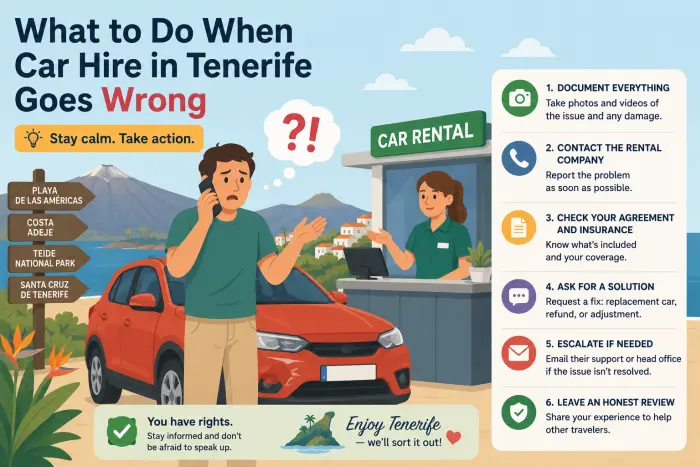
This guide pulls together everything on the site about problems, disputes, and things worth being alert to — organised by when in the rental they typically happen, from the desk, to the road, to getting your money back afterwards.
Common problems by stage
| Stage | Typical problem | What protects you |
|---|---|---|
| Before booking | Fake rental website | Check domain, payment method, price vs market |
| At the desk | Upsell pressure, wrong car | Know your excess in advance, ask for the booked category |
| At pickup | Undocumented existing damage | Full video inspection before driving off |
| On the road | Breakdown, flat tyre, accident | Save the company’s emergency number before you drive |
| After return | Surprise damage or dispute charge | Pickup video + prompt chargeback if needed |
Before you even reach the desk
A small number of problems start before you’ve picked up a car at all. Fake booking websites that mimic real rental companies or comparison sites are one of the more damaging ones, since the financial exposure can be far higher than a dispute over a damage charge — our guide to spotting a fake rental website covers the signs to check before you hand over card details. Common red flags include a price that’s noticeably below every other quote for the same dates, a request for payment by bank transfer rather than card, and a domain name that’s a close but not exact match for a real company’s site — small misspellings or an extra word tucked into the URL.
It’s also worth double-checking who you’re actually booking with. A number of well-known comparison sites act purely as intermediaries, and the contract that governs your rental is with the underlying local company, not the site you booked through. That distinction matters if something goes wrong later — the comparison site’s customer service typically can’t override decisions made at the desk.
At the pickup desk
This is where most avoidable problems actually originate, mostly because it’s where you’re tired from a flight, keen to get to your hotel, and dealing with a desk agent whose job partly involves selling upgrades and add-ons. Our guide to desk pressure tactics covers the common scripts — urgency around “last car in this category,” inflated claims about what your existing insurance doesn’t cover, and the classic push toward a full-tank prepay option that rarely benefits you. It’s worth reading this one before you fly, not after you’ve already said yes to something at the counter.
Two other pieces of desk advice come up often enough to warrant their own guides: our note on why you generally shouldn’t follow an instruction to not refuel before returning if your contract says full-to-full, and our practical inspection checklist for photographing and documenting the car’s condition before you drive off — the single most useful five minutes you can spend at pickup, and the thing that resolves the majority of later disputes in your favour if you did it properly.
The inspection itself is worth doing properly rather than quickly. Walk the full perimeter of the car with your phone, including the roof and underside where you can reach it, and take a short video rather than just stills — video captures existing scratches and scuffs in context, and the timestamp is harder to dispute than a handful of photos taken out of order. Check the windscreen for chips, the wheels for kerb damage, and the interior for anything beyond normal wear. If the desk agent points out existing damage and marks it on a paper diagram, ask for a copy or photograph that diagram too, rather than relying on their record alone.
If the car you’re handed isn’t the one you booked, our guide to getting a different car than booked covers what you’re entitled to ask for and when it’s reasonable to push back versus accept the swap.
On the road
Breakdowns and minor incidents happen occasionally, and having a plan before it happens matters more than most people think. Our breakdown guide covers who to call and what the company typically expects from you in the meantime, while our guide to a flat tyre with no spare addresses a specific and increasingly common situation, since a growing number of rental cars come with a repair kit or run-flats instead of a full spare wheel.
🚗 Discover Tenerife – Best Car Rental Deals
Compare top-rated suppliers, no hidden fees & free cancellation included.
If you’re actually involved in a collision, our car accident guide — part of the driving-rules cluster but directly relevant here too — covers the immediate steps, and our guides to lost hire car keys and rental car theft cover two of the more expensive things that can go wrong mid-rental, including what’s typically covered by insurance and what isn’t.
One easy-to-miss issue: if someone other than the named driver on the contract ends up behind the wheel, insurance cover is usually void for that period. Our guide to unauthorized drivers explains why this matters more than people assume, particularly for couples or families who assume any licensed adult in the group can drive.
After you’ve returned the car
Most disputes actually surface here — a charge appears on your card days or weeks after drop-off, often for damage you weren’t shown at the desk. Our guide to damage charges not on the original checklist covers what to do if this happens to you, and it’s exactly why the pickup inspection photos matter so much — they’re usually the deciding factor in whether a company backs down.
If you need to formally dispute a charge, our complaint and dispute guide walks through the escalation path — company complaints process, card chargeback options, and when it’s worth involving a Spanish consumer protection body versus handling it directly with the company. Timing matters here: chargebacks typically have a window of weeks to a few months from the transaction date, so if a charge looks wrong, it’s worth starting the dispute process promptly rather than waiting to see if it resolves itself.
It’s also worth knowing that the strength of your position in any post-return dispute usually comes down to documentation rather than argument. A company disputing a damage claim is far more likely to back down when shown timestamped video from pickup than when told, without evidence, that the damage wasn’t there. This is the main reason the inspection step above matters as much as it does — it’s not just a formality, it’s effectively your evidence file if anything goes wrong later.
How common are these problems, really
It’s worth keeping some perspective here. The overwhelming majority of rentals on the island complete without any dispute at all, and most of the guides in this cluster exist because a specific problem, even if it affects a small percentage of renters, tends to generate a disproportionate number of forum posts and search queries from people trying to figure out what happened to them. That’s useful context when you’re reading through all of this before a trip — the goal isn’t to travel expecting trouble, it’s to know what a handful of specific, recognisable situations look like so you’re not caught off guard if one of them happens to you.
The pattern behind most of these
Almost every guide in this cluster comes back to the same handful of habits: photograph the car thoroughly before you drive off, keep every document the desk gives you, know your excess and what it actually covers before you need it, and don’t let desk pressure talk you into an add-on you hadn’t already decided you wanted. None of that guarantees a problem-free rental, but it’s the difference between a five-minute phone call to resolve a dispute and a drawn-out chargeback process weeks after you’re home.
A related habit worth building: keep a single folder, either in your phone’s photo app or a cloud drive, for everything related to the rental — the booking confirmation, the pickup inspection video, the signed contract, and any email correspondence. If a dispute does surface after you’re home, having all of it in one place rather than scattered across email threads and camera roll folders saves a genuinely frustrating amount of time.
If insurance and excess are still unclear to you, that’s worth sorting out before you book rather than after something goes wrong — our guide to car hire insurance in Tenerife and our broader breakdown of the real cost of car hire in Tenerife both cover the decisions that end up mattering most when something does go wrong. Understanding what your excess actually covers before you’re standing at the desk being offered an upsell is, in practice, one of the strongest defences against most of the problems described above — a lot of desk pressure only works on renters who don’t already know the answer.
Choosing the right company in the first place also reduces how often you’ll need any of this. Our comparison of Tenerife’s main car hire companies is worth reading with an eye specifically toward reputation for post-rental disputes, not just price — a slightly higher headline rate from a company with a clean track record on charges is often the better deal once you account for the time and stress a dispute costs.