Masca is the most talked-about village on Tenerife and probably the most misdescribed. The photos promise a peaceful hilltop hamlet, while the map shows a thin line squeezed between mountains, and neither prepares you for what it is actually like. The village sits at 600 metres in the Teno range, above a ravine so dramatic that visitors keep comparing it to Machu Picchu, and the road that reaches it is narrow, winding and occasionally hosts a tour bus meeting you at a blind hairpin with less than a metre to spare. It is also one of the best drives in Europe, and with a little preparation, a perfectly manageable one.
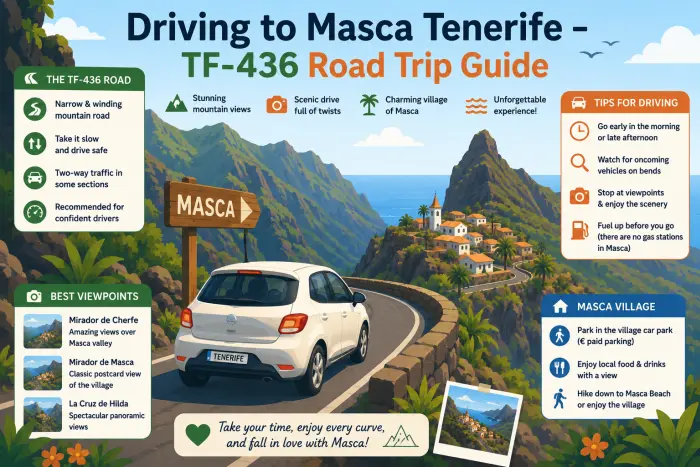
🧭 Before you turn onto TF-436
- The road is narrow but well surfaced: about 5 km from Santiago del Teide, about 17 km from Buenavista del Norte.
- Arrive before 9am or after 4:30pm. The village car park has around 40 spaces and a 2-hour limit between 8am and 2pm.
- Take the smallest car you can, ideally an automatic, and check what your excess cover actually includes.
- The gorge hike is now a booked, one-way day with a separate boat ticket, so nobody walks in on the day anymore.
- In high-risk summers TF-436 can close to visitor traffic, so check its status the night before.
Until the 1960s Masca was practically cut off from the outside world, which is partly why it kept its atmosphere and why it was once a refuge from pirates. Knowing that changes the arrival. You are not parking at a scenic viewpoint, you are reaching somewhere that was deliberately, and successfully, hidden.
The road is narrow, not dangerous, and you can approach it from two sides
TF-436 links Santiago del Teide in the south-east with Buenavista del Norte in the north-west, with Masca roughly in the middle, and you can drive it from either end. Each side has its own character:
| Approach | Best if you start from | Distance on TF-436 | Drive time on TF-436 | Character |
|---|---|---|---|---|
| Santiago del Teide | South resorts, TFS Airport, Teide | ~5 km | 20–25 min | The famous hairpins: steep, dramatic, shorter |
| Buenavista del Norte | North coast, TFN Airport, Puerto de la Cruz | ~17 km | 30–40 min | Longer, slightly wider, more agricultural |
The southern approach is the popular one, and the more spectacular. The road leaves Santiago del Teide and almost immediately climbs towards the ridge, and the descent to the village from Mirador de Cherfe is the section everyone photographs: the village far below, the ravine opening under it, the Atlantic beyond. From Costa Adeje or Tenerife South Airport, where most Masca day-trippers pick up their car, take the TF-1 motorway to the TF-82, go through Santiago del Teide and turn onto TF-436. That is about 37 km and 50 to 60 minutes. From Teide National Park it is the TF-38 west to the Chío junction, then the TF-82, which makes an excellent combination day.
The northern approach is less photographed but rewarding in a different way. It passes La Vica, Los Carrizales, Las Portellas and El Palmar, agricultural villages with banana plantations and the flat north coast below, and the road stays wider for longer. The dramatic narrowing only begins as you climb towards Masca. From Puerto de la Cruz or TFN Airport it is the TF-5 west to the TF-82, then Buenavista del Norte and TF-436, roughly 55 km and 70 to 80 minutes.
The best plan for most people is the loop: drive in from Santiago del Teide, explore Masca, then continue north to Buenavista del Norte instead of reversing through the hairpins. TF-436 is Route 1 in our ranking of the best roads to drive in Tenerife, and the loop is the reason.
Three viewpoints are worth a stop, and only one has a proper car park
Mirador de Cherfe is the only viewpoint on TF-436 with a dedicated car park, so it is the stop to plan your day around. Everywhere else on this road you stop at a designated pull-in or you do not stop at all, because there is no shoulder and the bends give you no visibility. Here are the three, with coordinates for your offline map:
| Viewpoint | GPS | What you see | Parking |
|---|---|---|---|
| Mirador de Cherfe | 28.299651, -16.823957 | The switch: a wide valley panorama with the road disappearing into the ravine | Small dedicated car park |
| Mirador de Masca | 28.300315, -16.826727 | The village for the first time, cliff faces, the Atlantic horizon | Small pull-in |
| Mirador sobre Masca | 28.304590, -16.829810 | A high-angle view of the whole ravine system | Limited roadside |
Cherfe is where the landscape suddenly makes sense. The road you have been driving drops over the edge below you, the ravine falls away, and Masca appears as a cluster of white houses clinging to the opposite face. Allow an extra 30 minutes on top of the 50 to 60 minute drive for the three stops and a proper look at the village.
How bad is parking in Masca, really?
Bad enough to plan around: the village has only about 40 spaces, they are free, and between 8am and 2pm you are limited to two hours. For one of the most visited places on the island, that number is the single most important practical fact about going by car.
Arrive before 9am and you will find a space, and you will need to be back at the car by 11am, which is enough for a coffee, the square and the ravine view but not for the gorge. Arrive late morning and you may circle the village and leave without stopping. After 2pm the two-hour cap no longer applies and the car park thins out, so a late-afternoon arrival, especially after 4:30pm, works very well for sunset views and a quiet walk.
If you are hiking the gorge, do not park in the village at all. The hikers’ routine is to leave the car in Santiago del Teide (the cemetery car park is a large free option), then walk about 10 minutes to the official shuttle stop.
Which car to take: the smallest one you can comfortably fit in
Rent the smallest car you can travel in, because on TF-436 that is physics rather than preference. Some sections need one car to find a passing place and reverse carefully, and two large cars meeting at the wrong spot is a real problem. Minis and economy cars like the Fiat 500, Fiat Panda or VW Up are the easiest. A Seat Ibiza or VW Polo is the sweet spot, roomy enough for a holiday and small enough to tuck into a passing place. A compact like the Seat Leon is manageable if you are precise, a mid-size estate gets stressful on the narrowest stretches, and a large SUV is the one thing we would avoid, especially when tour buses are involved.
An automatic makes a bigger difference here than almost anywhere else on the island. Steep gradients, tight bends and frequent stops to let traffic through mean constant gear changes in a manual, while an automatic handles all of it quietly. Full insurance is worth having too. Rock walls on one side and a drop with no barrier on the other make a clipped mirror or wing a genuine risk, and it helps to know what standard CDW usually leaves out on roads like this before you leave the rental desk.
Timing decides how the road feels
The difference between 8am and 10am on TF-436 is not preference, it is a functionally different road. Before 9am the road is flowing, quiet and yours, with morning light on the cliffs and space in the car park. After 10am in peak season you are stop-start behind tour buses, the car park is full and the miradors have queues.
The best windows are before 8:30am, which is close to perfect, and 8:30 to 9:30am, which is still excellent while the car park fills. From 9:30 to 11am it is busier and you will need patience. Between 11am and 2pm it is peak congestion and the car park is full or nearly so. From about 3:30pm the crowds start to thin, and after 4:30pm the village is quiet, parking is easy and the afternoon light on the ravine is beautiful.
🚗 Discover Tenerife – Best Car Rental Deals
Compare top-rated suppliers, no hidden fees & free cancellation included.
In winter, from November to February, the light is lower and mist can settle over the upper section. If Mirador de Cherfe is in cloud when you arrive, wait 30 minutes and it usually clears, and the view when it does is worth it. If meeting oncoming traffic on narrow roads makes you nervous, our guide to driving in Tenerife covers who reverses and how to do it calmly.
When TF-436 closes to visitors altogether
Some summers the road shuts to tourist traffic entirely, no matter what time you arrive. When wildfire risk is elevated, the Cabildo de Tenerife restricts TF-436 to residents, property owners, essential workers and public transport, and rental cars are turned back at checkpoints, typically around Las Lagunetas and Santiago del Teide. This is separate from the everyday crowding above: it is a conditional closure tied to fire-risk alerts, and it can last for days with little warning for visitors who booked around it.
If you are planning Masca in peak summer, roughly July to September, check the road status the night before or on the morning itself rather than assuming it is open. Searching “Masca acceso” or “TF-436 restricción” usually surfaces an active alert faster than English-language sources. Our piece on driving in Tenerife during wildfire risk explains how these restrictions work and what your rental agreement says if plans change.
What the village gives you in 30 to 45 minutes
Masca itself is small, and the point is the setting rather than the sights: the views, and the sense of having arrived somewhere remote. In 30 to 45 minutes you can see the Plaza de Masca with its ancient laurel tree, thought to be several hundred years old, and the small 18th-century Chapel of the Immaculate Conception. Walk down to the lower end of the village for the view into the ravine towards the sea, then have a coffee at one of the cafés and shops kept going by the few families who still live here. Most of them close between 5pm and 6pm, especially out of season, so a very late arrival may find little open.
The gorge hike is now a booked, one-way day trip
Hiking the Masca Gorge means booking a time slot in advance on the official Camino del Barranco de Masca website, and the old advice about walking in and coming back up no longer applies. The trail runs about 4.5 km down from the village to Masca beach, three to four hours through a canyon with 600-metre walls, and it is rated moderate to difficult with some scrambling over boulders. Children under 8 and anyone in poor physical condition are not recommended to attempt it.
What has changed is the logistics. The ticket is for a specific slot, with groups of about 25 starting every 30 minutes on the descent, so popular dates sell out. At last check it was around €40 per adult, with special rates for Canary Islands residents and under-18s, but always confirm the current price on the official site. Masca beach is closed to the public, which means the only way out is the compulsory boat transfer to Los Gigantes, booked in advance and priced at roughly €25. You also have to use the official shuttle from Santiago del Teide to reach the start, keep your ticket for the checks, carry ID that matches the booking (even for children), and wear closed mountain footwear, because trainers get you refused at the entrance. A helmet is required and handed out at the start. The gorge is not open every day, and once booked you can change a reservation only twice and not within 72 hours of the slot.
For drivers, the practical upshot is simple: park in Santiago del Teide rather than the village, take the shuttle up, walk down, take the boat and use public transport back to your car. Our dedicated guide to the Masca Gorge permit and booking process walks through it step by step. If you are not hiking, you do not need any of this: the village and the road are open to everyone.
A west-coast day that keeps you off TF-436 at midday
The best way to use Masca is as the centrepiece of a loop that has you on the road at its quietest and never reversing through the hairpins. It works like this:
- 07:30 leave the south resorts via the TF-1 and TF-82 to Santiago del Teide
- 08:30 Mirador de Cherfe for early light on the valley
- 09:00 Masca village: park, walk, see the chapel and the ravine view, have a coffee
- 10:00 continue north on TF-436 through La Vica and El Palmar
- 10:45 coffee stop in Buenavista del Norte
- 11:30 Los Gigantes for the cliff-road approach and the harbour, where our guide to Los Gigantes by car covers parking and boat trips
- 13:30 seafood lunch on the harbour
- 15:00 coastal drive back on the TF-47 via Playa de la Arena and Santiago del Teide
- 16:00 optional: the volcanic forest around Chinyero, with Teide views from the west
- 17:30 return to the south via the TF-82 and TF-1
This avoids TF-436 in its busiest midday window and finishes the circuit instead of doubling back. If Masca leaves you wanting another mountain drive, Anaga is the island’s other great road trip, with ancient forest, coastal villages and a completely different atmosphere.
Questions people ask before driving to Masca
How do I drive to Masca from the south of Tenerife?
Take the TF-1 west, exit towards Santiago del Teide on the TF-82, go through the town and turn onto TF-436. From Costa Adeje it is about 37 km and 50 to 60 minutes at a sensible pace, and the TF-436 section itself is about 5 km from Santiago del Teide to the village.
Is the road to Masca really dangerous?
Dangerous is too strong, challenging is accurate. The surface is good, the bends are visible and thousands of people drive it every week, but it is very narrow with sharp drops and no guardrails in many places. Meeting a tour bus on a tight section means one driver reverses to the nearest passing place, so go early, take a small car and drive at a careful pace. Nervous drivers might prefer the bus or an organised tour.
What time should I arrive at Masca?
Before 9am, or after 4:30pm. Early gives you the car park, the quiet road and the morning light on the cliffs, and late gives you free parking and a thinner crowd.
What is the best car for driving to Masca?
The smallest one you are comfortable travelling in. A VW Polo, Seat Ibiza, Fiat Panda or similar economy car is ideal, large SUVs need more precision at passing points, and an automatic gearbox is strongly recommended for the stop-start hairpins.
Is there parking at Masca village?
Yes, in a free car park of about 40 spaces. Between 8am and 2pm it is capped at two hours, outside those hours it is free and uncapped, and it fills by mid-morning on busy days. If you plan to hike the gorge, do not park in the village.
Do I need a ticket to hike the Masca Gorge?
Yes. The trail is one-way and has to be booked in advance on the official Camino del Barranco de Masca website for a specific time slot, at around €40 per adult at last check. You also need the compulsory boat transfer from Masca beach to Los Gigantes (about €25), the official shuttle from Santiago del Teide, closed mountain footwear and ID matching the booking. Slots fill quickly, so book several weeks ahead for summer and Easter.
Can I drive through Masca and continue to Buenavista del Norte?
Yes, and it is the recommended option for most visitors. Continue through the village and follow TF-436 north for roughly 30 to 40 minutes. The northern section is slightly wider and less dramatic, and it connects to the north coast road and the TF-47 towards Los Gigantes.
Is Masca worth visiting without hiking the gorge?
Absolutely. The drive itself, with the viewpoints, the hairpins and the first sight of the village from Mirador de Cherfe, is the main experience for most visitors. The village takes 30 to 45 minutes to walk, and the ravine view from its lower end needs no ticket. Many people leave Masca without walking a single trail and still count it as a highlight of their trip.