Tenerife’s beaches get most of the attention, but some of the island’s most striking swimming spots aren’t beaches at all. Natural pools, known locally as charcos, are basins carved from old lava flows where the Atlantic fills in the gaps, creating calm, clear pockets of water surrounded by black volcanic rock. Almost all of them sit well off any regular bus route, tucked into small coastal towns along the north and west coasts — which makes this one of the clearest cases on the island where having your own car turns “I read about that online” into “we actually went.”
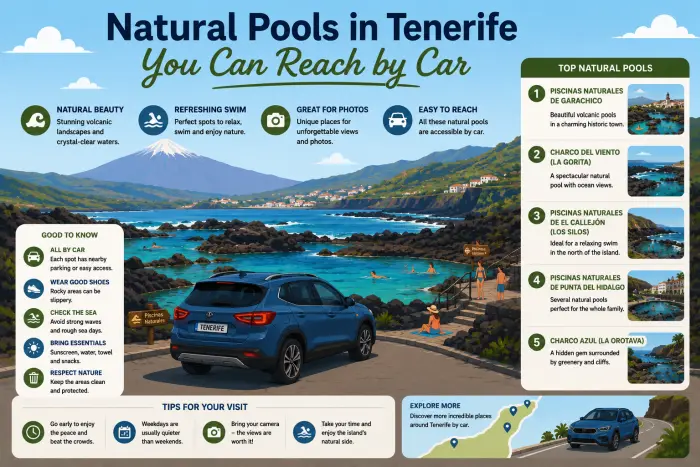
Tenerife’s natural pools are mostly concentrated along the north coast. El Caletón in Garachico is the most famous and easiest to combine with other sightseeing. Bajamar and Punta del Hidalgo, near La Laguna, are the best lifeguarded, family-friendly options. Charco de la Laja and Charco del Viento, further west, are quieter and especially photogenic. On the west coast, Charco de Isla Cangrejo near Los Gigantes offers a dramatic alternative with a different backdrop entirely. In the south, La Jaquita near Alcalá is the easiest pick if you’re staying in a south coast resort. Always check sea conditions before swimming — several of these pools close to bathers when the swell picks up, regardless of how calm they look from the car park.
What Exactly Is a “Charco”?
A charco is a natural or lightly adapted rock pool formed where hardened lava meets the sea — some are entirely untouched, others have had steps, railings, or a low wall added to make access and bathing safer. What they share is a genuinely different swimming experience from a beach: still, often crystal-clear water, a black volcanic floor instead of sand, and waves crashing somewhere nearby rather than directly on top of you.
Quick Comparison: Tenerife’s Best Natural Pools
| Pool | Region | Vibe | Facilities |
|---|---|---|---|
| 🏛️ El Caletón, Garachico | North | Famous, lively, historic backdrop | Ladders, lifeguards in summer, cafés nearby |
| 👨👩👧 Bajamar | North-east | Family-friendly, well-equipped | Showers, lifeguards, kids’ pool, restaurants |
| 🌄 Punta del Hidalgo | North-east | Wilder, more dramatic | Promenade, fewer facilities than Bajamar |
| 📸 Charco de la Laja | North | Quiet, photogenic, circular pool | Stairs, viewpoint, closes in rough seas |
| 🌊 Charco del Viento | North | Family-friendly cluster of pools | Small parking area, nearby restaurants |
| 🍷 Mesa del Mar | North (Tacoronte) | Semi-built pool plus a beach | Tunnel to a black-sand beach with Teide views |
| 🏔️ Charco de Isla Cangrejo | West (Los Gigantes) | Dramatic, sunset-friendly | Minimal facilities, sheltered lagoon |
| ☀️ La Jaquita | South-west (Alcalá) | Tamed, easy access | Walkways, ladders, paved terraces |
El Caletón, Garachico: The Most Famous Pools on the Island
Formed when an eruption in 1706 reshaped the entire coastline, El Caletón is the best-known natural pool complex in Tenerife — a network of interconnected basins, ladders, and platforms right beside the historic town of Garachico. It’s lively rather than secluded, with lifeguards on duty in summer and cafés just a short walk away, making it an easy add-on to a day already exploring the town. Our Garachico day trip by car guide covers the rest of what to see here.
Bajamar and Punta del Hidalgo: The Family-Friendly North Coast Pair
These two neighbouring towns, just past La Laguna toward the edge of the Anaga massif, offer two distinct takes on the same coastline:
- 🏖️ Bajamar has the most facilities of any natural pool on the island — showers, lifeguards in season, a dedicated children’s pool, and restaurants right along the seafront. It’s the safest, most straightforward choice if you’re travelling with kids.
- 🌄 Punta del Hidalgo, just up the coast, trades some of that polish for a wilder, more dramatic setting at the edge of the Anaga mountains, with a long seafront promenade and some of the best sunset views on this part of the coast.
Both sit close to La Laguna, making it easy to combine a pool visit with the historic city centre on the same day.
Charco de la Laja and Charco del Viento: The Photogenic Stops
Further west along the coast, two more pools are worth building into a north-coast driving day:
- 🌀 Charco de la Laja, in San Juan de la Rambla, is a near-circular pool reached by a short stairway from a clifftop viewpoint — one of the most photographed natural pools on the island, though it closes to swimmers when the sea is too rough.
- 🌊 Charco del Viento, in La Guancha, is actually a cluster of several pools protected by two lava arms, with a small parking area and nearby restaurants, making it one of the more practical stops for a longer visit.
Both fit naturally alongside a day exploring Puerto de la Cruz, Icod de los Vinos, or Los Realejos, all within easy reach of this stretch of coast.
Mesa del Mar, Tacoronte: A Pool and a Beach in One
In Tacoronte — already known to wine lovers via our Tenerife wine route guide — Mesa del Mar offers a slightly different experience: a large, semi-built pool kept full by the Atlantic rather than a fully natural rock basin, with a tunnel leading through to La Arena, a black-sand beach with views toward Mount Teide. It’s a good option if you want both a pool and a proper beach in the same short stop.
Charco de Isla Cangrejo: The West Coast Alternative Near Los Gigantes
Most of the island’s best-known charcos sit on the north coast, but the west has its own standout: Charco de Isla Cangrejo, a sheltered lagoon near the dramatic cliffs covered in our Los Gigantes by car guide. It’s particularly known for sunset swims and photography, with the towering cliffs providing a backdrop unlike anything on the north coast.
🚗 Discover Tenerife – Best Car Rental Deals
Compare top-rated suppliers, no hidden fees & free cancellation included.
La Jaquita: The Easiest Option From the South
If you’re based on the south coast and don’t want to drive all the way north, La Jaquita, near Alcalá in the municipality of Guía de Isora, is the most practical choice. It’s been adapted with walkways, ladders, and paved terraces, making it noticeably easier to access than most of the wilder northern pools, and the sea here tends to be calmer than the more exposed north coast. It pairs naturally with a wider south Tenerife road trip, or with a longer loop covering the north of the island if you’re prepared to make a full day of it.
Safety: When Not to Swim
Natural pools look calm right up until a larger wave reminds you they’re directly connected to the open Atlantic. A few rules worth following at every single one of these:
- 🌊 Check sea conditions before you go, not just the weather forecast — a sunny day can still mean a rough, closed sea.
- 🚫 Respect closure signs or flags. Several pools, including Charco de la Laja, are regularly closed to bathers when the swell is too strong.
- 🦶 Wear water shoes. Volcanic rock is sharp and often slippery, even on dry platforms.
- 👀 Never swim alone in an unlifeguarded pool, particularly at the wilder, less developed spots.
- ⏰ Check the tide. Many pools are easiest and safest to enjoy at low tide, with conditions changing noticeably as the water rises.
Natural Pools Checklist
- 🌊 Check sea conditions for your specific pool before setting off, not just the general forecast.
- 🦶 Pack water shoes for every stop — volcanic rock rewards it every time.
- 🅿️ Plan parking in advance — see our parking in Tenerife guide, since some pools only have small, informal parking areas.
- 👨👩👧 Choose Bajamar or La Jaquita if travelling with young children, both being the most developed and sheltered options.
- 📸 Visit Charco de la Laja or Isla Cangrejo if photography is the priority.
- 🕐 Time your visit around low tide where possible, for the calmest and safest conditions.
- 🧺 Bring a towel, sunscreen, and water — facilities are minimal at several of the wilder pools.
Frequently Asked Questions
What is a “charco” in Tenerife? A charco is a natural or lightly adapted rock pool formed where old lava flows meet the sea, filled with seawater and sheltered to varying degrees from the open ocean. They’re found mainly along Tenerife’s north and west coasts.
Which is the best natural pool in Tenerife for families? Bajamar is generally considered the best-equipped option, with showers, lifeguards in season, and a dedicated children’s pool. La Jaquita in the south offers a similarly accessible alternative if you don’t want to drive north.
Is El Caletón in Garachico worth visiting? Yes — it’s the most famous natural pool complex on the island, formed by a historic eruption, with ladders, lifeguards in summer, and the charming town of Garachico right beside it.
Are Tenerife’s natural pools safe to swim in? Generally yes, but conditions vary significantly by pool and by the day’s sea state. Several pools close to bathers when the swell is too rough, and it’s worth checking current conditions rather than assuming a calm-looking day guarantees safe swimming.
Can I visit a natural pool in Tenerife without a car? It’s difficult for most of them. Public transport reaches some of the larger towns nearby, but the pools themselves are often a walk from the nearest stop, and several, particularly on the west coast, are genuinely impractical without your own vehicle.
Which natural pool is best for photography? Charco de la Laja, with its near-circular shape and clifftop viewpoint, and Charco de Isla Cangrejo near Los Gigantes, with its dramatic cliff backdrop, are both particularly popular for photography.
Do I need to pay to visit Tenerife’s natural pools? No, the natural pools themselves are free to access. Some have nearby paid parking, and a few of the more developed ones have cafés or facilities where you might choose to spend money, but entry to the pools is free.
What should I bring to a natural pool in Tenerife? Water shoes are the single most useful item, given how sharp and slippery volcanic rock can be. Bring sunscreen, a towel, and drinking water too, since facilities are limited at several of the less developed pools.
Final Verdict: A Different Way to Swim in Tenerife
Tenerife’s natural pools offer something genuinely different from the island’s beaches — calmer water, dramatic volcanic settings, and a much stronger sense of being somewhere local rather than purely touristy. They’re scattered widely enough across the coast that a car isn’t just convenient here, it’s close to essential for seeing more than one in a single trip.
👉 Compare car hire deals in Tenerife and reach the island’s best volcanic pools at your own pace. This guide is part of our full Tenerife car hire guide.