You find a gap, you slide in, and then you notice the kerb is blue. Or yellow. Or there’s a sign with a clock on it and you can’t tell whether it applies to Tuesdays. Parking is the one part of a Tenerife road trip nobody mentions before you leave, and it has a way of quietly souring a good day, usually somewhere narrow, steep and busy.
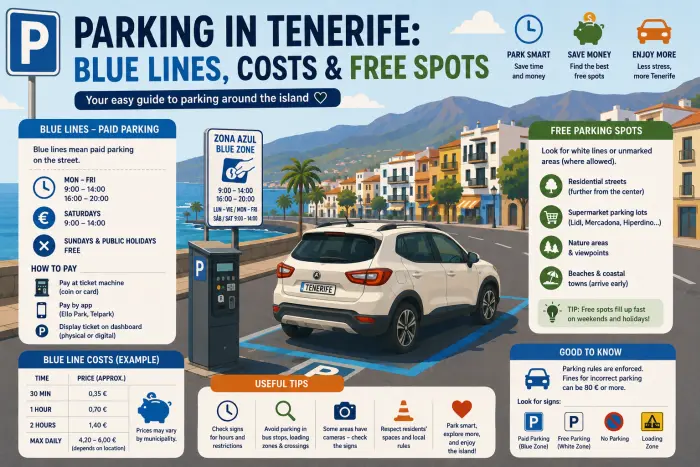
The good news is that Tenerife is not Barcelona. Outside a handful of town centres, parking is free or cheap, and the rules are a lot simpler than they look once you’ve learned four colours and a couple of habits.
White lines or no markings usually mean free parking, blue means you pay and there’s a time limit, yellow means don’t, and green is mostly for residents. Shopping-centre car parks and the edges of towns are where free spaces live; the closer you get to a promenade or an old town, the more likely you’ll pay or circle. Santa Cruz is changing its rules in stages, so read every sign there. And the best single habit is to arrive early at anywhere popular.
The four colours, and the one that catches people out
Spain paints its parking rules onto the kerb, and Tenerife follows the same system.
White (or no marking) is the one you want. It generally means you can park without paying, as long as no sign says otherwise. Free spaces are most common in residential streets, smaller towns and around beaches.
Blue marks regulated parking, known locally as the ORA or zona azul. You pay at a meter or through an app, the stay is often limited, and the rules apply at certain hours only, which is why the same street can be free on a Sunday and not on a Monday. Spain’s traffic code describes blue markings as limiting how long you can park at certain times of day, so the meter or sign is always the final word.
Yellow is where most visitors go wrong, because there are two kinds. A continuous yellow line along the kerb means you may neither stop nor park there. A broken yellow line means you can’t park, but you can usually stop briefly, unless a sign says otherwise. Yellow zigzags are reserved for something specific, such as a bus stop, so keep clear. “Just a minute” is exactly the sort of thing that gets a hire car towed.
Green is mainly for residents. In some Spanish towns visitors can pay to use them for a short time, but in general, treat green as “not for me” unless a machine tells you otherwise.
What it costs
Less than you’d expect, with one or two exceptions that are worth knowing about. Street parking in blue zones is usually charged by the hour, often in the region of one euro, with a maximum stay. Underground car parks cost more but save the hunting; in Santa Cruz, a recent local guide puts the first hour at roughly €1.10 to €1.75 and a full 24 hours at about €10 to €17, depending on the car park, with Plaza Weyler among the cheaper options for a day.
In the south, beachside car parks tend to charge somewhere between one and a half and two euros an hour, and underground parking near Los Cristianos harbour has been reported at around €2 an hour. Shopping centres are the pleasant surprise: several in the south give you free parking, or a free first hour, which is why they come up so often when people ask where to leave a car.
The exception is a private car park sitting right next to something popular. The Pirámides de Martiánez centre in Puerto de la Cruz, for example, publishes a non-resident rate of about €1.49 an hour with a daily maximum above €35. That’s a very different bill from the municipal car park a few minutes away. Whenever you drive into a car park, read the board before you commit, and remember that rates move.
Town by town
Santa Cruz. For years the capital was famous for having no blue zone at all. That’s changing: the city has been bringing in a regulated-parking scheme with blue zones for general use and green ones for residents, rolled out in phases over the next couple of years. In practice, that means a street that was free last year may now be paid, and neighbouring streets may not be. Underground car parks are the stress-free choice, and if you’re driving into the centre, it’s worth understanding the low-emission zone first; our guide to Santa Cruz’s ZBE covers it.
La Laguna and La Orotava. Both have beautiful historic centres with narrow streets and a lot of pedestrian areas. Don’t try to drive into the middle; park at the edge or in a signed car park and walk the last stretch. Our La Orotava by car guide shows the approach roads.
Puerto de la Cruz. It’s compact, busy and short on easy street parking near the front. Visitors report a large free lot on the seafront esplanade by the port, roughly fifteen minutes’ walk from Lago Martiánez, plus paid options closer in, including the Plaza de Europa car park. Blue-zone streets are reportedly free on Sundays and capped at about three hours the rest of the week, but check the meter. Our Puerto de la Cruz by car page has more on arriving by road. If you are choosing where to stay, see where to stay in Puerto de la Cruz as a driver.
🚗 Discover Tenerife – Best Car Rental Deals
Compare top-rated suppliers, no hidden fees & free cancellation included.
Costa Adeje and the southern resorts. This is the most car-friendly part of the island, and it’s also where free parking has the most competition. We’ve given it its own page: free parking in Costa Adeje covers the malls, a couple of free lots and the streets people actually use. If you’re based a little further along, our Los Cristianos car hire page has local details.
The big sights: Teide, Masca and the mountains
These are the places where timing beats money. Teide’s car parks are mostly free, but spaces at the cable car end fill early; our guide to Teide cable car tickets and parking covers when to go. Masca has limited parking and a narrow approach road, and if you plan to walk the gorge, the Masca gorge permit is a separate matter altogether. In Anaga and other rural areas, roadside spaces are limited and weekdays are far calmer than weekends.
A sensible default for any famous sight is simple: be there before ten. By late morning, you’ll be spending your holiday looking for a space instead of looking at the view.
Paying, and the habits that save you money
Blue-zone parking is a three-step routine: find the meter, pay for the time you need, and put the ticket on the dashboard so it’s visible through the windscreen. Most modern meters take cards, but carry a few coins for older machines. Many towns also support parking apps, which let you pay from your phone and top up from a restaurant table, and we’ve written a separate guide to paying for parking by app in Tenerife so it doesn’t need repeating here.
Two habits are worth the effort. First, check the hours. Blue zones commonly run in the morning and again in the late afternoon, with a break at lunchtime and free parking at night and on Sundays and holidays, but the exact times differ by town, so treat any general rule as a guide. Second, take a photo of your ticket and the street sign. If a dispute arrives later, it’s the quickest way to settle it.
How hire cars get fined or towed
The usual causes are boring. Parking on a yellow line “for a minute.” Blocking a driveway marked for permanent access, which locals call a vado. Staying beyond the time limit in a blue zone. Leaving a car in a spot that turns into a market, procession or loading zone overnight. Fines for parking in a prohibited place are generally cited from about €80 upwards, and some sources put a yellow-line offence closer to €200, with the exact amount depending on the municipality.
If the police tow the car, you’ll spend a morning and some money getting it back. If a fine arrives later, your rental company will pass it on to you, often with an administration charge added, sometimes weeks after you’ve gone home. We explain how that works in our guide to parking fines after returning a hire car.
Hotels and apartments
Whether you can park at your accommodation matters more than most people think. Many resort hotels in the south include free or low-cost parking, but town hotels often have none and expect you to find a public car park. Ask before you book, and ask what it costs per day. If you’re comparing places to stay with a car in mind, our guide to hotels and car hire in Tenerife helps you weigh it up. For a worked example of checking a hotel’s parking first, see Hotel Best Semiramis parking and car hire.
One more thing: leave nothing in sight
Break-ins aimed at hire cars are a recurring problem in busy car parks and quiet viewpoints alike. Leave nothing visible, not even a jacket or a charging cable, and take valuables with you. The cheapest parking spot in the world isn’t cheap if it costs you a window.
If you’re still getting used to the road itself, our driving in Tenerife guide is the best place to start before you even think about where to park.
Quick questions
What do the blue lines mean in Tenerife? Paid, time-limited parking (the ORA). Pay at the meter or in an app and keep the ticket on your dashboard if there is one.
Is parking free in Tenerife? Often. White-line streets and many shopping centres and beach areas are free, while blue zones and many central car parks charge.
Can I park on a broken yellow line? Not to leave the car there. A broken yellow line means no parking, though brief stops are usually allowed unless a sign says otherwise. A continuous yellow line means neither stopping nor parking.
Is parking free on Sundays? In many places blue zones don’t operate on Sundays and holidays, but towns differ, so read the meter.
Will my hire car be towed? It can be, particularly on yellow lines or in front of marked driveways. Stick to white or paid blue spaces and you’ll be fine.
Where’s the easiest place to park in Santa Cruz? An underground car park in the centre. Street rules there are still changing, so don’t rely on last year’s advice.