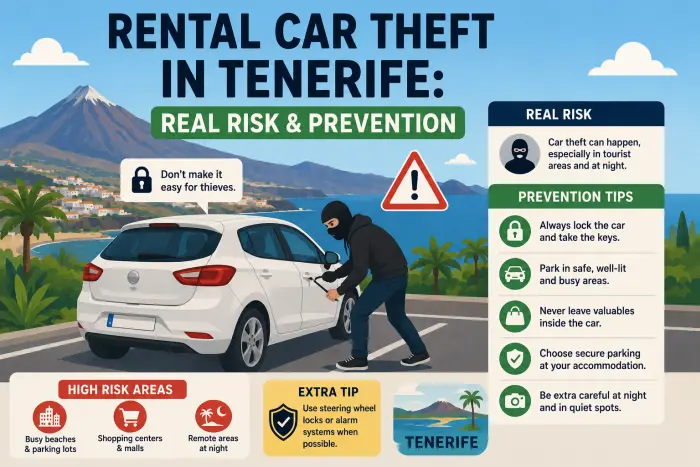
Rental cars in Tenerife do get targeted more than personal vehicles, mainly because they’re easy to spot, rental company branding, stickers, or simply an unfamiliar model parked at a tourist viewpoint signals to opportunistic thieves that the driver is a visitor, likely gone for a while, and possibly carrying valuables. It’s real enough that the UK Foreign Office has previously run a specific awareness campaign with CICAR, one of the island’s largest rental companies, urging visitors not to leave passports in parked cars. It’s not a reason to avoid renting, and it’s not a reason to feel anxious every time you park, it’s simply a reason to build a couple of habits into how you leave the car when you step away from it.
Worth Knowing Before You Go
- 🚗 Rental cars get targeted more than personal cars mainly because they’re identifiable, and because a tourist is statistically more likely to be away from the car for hours at a stretch.
- 🏔️ Remote, scenic viewpoint car parks, the kind you’ll find on the way to Masca or up toward Teide, carry more risk than busy, central parking areas simply because there are fewer people around.
- 🎒 The single most effective habit is packing anything valuable out of sight before you arrive, not once you’ve already parked in view of anyone watching.
- 🔑 Some reported cases involve a car being found still locked after a theft, worth knowing since it means a locked door alone isn’t proof nothing was taken.
- 👮 If it does happen, a police report is generally required for any travel insurance claim, so it’s worth doing promptly rather than treating it as not worth the hassle.
Are Rental Cars Actually Targeted More Than Regular Cars in Tenerife?
Yes, and it comes down to visibility rather than anything sinister about the island itself. A car with rental company branding, or simply one that looks unfamiliar and is parked at a well-known tourist stop for an extended period, reads as an easy target to an opportunist. This isn’t unique to Tenerife, it’s the same pattern reported across popular driving destinations worldwide, but the island’s mix of scenic viewpoints and long stretches where a car sits unattended for a hike or a photo stop does create real opportunity for anyone looking for one.
Which Parking Situations Actually Carry the Most Risk?
Isolated, scenic parking spots where cars are known to sit empty for a while, viewpoints along the Masca road, pull-offs near hiking trailheads, and quieter beach car parks away from the main resort strips. These carry more risk than a supervised hotel car park or a busy shopping center, simply because there’s less passing footfall to deter someone testing door handles. Understanding the general parking landscape across the island, which areas have formal supervised lots versus open roadside pull-offs, helps you make a quick judgment call in the moment rather than working it out on the spot. It doesn’t mean avoid these places, they’re often the best parts of a Tenerife road trip, it means adjusting what you do with your belongings before you get out of the car.
What Should You Actually Do With Your Belongings Before Parking?
Move anything worth taking out of sight before you arrive at the parking spot itself, not after you’ve already pulled in with other people around. Several long-time visitors report being told directly by rental companies to leave the boot cover or parcel shelf off entirely, or to leave the glovebox visibly empty and open, so a passerby glancing in sees nothing worth breaking a window for. It sounds excessive until you’ve heard how many reports involve exactly that scenario, an empty, visibly clear car left completely alone.
| Habit | Why It Helps |
|---|---|
| Pack valuables into the boot before you reach the parking area | Nobody sees you “hiding” something as you park |
| Leave the glovebox and door pockets visibly empty | Removes the incentive to check further |
| Choose busier, supervised parking over isolated pull-offs when the option exists | More passing footfall means less opportunity |
| Never leave a passport in the car | Consular advice specifically flags this as a common target |
| Keep a spare set of keys stored separately from the car | A small safeguard if a locked car is still accessed some other way |
Should You Worry About This Enough to Skip Certain Routes?
No, this isn’t a reason to avoid the island’s best drives. The viewpoints and remote roads that carry slightly more parking risk are also genuinely worth visiting, and the vast majority of visitors park, hike, photograph, and return without any issue at all. The sensible response is adjusting a couple of habits, not rerouting your entire trip around a low-probability risk.
What If Your Car Gets Broken Into Anyway?
Report it to the police as soon as you notice, since most travel insurance policies require a formal police report before they’ll process a claim for stolen belongings. It’s also worth documenting the car’s condition with photos immediately, both for your own insurance claim and in case the rental company needs to assess any damage from the break-in itself, similar to the standard handover inspection you’d do at pickup. Contact your rental company promptly too, particularly if the break-in caused any damage to the vehicle itself, since that’s a separate issue from the stolen belongings and worth flagging before you return the car. Keep copies of everything, the police report reference, your photos, and any correspondence with the rental company, since travel insurers often ask for more documentation than people expect when processing a claim of this kind.
🚗 Discover Tenerife – Best Car Rental Deals
Compare top-rated suppliers, no hidden fees & free cancellation included.
Does Your Rental Insurance Cover a Break-in?
This depends heavily on your policy, and it’s worth checking before you’re relying on it after the fact. Standard rental coverage typically deals with damage to the car itself, a smashed window from a break-in usually falls under this, but it rarely covers your personal belongings that were stolen. That’s genuinely a travel insurance matter, not a rental car insurance one, which is why the police report step matters so much, it’s the document your travel insurer will actually want to see. If you’re deciding whether additional excess cover is worth adding at pickup, a broken window from a break-in is exactly the kind of scenario where that decision pays off, since it directly reduces what you’re liable for on the vehicle side even though it won’t touch your stolen belongings.
Is This the Same as the Booking Scams You Might Have Read About?
No, it’s a genuinely different risk, worth not confusing with fake rental booking sites or other pre-booking scams. This is about physical theft from a parked car during your trip, not about being misled before you ever arrive. The prevention looks completely different too, this is about parking habits in the moment, not about verifying who you’re booking with weeks in advance.
FAQ
Are rental cars really targeted more than personal cars in Tenerife? Yes, mainly because they’re easier to identify as belonging to a visitor who’s likely away from the car for a while, which makes them a more predictable target than a locally owned vehicle.
Which areas of Tenerife have the most reported car break-ins? Isolated, scenic parking spots near popular hikes and viewpoints tend to see more reports than busy resort areas or supervised car parks, simply due to lower footfall and less passing observation from other visitors and staff.
Should I really leave my glovebox open and empty? Some rental companies and experienced visitors do recommend this specifically, since a visibly empty car gives a passing opportunist no reason to break a window in the first place.
What should I do immediately if my rental car is broken into? Report it to the police as soon as possible, since a formal report is usually required for any travel insurance claim, and contact your rental company promptly if the vehicle itself was damaged.
Does travel insurance usually cover items stolen from a rental car? Many policies do, but typically only with a police report as evidence, so treating that step as optional can end up costing you the claim entirely.
Is it safe to park at viewpoints along the Masca road or near Teide? Yes, millions of visitors do so without incident every year. The sensible approach is simply not leaving valuables visible, rather than avoiding these spots altogether.
Is this a common enough problem that I should worry about my whole trip? Not really, most visitors experience zero issues. It’s worth a few sensible habits rather than genuine worry, the same caution you’d apply to any unfamiliar tourist destination where you’re carrying a camera, a phone, and a bit of cash you’d rather not lose on day one of the trip.