July and August are Tenerife’s busiest months for car hire, and the island behaves noticeably differently during this window than it does the rest of the year. Prices climb, certain vehicle categories sell out weeks in advance, and the airport pickup process itself takes longer simply because more people are going through it at once. None of this makes summer a bad time to rent — it’s still entirely manageable, and remains one of the most popular times to visit for good reason — but going in with the right expectations, and booking on the right timeline, makes a real difference to both your budget and your first afternoon on the island.
Why peak season is different here specifically
Tenerife’s climate means it doesn’t have the sharp single summer peak that a lot of European destinations do — the island stays warm and dry year-round, which spreads demand more evenly across the calendar than somewhere with a genuine off-season. July and August are still the busiest months regardless, driven mainly by school holidays across the UK, Germany, and Scandinavia rather than by weather, which is fairly similar in June or September. That distinction matters: if your dates have any flexibility at all, shifting even a couple of weeks either side of peak season often gets you meaningfully better pricing and availability without giving up much in the way of weather or crowds.
This also explains why Tenerife’s peak season is somewhat less extreme, proportionally, than destinations with a genuinely narrow summer window. A ski resort or a strictly seasonal beach town might see demand multiply many times over in its short high season; Tenerife’s demand curve is flatter across the year, which means the July–August spike, while real, isn’t quite the all-or-nothing scramble it can be elsewhere. That’s useful context if you’re comparing notes with a rental experience from a more seasonally extreme destination and expecting the exact same level of intensity here.
What actually changes during July and August
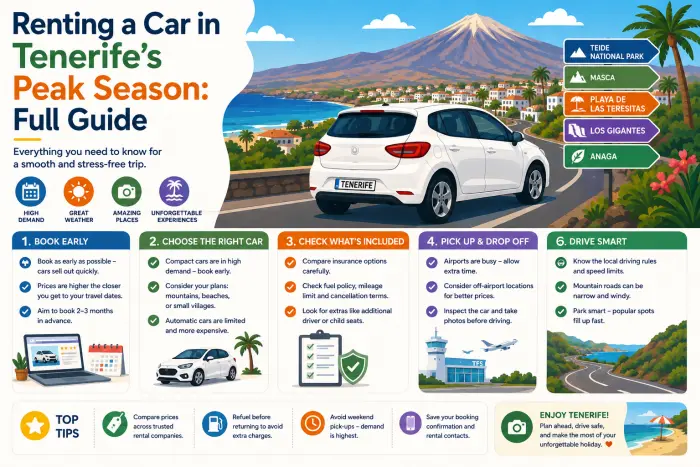
Rental rates typically increase across the board compared to shoulder-season pricing, and the increase isn’t uniform across vehicle categories — compact and economy cars, the most commonly booked type, tend to see the sharpest percentage increase simply because demand concentrates there. Larger and more specialised categories, like 9-seaters or SUVs, see less dramatic price movement but a much higher risk of running out entirely, since the fleet held in those categories is smaller to begin with. A convertible or other niche category can be gone from a given company’s fleet weeks before the compact category shows any sign of tightening, simply because there are fewer units to begin with across the whole island.
Airport pickup queues also lengthen. TFS in particular sees clusters of flights landing close together during peak weeks, and rental desks that handle this smoothly in April can genuinely struggle to keep pace in August. Our guide to car hire at Tenerife’s airports covers this in more general terms, but the short version for summer specifically is: budget more time between landing and actually being on the road than you would the rest of the year, particularly if your flight lands during a known busy window in the early afternoon or evening — a delay of thirty to forty-five minutes beyond your normal expectation isn’t unusual during the busiest weeks.
How far ahead to book
For a standard compact or economy car, booking four to six weeks ahead is usually enough to get reasonable availability and pricing during peak season, though earlier is always safer if your dates are fixed. For larger vehicles, specific categories like automatics, or anything with limited fleet numbers, booking two to three months out is a more realistic target if you want real choice rather than whatever’s left. Our guide to when car hire is cheapest in Tenerife covers the booking-timeline question in more depth across the whole year, and it’s worth reading alongside this if peak season isn’t fixed for your trip. Genuine last-minute bookings are still possible in July and August, but our last-minute car hire guide is realistic about the trade-offs — expect a narrower choice of vehicle and a noticeably higher price than the same booking made a couple of months earlier.
🚗 Discover Tenerife – Best Car Rental Deals
Compare top-rated suppliers, no hidden fees & free cancellation included.
Peak season at a glance
| Factor | Shoulder season | Peak season (Jul–Aug) |
|---|---|---|
| Compact/economy pricing | Lower | Noticeably higher |
| Larger vehicle availability | Generally good | Can sell out weeks ahead |
| Airport pickup wait | Shorter | Longer, especially at peak arrival times |
| Recommended booking lead time | 2–4 weeks | 4–8+ weeks for standard cars, longer for specialist categories |
Does driving itself change in summer?
The roads don’t get more crowded in a way that meaningfully affects mountain routes like Masca or Anaga — traffic there is more a function of time of day than season. Where you will notice more traffic is around the main resort towns and along the south coast’s principal roads during peak arrival and departure days, usually Saturdays, when a large share of the week’s flights land and take off in clusters. If your itinerary is flexible, avoiding a long coastal drive on a Saturday afternoon is a small thing that saves some genuinely frustrating time stuck near the airport approach roads, particularly on the TF-1 motorway between the airport and the main southern resorts.
One weather factor worth knowing about specifically for summer: calima, a spell of hot, dusty air blown over from the Sahara, is more common in the warmer months and can reduce visibility and air quality for a day or two at a time. Our guide to driving during calima covers what to expect if this happens during your trip — it’s not common enough to plan around, but worth knowing what it looks like if it does occur, particularly since it can catch first-time visitors off guard if they’ve never experienced anything like it before.
Fuel and running costs in summer
Fuel prices themselves don’t move meaningfully with tourist season — they track wider Spanish and European market prices rather than local demand — so a peak-season trip doesn’t carry a fuel cost premium the way the rental rate itself does. Our guide to fuel budgeting for car hire in Tenerife still applies the same way it would at any time of year, and it’s worth reading if you’re building out a full trip budget alongside the rental itself.
A realistic booking timeline for a July or August trip
If your flights are already booked for peak season, a reasonable sequence looks like this: lock in your rental car within the same week you confirm flights if you know your exact dates, rather than waiting until closer to departure. Decide on excess insurance and any add-ons — child seats, additional drivers — at the same time, since these can also become harder to guarantee the closer you get to peak dates. Reconfirm your booking details a week or two before travel, particularly the pickup location and any shuttle details, since desk hours and shuttle frequency occasionally shift during the busiest weeks to handle increased volume.
It’s also worth thinking about what happens if your specific first-choice category does sell out before you book. Rather than defaulting to whatever the search engine surfaces as an alternative, it’s worth deciding in advance which nearby category you’d accept as a substitute — an automatic instead of a manual, or one SUV model instead of another — so you’re making that call calmly ahead of time rather than under pressure at checkout when a preferred listing has just disappeared from the results entirely. This is a small piece of preparation that saves a surprising amount of last-minute stress during the busiest booking weeks of the year.
Putting it together
Summer in Tenerife is genuinely one of the best times to be on the island by car — long daylight hours, warm evenings for a late drive to catch the sunset, and every region covered elsewhere on this site fully open and running, from the northern towns to the western mountain roads. The trade-off is entirely on the logistics side: book earlier than you would the rest of the year, expect to pay somewhat more for the same category of car, and build in a little extra time at the airport on arrival. None of that requires much beyond planning a few weeks ahead of when you might otherwise think about it.
If your dates aren’t fixed yet, our full breakdown of the real cost of car hire in Tenerife and our comparison of Tenerife’s main car hire companies are worth reading together before you commit to exact dates, particularly if shifting a week or two either side of peak season is genuinely an option for your trip — a small shift in timing can be the difference between paying a premium and getting a perfectly ordinary rate for the same car.