The headline price you see on a booking site is rarely what you end up paying for a rental car in Tenerife. Between the deposit, the excess insurance, the local tax, and a handful of fees that only show up at the pickup desk, the gap between “advertised rate” and “actual cost” can be significant if you don’t know what to look for in advance. None of this is unique to Tenerife, but a few things — the IGIC tax structure, the number of independent local companies versus international brokers, and some fairly aggressive upselling at certain pickup desks — make it worth understanding the full cost stack before you book.
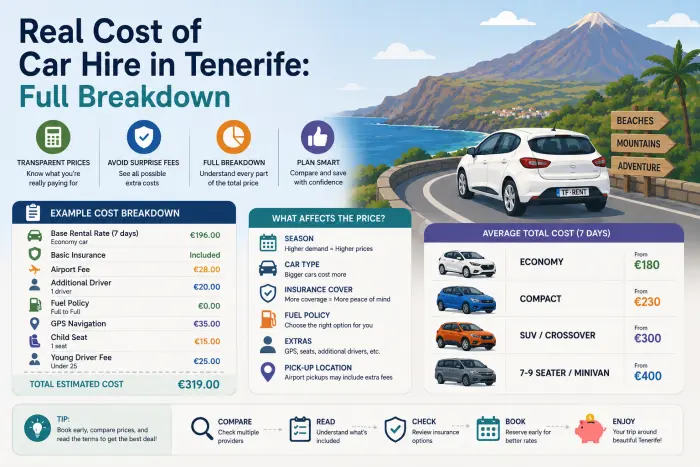
This guide walks through every layer of that cost, in roughly the order you’ll encounter it: from the moment you book, to the desk, to the moment you get your deposit back.
The base rate isn’t the real price
What you see on a comparison site is the rental rate before tax, before any mandatory local fees, and often before the insurance most people end up needing. Tenerife, as part of the Canary Islands, uses IGIC rather than mainland Spain’s IVA — our guide to IGIC tax on car hire explains how it’s applied and why some booking sites show it separately while others fold it into the headline price, which is part of why two seemingly identical quotes can differ once you reach checkout.
If you booked through a broker or comparison site rather than directly with the rental company, there’s often an additional layer worth knowing about — our guide to the broker operational fee explains what this charge covers and why it sometimes appears at the desk rather than at booking. It’s also worth reading our comparison of comparison sites versus booking direct if you’re still deciding how to book, and our roundup of local companies versus brokers, based on forum discussions if you want a sense of how renters on the ground actually feel about the trade-off.
Insurance and excess: the part that trips people up most
This is where the biggest cost swings happen, and where most complaints about surprise charges originate. Every rental in Tenerife comes with mandatory basic insurance, but that basic cover typically leaves you liable for an excess — often anywhere from a few hundred to well over a thousand euros — if the car is damaged. Our guide to car hire insurance in Tenerife explains what’s covered as standard and where the gaps usually are.
From there, you generally have three ways to reduce that exposure: buy excess insurance from the rental company at the desk (usually the most expensive option), buy it in advance from a third-party excess insurance provider (usually cheaper), or rely on a credit card that includes rental car excess cover. Our guide to whether excess insurance is worth it walks through that decision, and if you’re leaning on a card for cover, check our breakdown of credit card car hire insurance first — coverage varies a lot between providers and card tiers.
If you do end up needing to claim, it’s worth reading two things before you travel rather than after something goes wrong: our guide to the excess insurance claim process, and our breakdown of common excess exclusions — the situations, like driving on unpaved roads or damage to the underside of the car, that even a paid excess policy often won’t cover. We’ve also written specifically about what happens when an excess insurance claim gets rejected, since it happens more often than people expect and usually comes down to one of a handful of avoidable reasons.
Ways to cover the excess, compared
| Option | Typical cost | Trade-off |
|---|---|---|
| Desk excess insurance | Highest | Most convenient, no claim process if damage occurs |
| Third-party excess insurance (pre-booked) | Lower | Requires a claim/reimbursement process afterwards |
| Credit card excess cover | Often free with the card | Coverage limits and exclusions vary widely by provider |
| No cover (rely on standard basic insurance) | €0 upfront | Full excess exposure if the car is damaged |
Deposit and how you pay for it
Rental companies hold a security deposit on your card for the duration of the rental, separate from the rental cost itself. Our guide to deposit refund timing covers how long that hold typically takes to release after you return the car, which varies noticeably between companies. If you’d rather avoid a large hold altogether, our guide to no-deposit car hire options covers which companies offer that and what it usually costs you in exchange.
🚗 Discover Tenerife – Best Car Rental Deals
Compare top-rated suppliers, no hidden fees & free cancellation included.
Card type matters here too. Most rental companies expect a credit card for the deposit, and a debit card either isn’t accepted or comes with restrictions — our guides to paying with a debit card and the best debit cards for car hire cover which companies are more flexible on this point. And if you’re paying in euros with a foreign card, watch for Dynamic Currency Conversion at the desk — our guide to paying in euros and avoiding DCC explains why the “pay in your home currency” option the terminal offers is almost always the worse deal.
Fees that show up after you’ve already booked
A handful of charges tend to catch renters by surprise specifically because they don’t appear on the original booking summary. Our roundup of hidden fees in Tenerife car hire is the best starting point, but a few are worth calling out individually: an out-of-hours pickup fee if your flight lands outside normal desk hours, a late return charge that’s often steeper than people expect for even a short delay, and the cost of exceeding your mileage allowance if you didn’t book unlimited mileage — easy to overlook if your trip includes a full island road trip rather than short local drives.
Fuel: the policy matters more than the price per litre
Fuel policy is a separate cost decision from fuel price itself. Our guide to fuel budgeting for car hire in Tenerife gives a realistic sense of what a typical week’s driving costs, while our breakdown of petrol and fuel policy explains the difference between full-to-full and other arrangements — full-to-full is almost always the better deal, since prepaid fuel options rarely account for what you actually use.
Booking timing: when and how far ahead
Pricing on the island moves with demand more than people expect, and a few decisions at the booking stage affect the total cost as much as anything at the desk. Our guide to when car hire is cheapest in Tenerife covers the seasonal patterns, while our roundup of general cheap car hire strategies covers the booking-side tactics. If your plans are more spontaneous, our last-minute car hire guide is realistic about what’s still available and at what premium.
Flexibility has a cost too, in both directions. Our comparison of prepay versus pay-at-pickup covers the trade-off between a cheaper locked-in rate and the ability to cancel, and our guide to free cancellation policies explains which bookings actually qualify. If your plans shift after booking, our guide to amending or changing a booking covers what that typically costs versus cancelling and rebooking from scratch.
Rental length changes the maths
The per-day rate isn’t fixed regardless of how long you rent — our guides to one-day car hire and long-term car hire both cover how the daily rate shifts at each end of that range, and where the genuine savings are for longer stays versus what looks like a discount but isn’t.
A rough worked example
To make this less abstract: imagine a one-week rental in August, booked a month out, for a mid-size automatic. The advertised rate might read around €35 a day, or roughly €245 for the week. Add IGIC, and you’re already a little higher than the headline number. Decline the desk excess insurance and rely on a pre-purchased third-party policy instead, and you might add another €40–60 for the week rather than the €150+ a desk policy often costs. Factor in a full tank of fuel to return the car as agreed, and a deposit hold of anywhere from €300 to over €1,000 depending on the company and car category — money that isn’t spent, but that needs to sit uncommitted on your card until it’s released. None of these numbers are fixed, and they shift with company, season, and category, but the shape of the calculation stays the same: base rate, tax, insurance decision, deposit, fuel. Skipping any one of those steps when budgeting is usually where the “why did this cost so much more than I expected” feeling comes from at the end of a trip.
Putting the full picture together
Add it up and the real cost of a Tenerife rental is really four things stacked on top of each other: the base rate plus IGIC, the excess insurance decision, the deposit and how it’s held, and a short list of situational fees that only apply if you trigger them — late return, out-of-hours pickup, going over your mileage. Budgeting for the base rate alone is how most surprise charges happen; budgeting for the full stack is how you avoid them.
Once the cost side is clear, the company you book with matters just as much — pricing structures, deposit amounts, and how strictly fees are enforced vary noticeably between operators. Our comparison of Tenerife’s main car hire companies is the natural next read if you haven’t picked one yet.