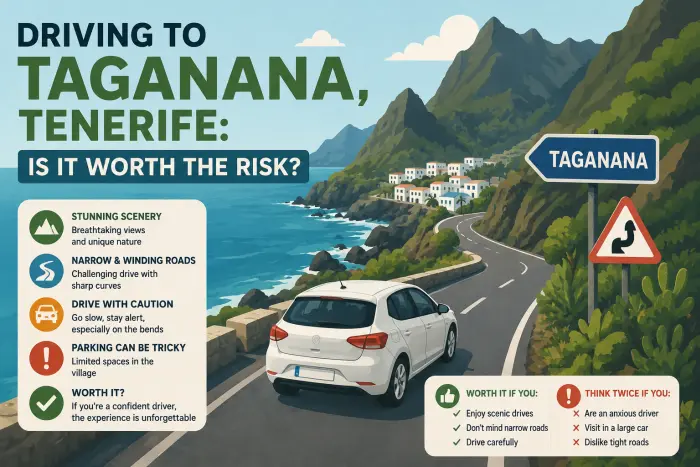
Yes, the road to Taganana is genuinely one of the narrowest and most winding drives on Tenerife, single-lane in stretches with passing places rather than a proper two-lane road, but it’s manageable in a rental car if you go slowly, go early, and know what you’re walking (or driving) into. It’s a different kind of challenge from Masca: less about hairpin drama and more about a long stretch of blind bends where you genuinely don’t know what’s coming the other way.
The Real Deal
- 🛣️ The road in question is the TF-134 (with a TF-123 approach from the La Laguna side), dropping from the Anaga ridge down into Taganana village.
- ↔️ Much of it is one car width, with passing places cut into the rock rather than a continuous two-lane surface.
- 🌅 Early morning (before 10am) means far less oncoming traffic and no tour buses to negotiate around.
- 🚌 If driving it doesn’t appeal, local bus line 946 runs from Santa Cruz to Taganana and on to Almáciga several times a day.
- 🅿️ Parking in the village itself is minimal — a handful of spaces near the church square, gone quickly once other cars arrive.
What Makes This Road Different From Masca or Teide
Tenerife has a few roads with a reputation, and it’s worth being specific about which reputation applies here. The drive up to Teide is wide, well-surfaced, and intimidating mostly because of altitude and switchbacks, not width. Masca’s TF-436 is narrow with heavy tourist bus traffic congesting the bends. Taganana’s roads are narrower again, but with far less traffic, which sounds safer until you realize it also means fewer passing places have been worn in by regular use and fewer other drivers slowing down out of habit.
The honest comparison: Masca tests your patience because of queues behind slow-moving coaches. Taganana tests your nerve because of blind corners where the next car could appear at any second, and there’s often nowhere obvious to pull in until you’ve already committed to the bend.
The Two Routes In
There are effectively two ways to reach Taganana by car, and they meet the same reputation from different directions.
From San Andrés (the coastal approach): Leaving the TF-1 near Santa Cruz, the road climbs through San Andrés and immediately narrows as it winds up toward the Anaga ridge. This is the more commonly used route and the one most rental drivers end up on, since it connects naturally with a day that also includes Las Teresitas beach.
From the Cruz del Carmen ridge (the park approach): If you’re already exploring Anaga Rural Park from La Laguna, the descent to Taganana via El Bailadero drops you down through dense laurisilva forest before the road narrows further near the village itself. This approach tends to have more forest-shaded, damp sections, worth remembering if it’s rained recently.
Neither route is objectively easier. Most drivers find the descent (whichever direction) more nerve-wracking than the climb, simply because you’re looking down the slope rather than up it.
What the Road Actually Feels Like
Local travel writers and reviewers who’ve driven it are fairly consistent on a few points, and it’s worth setting expectations properly rather than either scaring you off or downplaying it.
| What to expect | Why it matters |
|---|---|
| One-lane sections with passing bays | You’ll need to reverse into a bay occasionally if you meet oncoming traffic mid-bend |
| No hard shoulder or barrier in places | A low, steady speed matters more than confidence |
| Damp, shaded stretches near the forest | Grip can feel different than on the sunnier coastal roads |
| Very limited mobile signal | Download offline maps before you start descending |
| A tiny village at the end | Taganana itself is small — this is a drive for the road and the coastline, not a bustling destination |
Should You Actually Drive It Yourself?
This is the question most guides dodge. Here’s a straight answer: if you’re a nervous driver, uncomfortable with reversing on an incline, or driving an unfamiliar automatic for the first time, this isn’t the road to build confidence on. Save it, and consider taking the local bus instead, or pairing a rental car day with a shorter Anaga loop that doesn’t drop all the way to the village.
If you’re a reasonably confident driver who’s already handled a Tenerife mountain road or two, Taganana is entirely doable. The key differences from a flat coastal drive: go slower than feels necessary, use your horn lightly on blind bends the way locals do, and accept that you may need to reverse a short distance if you meet another car mid-bend. None of this is dangerous if you’re patient about it. It becomes a problem only when someone tries to power through at speed.
Timing It Right
Traffic on the TF-134 isn’t heavy by any normal standard, but it’s concentrated. Tour minibuses and rental cars cluster mid-morning through early afternoon, which is exactly when meeting oncoming traffic on a blind bend becomes more likely.
🚗 Discover Tenerife – Best Car Rental Deals
Compare top-rated suppliers, no hidden fees & free cancellation included.
Setting off before 10am, or after 4pm in summer when the light is still good, cuts down meaningfully on how often you’ll need to negotiate a passing place with someone coming the other way. It also means better light for the coastal views, which is really the point of the drive in the first place.
What’s Actually at the End of the Road
Taganana itself is a small, working village rather than a polished tourist stop, and that’s part of its appeal. There’s a handful of seafood restaurants worth the detour, a 16th-century church, and from the village you can continue a short distance further to reach Playa de Benijo, one of the island’s most photographed black-sand beaches, backed by the same volcanic ridges you’ve just driven past.
Parking in the village square is limited to a small number of spaces, and they fill early on weekends. If the square is full, there’s usually a bit more room a short walk back along the approach road, but don’t expect a proper car park.
What Locals Say vs. What Tourists Write Online
There’s a gap worth noting between how residents talk about this road and how visitors describe it afterward. Ask someone from La Laguna or Santa Cruz, and the TF-134 barely registers as remarkable, it’s just the way you get to a favorite fish restaurant. Read a tourist review, and it’s often framed as a white-knuckle adventure. Both are true, in their own way. Locals have muscle memory for exactly where the passing places sit and how wide their own car actually is. Visitors are doing that calculation for the first time, in an unfamiliar rental, which naturally feels more intense even when the actual risk is modest.
The practical takeaway: if this is your first Tenerife mountain road, it will feel harder than it objectively is. If you’ve already driven the route to Masca or spent a day on Teide’s switchbacks, Taganana will likely feel like a smaller step up rather than a shock.
What If Something Scrapes the Car?
It’s a fair question on a road this narrow, and it’s worth thinking about before you set off rather than after a close call. Wing mirrors and rear panels are the most common casualties on tight passing places, usually from misjudging a gap rather than any dramatic collision. This is exactly the kind of scenario where it’s worth knowing in advance what your policy actually covers, particularly whether excess insurance is worth adding before you leave the rental office rather than deciding on the fly. A quick read of how rental insurance in Tenerife works in general is a sensible five minutes before any narrow-road day, not just this one.
FAQ
Is the road to Taganana dangerous to drive? It’s narrow and demands full attention, but it’s not inherently dangerous if you drive slowly and expect to meet oncoming traffic on blind bends. Most incidents come from drivers going too fast for the road, not from the road itself.
Can a normal rental car handle the road to Taganana? Yes, a standard compact or economy rental is fine. There’s no need for a 4×4, and a smaller car actually makes the passing places easier to use than a larger SUV would.
Is it better to drive to Taganana from San Andrés or from Cruz del Carmen? Both routes have narrow, winding sections. The San Andrés approach is more commonly used and connects naturally with a coastal day out; the Cruz del Carmen route suits a day already spent exploring Anaga’s forest trails.
Is there parking in Taganana village? Yes, but it’s limited to a small number of spaces near the church square, and they fill quickly on weekends. Arriving early or midweek makes finding a spot much easier.
Should I avoid driving to Taganana if it’s rained recently? The forested sections near Cruz del Carmen can stay damp longer than the coastal approach, so it’s worth taking those bends a little slower after rain, though the road itself doesn’t usually close for weather.
Is there an alternative to driving if I don’t feel confident? Yes, local bus line 946 runs between Santa Cruz and Taganana (continuing to Almáciga) several times a day, fewer on weekends. It’s a reasonable option if the road itself is the deciding factor for you.
How long should I budget for the drive and a stop in the village? From Santa Cruz or La Laguna, budget around 45 minutes to an hour each way given the necessary slow pace, plus at least an hour in the village and, if time allows, a further stop at Playa de Benijo.