Tenerife is small enough to circle in a day and varied enough to feel like four different islands stitched together. That contrast is exactly why so many visitors choose to rent a car here instead of sticking to a resort and the occasional organised excursion. Within an hour’s drive you can go from a sun-baked volcanic coastline to laurel forest dripping with mist, from a working fishing village to a UNESCO old town. A bus route or a tour bus schedule will only ever show you a fraction of that. A rental car shows you the rest.
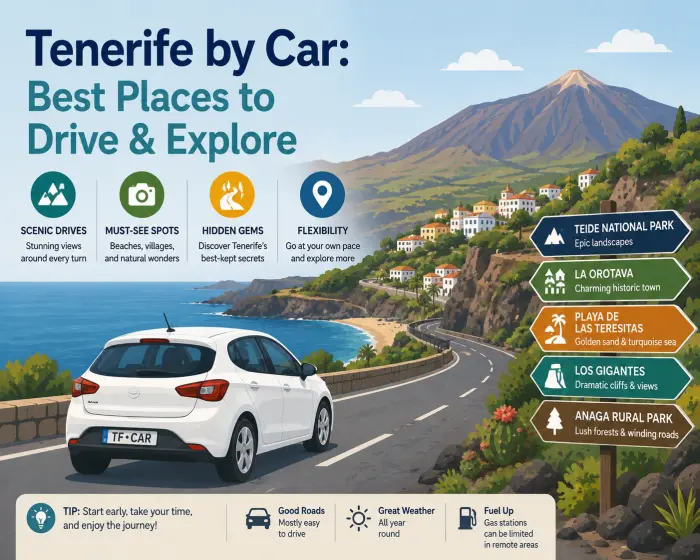
The island breaks down naturally into four driving regions, plus a handful of themes — beaches, hikes, viewpoints — that cut across all of them. This guide is built around that logic, so you can either read it region by region or jump straight to whatever kind of day you’re planning.
If you haven’t decided yet whether a car actually makes sense for your trip, it’s worth reading our breakdown of when a car is worth it in Tenerife before you go further. And once you know where you’re headed, our guide to driving rules and road conditions covers everything from speed limits to what the local drivers expect from you.
The four regions at a glance
| Region | Driving difficulty | Best for |
|---|---|---|
| South | Easy — wide roads, flat terrain | First-time renters, resort-based trips |
| North | Moderate — some winding roads inland | Culture, greenery, fewer crowds |
| West & Anaga | Harder — narrow mountain roads, hairpins | Confident drivers, dramatic scenery |
| East & capital | Easy to moderate | History, city driving, day trips |
South Tenerife: easiest first, built for tourists
The south is where most flights land, most hotels sit, and where the vast majority of first-time renters start their trip. It’s also the flattest, most forgiving part of the island to drive — wide roads, plenty of parking, and a layout that rewards a bit of confidence rather than local knowledge.
Costa Adeje is the polished end of the south coast — upscale resorts, a long promenade, and quick access to golf courses and the TF-1 motorway. A few minutes down the road, Los Cristianos and Playa de las Américas run into each other and form the busiest tourist strip on the island, useful mainly because everything — ferries to La Gomera, nightlife, beaches — is within a short drive.
For something quieter, Adeje’s old town sits just inland from the resorts and feels like a different decade entirely, with narrow streets and a ravine walk that most beach-goers never bother to find. La Caleta is the south’s answer to a proper seafood lunch — a small former fishing village that’s become one of the better places on the island to eat, without the crowds of Los Cristianos. Further along the coast, Los Abrigos does something similar on a smaller scale, and Costa del Silencio offers a calmer, more residential stretch of coastline if you want to base yourself away from the main resorts.
Inland and uphill, El Médano is worth the detour for its wind — it’s one of the best kitesurfing and windsurfing spots in Europe, with a beach town vibe that’s noticeably more laid-back than the resorts nearby. And if you’re heading up toward Teide, Vilaflor — Spain’s highest village — makes a good stop on the way, with pine forest trails and a much cooler climate than the coast below.
North Tenerife: greener, older, less crowded
Cross the island and the landscape changes fast. The north gets more rain, which means more green — banana plantations, vineyards, and a string of towns that were shaping Tenerife’s history long before the southern resorts existed.
Puerto de la Cruz was the island’s original tourist town, and it still has the character to prove it — volcanic-sand beaches, colonial architecture, and Loro Parque nearby. A short drive inland, La Orotava is arguably the most beautiful town on the island, with balconied mansions and a valley view toward Teide that’s used in half the postcards sold on Tenerife. Los Realejos sits nearby and is a good base if you want the same green, historic feel with fewer visitors.
Further west, Icod de los Vinos is home to the Drago Milenario, one of the oldest trees on the island, and to some of the best wine-growing land in the Canaries. Garachico is smaller and quieter still — a town that was rebuilt around natural volcanic rock pools after a 1706 eruption buried its original harbour, and one of the most underrated day trips on the island. Push on to Buenavista del Norte and you’re at the edge of the developed north, right before the roads start climbing toward the wilder west coast.
On the north-east side, Bajamar and Punta del Hidalgo offer a rougher, more dramatic coastline — natural pools carved into black volcanic rock, popular with locals rather than tour groups.
The wild west and Anaga: for confident drivers
This is where Tenerife stops looking like a holiday brochure and starts looking like the volcanic island it actually is. The roads here are narrower, the drops are steeper, and the reward is scenery that most visitors never see.
🚗 Discover Tenerife – Best Car Rental Deals
Compare top-rated suppliers, no hidden fees & free cancellation included.
Los Gigantes gets its name from the cliffs that plunge straight into the Atlantic — some of the tallest sea cliffs in Europe, best viewed either from a boat or from a few specific roadside points that are far easier to find with your own car. Inland, the Masca Gorge is the island’s most famous hike, but note that access now requires a permit — worth checking before you plan a full Masca road trip, since the drive itself, with its hairpin turns through the Teno mountains, is as much the point as the destination.
Beyond Masca, Punta de Teno sits at the true western tip of the island, reachable only by a single access road that’s occasionally closed for safety reasons — check current access before you set out, since there’s no alternative route.
On the opposite end of the island, the Anaga road trip covers similarly dramatic terrain — a laurel forest so old it’s classified as a relict of a prehistoric ecosystem, with roads that wind through cloud forest rather than desert scrubland. Taganana, tucked into the Anaga massif, is often the endpoint of that drive and one of the more isolated villages on the island — worth the winding descent for the black-sand beach alone.
Both of these routes are best driven with some prior confidence behind the wheel, ideally in daylight, and not rushed — our guide to best roads to drive in Tenerife goes into more detail on what to expect from each.
East Tenerife and the capital
The east side of the island gets skipped by a surprising number of visitors, which is part of its appeal — this is Tenerife’s working, lived-in side rather than its holiday side.
Santa Cruz, the island’s capital, has a modern waterfront, a striking concert hall, and none of the resort-town feel of the south. Just up the hill, La Laguna is a UNESCO World Heritage town and the island’s old capital, with a compact historic centre that’s genuinely worth a slow walk. South along the coast, Candelaria is a pilgrimage town built around the basilica of the island’s patron saint, easily combined with a stop at the Güímar pyramids a little further down the road — six stepped stone structures whose origin is still debated by archaeologists.
The Centre: Teide National Park, Reachable From Every Region
Sitting almost dead centre on the island, Teide doesn’t belong to any one of the four regions above — it’s reachable from all of them, which is exactly why it’s the one place that shows up in nearly every visitor’s plans regardless of where they’re based. Spain’s highest peak, a UNESCO World Heritage site, and a landscape so different from the coast below that it’s genuinely hard to believe you’re still on the same island: black volcanic rock, wide caldera floor, and — on a clear day — views stretching to the other Canary Islands from the upper cable car station.
The roads up are part of the experience rather than just a means to an end. From the south, the TF-21 climbs through pine forest before opening onto the caldera; from the north, the approach via La Orotava or Icod is steeper and windier, with more hairpins per kilometre. Either way, it’s slower going than the map distance suggests — budget more time than you’d expect for the altitude change alone.
Our driving to Teide guide covers both routes in detail, along with cable car booking, what to expect at altitude, and why an early start matters more here than almost anywhere else on the island — cloud cover tends to roll in by early afternoon, and the car park at the base station fills up fast once it does.
Themed routes: chasing an experience, not a town
Sometimes the plan isn’t “which town” but “which kind of day.” A few of our guides are built around that instead of geography:
If a beach day is the goal, start with our roundup of the island’s best beaches, which covers everything from black volcanic sand in the north to the golden imported sand of the south. For something more active, the best hikes guide pulls together trailheads across all four regions above. And if you’d rather just find a good view, our best viewpoints and best sunset spots guides are built specifically around what’s reachable by car, with parking notes included.
Elsewhere, the island’s volcanic coastline has carved out some genuinely striking natural pools, and between January and April, whale and dolphin watching off the south-west coast is one of the more memorable things you can do here — most boats leave from Los Cristianos or Los Gigantes, both an easy drive from anywhere in the south. If food and drink matter more to you than scenery, the north’s wine route and winery tastings are worth building a full afternoon around, and our guide to local markets is useful if you’d rather shop for produce than souvenirs. For families, Siam Park and Loro Parque remain the two big draws in the south, and both are far easier with your own car and your own schedule than with a coach transfer.
Turning this into an actual route
Reading about individual towns is one thing — stringing them into a route that fits your trip is another. If you’re short on time, our south Tenerife road trip and north Tenerife road trip guides each cover a full day’s loop through the regions above. If you have longer, our 3-day, 5-day, and full 7-day road trip itinerary guides combine several of these regions into a single, realistic driving plan — realistic meaning they account for how much slower mountain roads actually are than the map suggests.
None of this works without the right car underneath you, of course. If you haven’t picked a rental company yet, our comparison of Tenerife’s main car hire companies is the natural next stop — it’s written around exactly the kind of driving covered here, from easy coastal cruising in the south to the tighter mountain roads of the west.